

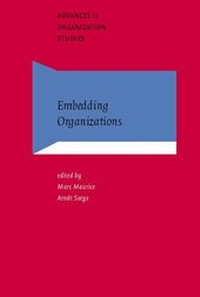
Embedding Organizations
Societal analysis of actors, organizations and socio-economic context
1st Edition
Published on 15. February 2000
X, 434 pages
978-90-272-9980-2 (ISBN)
Description

The widely discussed 'globalization' of economic activities has given rise to a renewed interest in the relations between such tendencies, the nature and demarcation of societies, and the nature and strategies of various actors and organizations within and cross-cutting societies. One approach to capture and express these themes has been Societal Analysis, initially developed above all to confront the internationally comparative study of work, organization, education and training, industrial relations, business and industrial structures.
After twenty-five years of practising and developing Societal Analysis, this book serves to systematize and redefine the approach, and to react to criticism and newly arising issues. It brings together proponents, sympathizers and critics of Societal Analysis. It enters new fields, and contributions are clustered around the enterprise, the economy, theoretical and methodological aspects, public policy and gender issues. The message stressed and demonstrated by the editors and various authors, is that the 'societal space' of social, economic political interdependencies is not being obliterated but complexified, and therefore a topical, useful and indeed necessary explanatory framework.
After twenty-five years of practising and developing Societal Analysis, this book serves to systematize and redefine the approach, and to react to criticism and newly arising issues. It brings together proponents, sympathizers and critics of Societal Analysis. It enters new fields, and contributions are clustered around the enterprise, the economy, theoretical and methodological aspects, public policy and gender issues. The message stressed and demonstrated by the editors and various authors, is that the 'societal space' of social, economic political interdependencies is not being obliterated but complexified, and therefore a topical, useful and indeed necessary explanatory framework.
More details
Other editions
Additional editions
Marc Maurice | Arndt Sorge
Embedding Organizations
Societal analysis of actors, organizations and socio-economic context
Book
02/2000
John Benjamins Publishing Co
€68.90
Shipment within 10-15 days
Persons
Content
- EMBEDDING ORGANIZATIONS
- Editorial page
- Title page
- LCC data
- Table of Contents
- Preface
- Chapter 1. General introduction
- PART I: THEORY, METHODOLOGY AND EPISTEMOLOGY
- Introduction
- Chapter 2. The paradoxes of societal analysis: A review of the past and prospects for the future
- Chapter 3. The diabolical dialectics of societal effects
- Chapter 4. Societal or systems effects?
- Chapter 5. Towards a relational approach to the study of the variety in situated creativity of economic actors
- Chapter 6. The implications of "societal analysis" for a programme of research
- Chapter 7. Theoretical problems in international comparisons
- Chapter 8. Positivist, hermeneutical, and postmodern positions in the comparative management debate
- PART II: THE ECONOMY
- Introduction
- Chapter 9. The contribution of societal analysis to the economic theory of the firm
- Chapter 10. Explaining changes in institutional frameworks: Societal patterns of business coordination
- PART III: THE ENTERPRISE
- Introduction
- Chapter 11. Understanding the globalization strategies of German and British multinational companies
- Chapter 12. The evolution of teamwork at Rover: Societal, sectoral and organisational explanations
- Chapter 13. The societal effects school and transnational transfer: The case of Japanese investment in Britain
- Chapter 14. The transfer of business practices to Britain and France
- Chapter 15. Society, organization and work in China
- PART IV: GOVERNMENT, PUBLIC POLICY AND PUBLIC SERVICES
- Introduction
- Chapter 16. Deregulation and societal systems
- Chapter 17. Do we compare societies when we compare national university systems?
- Chapter 18. Path dependencies of education systems and the division of labour within organizations
- Chapter 19. Reintroducing public action into societal analysis
- PART V: GENDER, THE FAMILY AND WORK ARRANGEMENTS
- Introduction
- Chapter 20. Is it time to gender the societal effect?
- Chapter 21. Societal comparison and social change of the family division of labour
- Chapter 22. Male and female patterns of labour force participation: A comparison between France and Japan
- Chapter 23. Conclusions
- References
- Authors
- Advances in Organization Studies
