

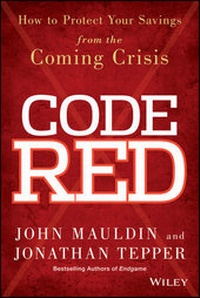
Code Red
Description

Reviews / Votes
"If you read only one book on finance this year, make itCode Red: How to Protect Your Savings from the ComingCrisis, by John Mauldin and Jonathan Tepper, authors of thebestseller Endgame, which delved into the 2008collapse."--Forbes magazineMore details
Other editions
Additional editions
Persons
Content
Introduction: Code Red
When Lehman Brothers went bankrupt and AIG was taken over by the U.S. government in the fall of 2008, the world almost came to an end. Over the next few weeks, stock markets went into free fall as trillions of dollars of wealth were wiped out. However, even more disturbing were the real-world effects on trade and businesses. A strange silence descended on the hubs of global commerce. As international trade froze, ships stood empty near ports around the world because banks would no longer issue letters of credit. Factories shut as millions of workers were laid off as commercial paper and money market funds used to pay wages froze. Major banks in the United States and the United Kingdom were literally hours away from shutting down and ATMs were on the verge of running out of cash. Bank stopped issuing letters of credit to former trusted partners worldwide. The interbank market simply froze, as no one knew who was bankrupt and who wasn’t. Banks could look at their own balance sheets and see how bad things were and knew that their counterparties were also loaded up with too much bad debt.
The world was threatened with a big deflationary collapse. A crisis that big only comes around twice a century. Families and governments were swamped with too much debt and not enough money to pay them off. But central banks and governments saved the day by printing money, providing almost unlimited amounts of liquidity to the financial system. Like a doctor putting a large jolt of electricity on a dying man’s chest, the extreme measures brought the patient back to life.
The money printing that central bankers did after the failure of Lehman Brothers was entirely appropriate in order to avoid a Great Depression II. The Fed and central banks were merely creating some money and credit that only partially offset the contraction in bank lending.
The initial crisis is long gone, but the unconventional measures have stayed with us. Once the crisis was over, it was clear that the world was saddled with high debt and low growth. In order to fight the monsters of deflation and depression, central bankers have gone wild. Central bankers kept on creating money. Quantitative easing was a shocking development when it was first trotted out, but these days the markets just shrug. Now, the markets are worried about losing their regular injections of monetary drugs. What will withdrawal be like?
The amount of money central banks have created is simply staggering. Under quantitative easing, central banks have been buying every government bond in sight and have expanded their balance sheets by over nine trillion dollars. Yes, that’s $9,000,000,000,000—12 zeros to be exact. (By the time you read this book, the number will probably be a few trillion higher, but who’s counting?) Numbers so large are difficult for ordinary humans to understand. As Senator Everett M. Dirksen once probably didn’t say, “A billion here, a billion there, and soon you’re talking about real money.” To put it in everyday terms, if you had a credit limit of $9 trillion on your credit card, you could buy a MacBook Air for every single person in the world. You could fly everyone in the world on a round-trip ticket from New York to London. You could do that twice without blinking. We could go on, but you get the point: it’s a big number.
In the four years since the Lehman Brothers bankruptcy, central bankers have torn up the rulebook and are trying things they have never tried before. Usually, interest rates move up or down depending on growth and inflation. Higher growth and inflation normally means higher rates, and lower growth means lower rates. Those were the good old days when things were normal. But now central bankers in the United States, Japan, and Europe have pinned interest rates close to zero and promised to leave them there for years. Rates can’t go lower, so some central bankers have decided to get creative. Normally, central banks pay interest on the cash banks deposit with them overnight. Not anymore. Some banks like the Swiss National Bank and the Danish National Bank have even created negative deposit rates. We now live in an upside-down world. Money is effectively taxed (by central bankers, not representative governments!) to get people to spend instead of save.
These unconventional policies are generally good for big banks, governments, and borrowers (who doesn’t like to borrow money for free?), but they are very bad for savers. Near-zero interest rates and heavily subsidized government lending programs help the banks to make money the old-fashioned way: borrow cheaply and lend at higher rates. They also help insolvent governments, allowing them to borrow at very low costs. The flip side is that near-zero rates punish savers, providing almost no income to pensioners and the elderly. Everyone who thought their life’s savings might carry them through their retirement has to come up with a Plan B when rates are near zero.
In the bizarre world we now inhabit, central banks and governments try to induce consumers to spend to help the economy, while they take money away from savers who would like to be able to profitably invest. Rather than inducing them to consume more, they are forcing them to spend less in order to make their savings last through their final years!
Savers and investors in the developed world are the guinea pigs in an unprecedented monetary experiment. There are clear winners and losers as prudent savers are called upon to bail out reckless borrowers. In the United States, United Kingdom, Japan, and most of Europe, savers receive close to zero percent interest on their savings, while they watch the price of gasoline, groceries, and rents go up. Standards of living are falling for many and economic growth is elusive. Today is a time of financial repression, where central banks keep interest rates below inflation. This means that the interest savers receive on their deposits cannot keep up with the rising cost of living. Big banks are bailed out and continue paying large bonuses, while older savers are punished.
In the film A Few Good Men, Jack Nicholson plays Colonel Nathan Jessup. He subjects his troops to an unconventional and extreme approach to discipline by ordering a Code Red. Toward the end of the film, Colonel Jessup explains to a court-martial proceeding that while his methods are grotesque and abnormal, they are necessary for the defense of the nation and the preservation of freedom.
While central bank Code Red policies are certainly unorthodox and even distasteful, many economists believe they are necessary to kick-start the global economy and counteract the crushing burden of debt. David Zervos, chief market strategist at Jefferies & Co., humorously observes that “Colonel” Ben Bernanke, chairman of the Fed, is likewise brutally honest and just as insistent that his extreme policies are absolutely necessary.
We began to wonder what Colonel Jessup’s speech might sound like if the colonel were a central banker. Perhaps it would go something like this (cue Jack Nicholson):
You want the truth? You can’t handle the truth! Son, we live in a world that has unfathomably intricate economies, and those economies and the banks that are at their center have to be guarded by men with complex models and printing presses. Who’s gonna do it? You? You, Lieutenant Mauldin? Can you even begin to grasp the resources we have to use in order to maintain balance in a system on the brink?
I have a greater responsibility than you can possibly fathom! You weep for savers and creditors, and you curse the central bankers and quantitative easing. You have that luxury. You have the luxury of not knowing what I know: that the destruction of savers with inflation and low rates, while tragic, probably saved lives. And my existence, while grotesque and incomprehensible to you, saves jobs and banks and businesses and whole economies!
You don’t want the truth, because deep down in places you don’t talk about at parties, you want me on that central bank! You need me on that committee! Without our willingness to silently serve, deflation would come storming over our economic walls and wreak far worse havoc on an entire nation and the world. I will not let the 1930s and that devastating unemployment and loss of lives repeat themselves on my watch.
We use words like full employment, inflation, stability. We use these words as the backbone of a life spent defending something. You use them as a punchline!
I have neither the time nor the inclination to explain myself to a man who rises and sleeps under the blanket of the very prosperity that I provide, and then questions the manner in which I provide it! I would rather you just said “thank you” and went on your way.
Central bankers must hide the truth in order to do their job. Jean-Claude Juncker, the Prime Minister of Luxembourg and head of the European Union at one point, told us, “When it becomes serious, you have to lie.” We may dislike what they are doing, but if politicians want to avoid large-scale defaults, the world needs loose money and money printing.
Ben Bernanke and his colleagues worldwide have effectively issued and enforced a Code Red monetary policy. Their economic theories and experience told them it was the correct and necessary thing to do—in fact, they were convinced it was the only thing to do!
Chairman Ben Bernanke could not be further from Colonel Nathaniel Jessup, but they are both men on a mission. Colonel Jessup is maniacally obsessed with enforcing discipline on his base at Guantanamo. He has seen war...
