

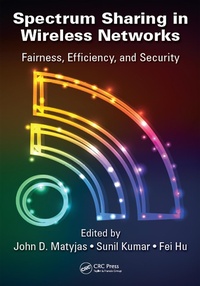
Spectrum Sharing in Wireless Networks
Fairness, Efficiency, and Security
Published on 17. November 2016
748 pages
978-1-4987-2636-8 (ISBN)
Description

Spectrum Sharing in Wireless Networks: Fairness, Efficiency, and Security provides a broad overview of wireless network spectrum sharing in seven distinct sections: The first section examines the big picture and basic principles, explaining the concepts of spectrum sharing, hardware/software function requirements for efficient sharing, and future trends of sharing strategies.
The second section contains more than 10 chapters that discuss differing approaches to efficient spectrum sharing. The authors introduce a new coexistence and sharing scheme for multi-hop networks, describe the space-time sharing concept, introduce LTE-U, and examine sharing in broadcast and unicast environments. They then talk about different cooperation strategies to achieve mutual benefits for primary users (PU) and secondary users (SU), discuss protocols in a spectrum sharing context, and provide different game theory models between PUs and SUs.
The third section explains how to model the interactions of PUs and SUs, using an efficient calculation method to determine spectrum availability. Additionally, this section explains how to use scheduling models to achieve efficient SU traffic delivery. The subject of the fourth section is MIMO-oriented design. It focuses on how directional antennas and MIMO antennas greatly enhance wireless network performance. The authors include a few chapters on capacity/rate calculations as well as beamforming issues under MIMO antennas.
Power control is covered in the fifth section which also describes the interference-aware power allocation schemes among cognitive radio users and the power control schemes in cognitive radios. The sixth section provides a comprehensive look at security issues, including different types of spectrum sharing attacks and threats as well as corresponding countermeasure schemes. The seventh and final section covers issues pertaining to military applications and examines how the military task protects its data flows when sharing the spectrum with civilian applications.
The second section contains more than 10 chapters that discuss differing approaches to efficient spectrum sharing. The authors introduce a new coexistence and sharing scheme for multi-hop networks, describe the space-time sharing concept, introduce LTE-U, and examine sharing in broadcast and unicast environments. They then talk about different cooperation strategies to achieve mutual benefits for primary users (PU) and secondary users (SU), discuss protocols in a spectrum sharing context, and provide different game theory models between PUs and SUs.
The third section explains how to model the interactions of PUs and SUs, using an efficient calculation method to determine spectrum availability. Additionally, this section explains how to use scheduling models to achieve efficient SU traffic delivery. The subject of the fourth section is MIMO-oriented design. It focuses on how directional antennas and MIMO antennas greatly enhance wireless network performance. The authors include a few chapters on capacity/rate calculations as well as beamforming issues under MIMO antennas.
Power control is covered in the fifth section which also describes the interference-aware power allocation schemes among cognitive radio users and the power control schemes in cognitive radios. The sixth section provides a comprehensive look at security issues, including different types of spectrum sharing attacks and threats as well as corresponding countermeasure schemes. The seventh and final section covers issues pertaining to military applications and examines how the military task protects its data flows when sharing the spectrum with civilian applications.
More details
Language
English
Place of publication
London
United Kingdom
Publishing group
Taylor & Francis Ltd
Target group
College/higher education
Professional and scholarly
Illustrations
236 s/w Abbildungen, 21 s/w Tabellen
21 Tables, black and white; 236 Illustrations, black and white
File size
19,08 MB
ISBN-13
978-1-4987-2636-8 (9781498726368)
Copyright in bibliographic data and cover images is held by Nielsen Book Services Limited or by the publishers or by their respective licensors: all rights reserved.
Schweitzer Classification
Other editions
Additional editions
John D. Matyjas | Sunil Kumar | Fei Hu
Spectrum Sharing in Wireless Networks
Fairness, Efficiency, and Security
Book
06/2020
1st Edition
CRC Press
€68.10
Shipment within 15-20 days

John D. Matyjas | Sunil Kumar | Fei Hu
Spectrum Sharing in Wireless Networks
Fairness, Efficiency, and Security
Book
12/2016
1st Edition
CRC Press
€200.56
Shipment within 15-20 days
Persons
Dr. John D. Matyjas earned his PhD in electrical engineering from State University of New York at Buffalo in 2004. Currently, he is serving as the Connectivity & Dissemination Core Technical Competency Lead at the Air Force Research Laboratory (AFRL) in Rome, NY. His research interests include dynamic multiple-access communications and networking, software defined RF spectrum mutability, statistical signal processing and optimization, and neural networks. Dr. Matyjas is an IEEE senior member, chair of the IEEE Mohawk Valley Signal Processing Society, and member of Tau Beta Pi and Eta Kappa Nu. He also serves on the IEEE Transactions on Wireless Communications Editorial Advisory Board.
Dr. Fei Hu is currently a professor in the Department of Electrical and Computer Engineering at the University of Alabama, Tuscaloosa, Alabama. He earned his PhD degrees at Tongji University, Shanghai, China, in the field of signal processing in 1999 and at Clarkson University, New York, USA, in electrical and computer engineering in 2002. He has published over 200 journal/conference papers and books. Dr. Hu's research has been supported by the U.S. National Science Foundation, Department of Defense, Cisco, Sprint, and other sources. His research expertise is primarily in the areas of security, signals, and sensors.
Dr. Sunil Kumar is currently a professor and Thomas G. Pine faculty fellow in the Electrical and Computer Engineering Department at San Diego State University (SDSU), San Diego, California, USA. He earned his PhD in electrical and electronics engineering from the Birla Institute of Technology and Science (BITS), Pilani, India, in 1997. From 1997 to 2002, Dr. Kumar was a postdoctoral researcher and adjunct faculty at the University of Southern California, Los Angeles. He has published over 130 technical papers in journals/conferences. His research interests include the cross-layer wireless protocols and image/video processing.
Dr. Fei Hu is currently a professor in the Department of Electrical and Computer Engineering at the University of Alabama, Tuscaloosa, Alabama. He earned his PhD degrees at Tongji University, Shanghai, China, in the field of signal processing in 1999 and at Clarkson University, New York, USA, in electrical and computer engineering in 2002. He has published over 200 journal/conference papers and books. Dr. Hu's research has been supported by the U.S. National Science Foundation, Department of Defense, Cisco, Sprint, and other sources. His research expertise is primarily in the areas of security, signals, and sensors.
Dr. Sunil Kumar is currently a professor and Thomas G. Pine faculty fellow in the Electrical and Computer Engineering Department at San Diego State University (SDSU), San Diego, California, USA. He earned his PhD in electrical and electronics engineering from the Birla Institute of Technology and Science (BITS), Pilani, India, in 1997. From 1997 to 2002, Dr. Kumar was a postdoctoral researcher and adjunct faculty at the University of Southern California, Los Angeles. He has published over 130 technical papers in journals/conferences. His research interests include the cross-layer wireless protocols and image/video processing.
Content
BIG PICTURE. Physical Aspects of Spectrum Sharing. Perspective on the Design of Opportunistic Spectrum Sharing. APPROACHES TO SPECTRUM SHARING. New Coexistence and Sharing Paradigms for Multihop Secondary Networks. Space-Time Spectrum Sharing in Cognitive Radio Networks. LTE in the Unlicensed Band (LTE-U). Spectrum Sharing in Broadcast and Unicast Hybrid Cellular Networks. Cooperation-Based Dynamic Spectrum Sharing in CRNs. Cooperation in Cognitive Radio Networks. Cross-Layer Design for Spectrum Efficiency. Spectrum-Aware Routing in Cognitive Radio Vehicular Ad Hoc Networks (CRVANETs): Challenges and Solutions. The Spectrum Sharing Games. Game-Theoretic Opportunistic Spectrum Sharing. An Adaptive Game Theoretic Framework for Self-Coexistence among Cognitive Radio Enabled Smart Grid Networks. MODELING ISSUES. Performance Modeling of Opportunistic Spectrum Sharing. Calculation Methods for Spectrum Availability. How to Use Novel Methods for Improving the Performance of Wireless Cognitive Networks. Low-Complexity and High-Efficient Scheduling Schemes for Spectrum-Sharing Based Secondary Transmissions. MIMO-ORIENTED DESIGN. Capacity Scaling of MIMO Broadcast Channels with Finite-Rate Feedback. On the Achievable Sum-Rate of MIMO Bidirectional Underlay Cognitive Cooperative Networks. Robust Beamforming Optimization for the Secondary Transmission in a Spectrum Sharing Cognitive Radio Network. POWER CONTROL. Interference-Aware Power Allocation in Spectrum Sharing Cognitive Radio. Energy-Efficient Power Control for Spectrum Sharing in Next-Generation Wireless Networks. SECURITY. Spectrum Sharing Vulnerability and Threat Assessment. Security Measures for Efficient Spectrum Sharing. Pragmatic Security Issues and Solutions for Spectrum Sharing in Wireless Networks. MILITARY APPLICATIONS. The Spectrum in Defense: From Commodity to Maneuver Space.
