

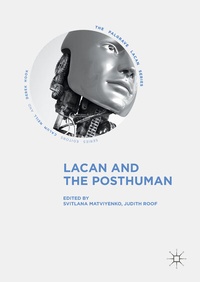
Lacan and the Posthuman
Description

When Posthumanism displaces the traditional human subject, what does psychoanalysis add to contemporary conversations about subject/object relations, systems, perspectives, and values? This book discusses whether Posthumanism itself is a cultural indication of a shift in thinking that is moving from language to matter, from a politics focused on social relations to one organized according to a broader sense of object in environments. Together the authors question what is at stake in this shift and what psychoanalysis can say about it.
Promoting psychoanalysis' focus on the cybernetic relationships among subjects, language, social organizations, desire, drive, and other human motivations, this book demonstrates the continued relevance of Lacan's work not only to continued understandings of the human subject, but to the broader cultural impasses we now face. Why Posthumanism? Why now? In what ways is Posthumanist thought linked to the emergence of digital technologies? Exploring Posthumanism from the insights of Lacan's psychoanalysis, chapters expose and elucidate not only the conditions within which Posthumanist thought arises, but also reveal symptoms of its flaws: the blindness to anthropomorphization, projection, and unrecognized shifts in scale and perspective, as well as its mode of transcendental thought that enables many Posthumanist declarations. This book explains how Lacanian notions of the subject inform current discussions about human complicity with, and resistance to, algorithmic governing regimes, which themselves more wholly produce a "post"- humanism than any philosophical displacement of human centrality could.
More details
Other editions
Additional editions
Persons
Judith Roof is William Shakespeare Chair in English at Rice University, USA and an attorney-at-law. She is author of seven monographs and essays to date on topics ranging from psychoanalysis and popular culture, to cinema, modern drama, legal studies, feminist theory, sexuality, narrative theory and comedy.
