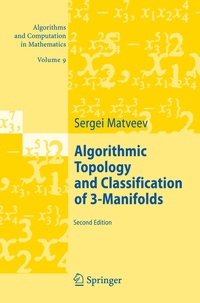
Algorithmic Topology and Classification of 3-Manifolds
Description

From the reviews of the 1st edition:
"This book provides a comprehensive and detailed account of different topics in algorithmic 3-dimensional topology, culminating with the recognition procedure for Haken manifolds and including the up-to-date results in computer enumeration of 3-manifolds. Originating from lecture notes of various courses given by the author over a decade, the book is intended to combine the pedagogical approach of a graduate textbook (without exercises) with the completeness and reliability of a research monograph.
All the material, with few exceptions, is presented from the peculiar point of view of special polyhedra and special spines of 3-manifolds. This choice contributes to keep the level of the exposition really elementary.
In conclusion, the reviewer subscribes to the quotation from the back cover: "the book fills a gap in the existing literature and will become a standard reference for algorithmic 3-dimensional topology both for graduate students and researchers".
Zentralblatt für Mathematik 2004
For this 2 nd edition, new results, new proofs, and commentaries for a better orientation of the reader have been added. In particular, in Chapter 7 several new sections concerning applications of the computer program "3-Manifold Recognizer" have been included.
Reviews / Votes
From the reviews of the first edition:
"This book provides a comprehensive and detailed account of different topics in algorithmic 3-dimensional topology, culminating with the recognition procedure for Haken manifolds and including the up-to-date results in Computer enumeration of 3-manifolds. Originating from lecture notes of various courses given by the author over a decade, the book is intended to combine the pedagogical approach of a graduate textbook (without exercises) with the completeness and reliability of a research monograph. This motivates the about 400 pages length of the main text.
All the material, with few exceptions, is presented from the peculiar point of view of special polyhedra and special spines of 3-manifolds. This choice contributes to keep the level of the exposilion really elementary. ..
In conclusion, the reviewer subscribes to the quotation from the back cover: "the book fills a gap in the existing literature and will become a standard reference for algorithmic 3-dimensional topology both for graduate students and researchers".
Riccardo Piergallini (Camerino), Zentralblatt für Mathematik 1048 (2004)
"The purpose of the book is to present a detailed overview of the algorithmis aspects of 3-manifold topology. As noted by the author, the book is largely self-contained, though basic topology and group theory are assumed. The book contains extensive references, as the author makes use of many statemants from primary sources, and a large number of figures that help the reader follow the exposition. On the whole, the book is well organized. ..."
James W. Anderson, Mathematical Reviews, Clippings from Issue 2004i
"Almost coincident with the 1985 publication of the first edition of Gerard Burde and Heiner Zieschang's otherwise magisterial Knots, V. Jones's revolutionary "polynomial invariants" blew that subject wide open. History now repeats itself. ... Just asMatveev ... provides a state-of-the-art fast track into all the mathematics surrounding the notorious Poincaré ... conjecture, G. Perelman appears to have proved not only the Poincaré conjecture, but the whole Thurston geometrization conjecture, holy grail of three-dimensional topology. ... Summing up: Recommended. Upper-division undergraduates through faculty."
D.V. Feldman, Choice - Current Reviews for College Libraries 2003
From the reviews of the second edition:
"The aim of this fine book is to study the algorithmic topology of low-dimensional manifolds . . The book is written in a very accurate and readable style. . It looks like as a selfcontained and fundamental work on the algorithmic 3-dimensional topology both for graduate students and researchers. . This is a book I am very happy to have, and it is heartily recommended to anyone interested in studying topology of 3-manifolds from an algorithmic point of view." (Alberto Cavicchioli, Zentralblatt MATH, Vol. 1128 (6), 2008)
More details
Other editions
Additional editions
Previous edition