

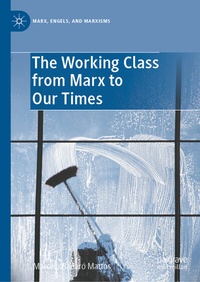
The Working Class from Marx to Our Times
Description

This book reviews Marx's contributions to the debate on the working class. The first part of the work presents the synthesis of the main contributions of Marx and Engels (and 20th century Marxist writers) to the understanding of social classes, the class struggle, and the working class. The remaining parts present exercises of dialogue between Marx's and Marxists' discussions on the working class, presented in the first part, and empirical elements of class reality today, as well as debates in the social sciences and historiography on the same issues. The thesis defended in the book is simple: the "working class," also called the "proletariat," as it appears in the work of Karl Marx, had and has validity as an analytical category for the understanding of social life under capitalism. Nevertheless, Marx's discussion on the issue is complex and the category "working class" in his approach is wider than many Marxists have presented it.
More details
Other editions
Additional editions
Persons
Marcelo Badaró Mattos is Full Professor of Brazilian History at Universidade Federal Fluminense, Brazil. He is the author of Laborers and Enslaved Workers. Experiences in Common in the making of Rio de Janeiro's Working Class - 1850-1920 (2017), as well as several other books, articles and chapters on labour history and Marxism.
