

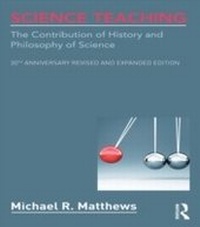
Science Teaching
The Contribution of History and Philosophy of Science, 20th Anniversary Revised and Expanded Edition
2nd Edition
Published on 19. September 2014
478 pages
978-1-136-33675-1 (ISBN)
Description

Science Teaching explains how history and philosophy of science contributes to the resolution of persistent theoretical, curricular, and pedagogical issues in science education. It shows why it is essential for science teachers to know and appreciate the history and philosophy of the subject they teach and how this knowledge can enrich science instruction and enthuse students in the subject. Through its historical perspective, the book reveals to students, teachers, and researchers the foundations of scientific knowledge and its connection to philosophy, metaphysics, mathematics, and broader social influences including the European Enlightenment, and develops detailed arguments about constructivism, worldviews and science, multicultural science education, inquiry teaching, values, and teacher education. Fully updated and expanded, the 20th Anniversary Edition of this classic text, featuring four new chapters-The Enlightenment Tradition; Joseph Priestley and Photosynthesis; Science, Worldviews and Education; and Nature of Science Research-and 1,300 references, provides a solid foundation for teaching and learning in the field.
Reviews / Votes
"Matthews (Univ. of New South Wales, Australia) states that research in the history and philosophy of science and science teaching contributes to the resolution of theoretical questions science teachers face on the nature of science, science curricula, and pedagogy...Summing Up: Recommended. Upper-division undergraduates and above." - D. L. Stoloff, Eastern Connecticut State University, in CHOICE, April 2015"This is a transformative book. It provides an enlightening cartography of the uses of history and philosophy in the science classroom. No one interested in science teaching or science culture should be without a copy of this updated classic." -Alberto Cordero, Philosophy Program, The CUNY Graduate Center and Queens College CUNY, USA
"This book's importance transcends science education. Its coverage of topics such as the impact of constructivism on education provides the book with a universal importance. I strongly recommend it to everyone interested in teaching and learning." -John Sweller, School of Education, University of New South Wales, Australia
"The Pendulum chapter is a masterpiece! It should be considered obligatory reading for everyone who aims at becoming a science (especially physics) teacher." -Ricardo Karam, Physikdidaktik, Universitaet Hamburg, Germany
"Science Education is a rigorous and necessary resource for science education researchers, policy makers and practitioners." -Sibel Erduran, School of Education, University of Limerick, Ireland
"The new edition of the book by Matthews is a rich source of historical, epistemological and philosophical ideas that can be of immense help to the graduate students, teachers and researchers." -Educacion Quimica
"Readers would be delighted to know that a second edition of this wonderful book has just been published by Routledge as the 20th Anniversary Revised and Expanded edition and that it is even better. I strongly recommend it to any one interested in science education even if they own a copy of the first edition. ... Science Teaching is a book that is rich, sophisticated and comprehensive, covering all the major topics and issues in science education. It is indispensable reading not only for scholars of science education, science teachers and students, but also for science curriculum designers and policy makers. It puts the philosophy of liberal education back on the table with passion and rigor. After 20 years of hype about fashionable -isms, it was much needed." -Science & Education
More details
Edition
2nd edition
Language
English
Place of publication
London
United Kingdom
Publishing group
Taylor & Francis Ltd
Target group
College/higher education
Edition type
Revised edition
Product notice
Reflowable
Illustrations
7 s/w Tabellen
7 Tables, black and white
File size
4,15 MB
ISBN-13
978-1-136-33675-1 (9781136336751)
Copyright in bibliographic data and cover images is held by Nielsen Book Services Limited or by the publishers or by their respective licensors: all rights reserved.
Schweitzer Classification
Other editions
Additional editions
Michael R. Matthews
Science Teaching
The Contribution of History and Philosophy of Science, 20th Anniversary Revised and Expanded Edition
Book
09/2014
2nd Edition
Routledge
€243.50
Shipment within 15-20 days
Michael R. Matthews
Science Teaching
The Contribution of History and Philosophy of Science, 20th Anniversary Revised and Expanded Edition
Book
08/2014
2nd Edition
Routledge
€111.20
Shipment within 15-20 days
Person
Michael R. Matthews is an Honorary Associate Professor in the School of Education at the University of New South Wales, Australia. He is Founding Editor of the international journal Science & Education; Founding President of the International History, Philosophy and Science Teaching Group; and President of the Inter-Divisional Teaching Commission of the International Union of History and Philosophy of Science. He has trained, taught and published in science education and in history and philosophy of science.
Content
BRIEF CONTENTS
Preface (2014)
Preface (1994)
Acknowledgments and Sources (2014)
Acknowledgments (1994)
Chapter One: The Rapprochement between History, Philosophy, and Science Education
Chapter Two: The Enlightenment Tradition in Science Education
Chapter Three: Historical and Current Developments in Science Curricula
Chapter Four: History of Science in the Curriculum and in Classrooms
Chapter Five: Philosophy in Science and in Science Classrooms
Chapter Six: History and Philosophy in the Classroom: Pendulum Motion
Chapter Seven: History and Philosophy in the Classroom: Joseph Priestley and the Discovery of Photosynthesis
Chapter Eight: Constructivism and Science Education
Chapter Nine: A Central Issue in Philosophy of Science and Science Education: Realism and Anti-Realism
Chapter Ten: Science, Worldviews and Education
Chapter Eleven: The Nature of Science and Science Teaching
Chapter Twelve: Philosophy and Teacher Education
Name Index
Subject Index
Preface (2014)
Preface (1994)
Acknowledgments and Sources (2014)
Acknowledgments (1994)
Chapter One: The Rapprochement between History, Philosophy, and Science Education
Chapter Two: The Enlightenment Tradition in Science Education
Chapter Three: Historical and Current Developments in Science Curricula
Chapter Four: History of Science in the Curriculum and in Classrooms
Chapter Five: Philosophy in Science and in Science Classrooms
Chapter Six: History and Philosophy in the Classroom: Pendulum Motion
Chapter Seven: History and Philosophy in the Classroom: Joseph Priestley and the Discovery of Photosynthesis
Chapter Eight: Constructivism and Science Education
Chapter Nine: A Central Issue in Philosophy of Science and Science Education: Realism and Anti-Realism
Chapter Ten: Science, Worldviews and Education
Chapter Eleven: The Nature of Science and Science Teaching
Chapter Twelve: Philosophy and Teacher Education
Name Index
Subject Index
