

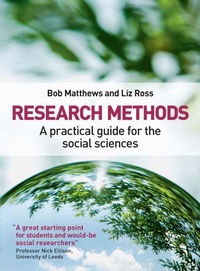
Research Methods
Description

Research Methods: A Practical Guide for the Social Sciences is an essential resource for the social researcher. It offers a comprehensive introduction for first time researchers right through to thorough and practical advice for those undertaking more advanced work. The book draws on real life experiences from a wide variety of disciplines to show how theory translates into practice, and offers a rigorous analysis of why researchers choose the methods they use. Think about it boxes throughout the text offer questions and ideas to help the researcher to focus on core issues and practical considerations, whilst your research summaries present questions, activities and checklists to help the researcher to develop their ideas.
Written to reflect the breadth of the social sciences, Research Methods is essential for anyone conducting research in sociology, health policy, social work, criminology, social policy, cultural studies, political studies, public policy and related fields.
The full text downloaded to your computer
With eBooks you can:
- search for key concepts, words and phrases
- make highlights and notes as you study
- share your notes with friends
eBooks are downloaded to your computer and accessible either offline through the Bookshelf (available as a free download), available online and also via the iPad and Android apps.
Upon purchase, you'll gain instant access to this eBook.
Time limit
The eBooks products do not have an expiry date. You will continue to access your digital ebook products whilst you have your Bookshelf installed.
More details
Other editions
Additional editions
Content
- Introduction
- PART A: Thinking About Research
- A1: What is Research?
- A2: Knowledge, Theories, Paradigms and Perspectives
- A3: The Nature of Data
- A4: Research Questions, Hypotheses and Operational Definitions
- A5: Research as an Ethical and Cultural Issue
- PART B: Preparing for Research
- B1: Planning a Research Project
- B2: Reviewing the Literature
- B3: Research Design
- B4: Choosing Methods
- B5: Sampling
- B6: Research Proposals
- PART C: Data Collection
- C1: Collecting Data
- C2: Data Collection Skills
- C3: Questionnaires
- C4: Semi-structured Interviews
- C5: Focus Groups
- C6: Observation
- C7: Narrative Data
- C8: Documents
- C9: Secondary Sources of Data
- C10: Collecting Data Using Computer Mediated Communication (CMC)
- PART D: Data Analysis
- D1: Beginning to Analyse
- D2: Working With Data
- D3: Statistical Analysis
- D4: Thematic Analysis
- D5: Analysing Narrative
- D6: Discourse Analysis
- D7: Content Analysis
- D8: Grounded Theory
- D9: Using Computers in Data Analysis
- D10: So What? Drawing Conclusions
- PART E: Data Presentation and Reports
- E1: The Importance of Audience
- E2: Writing for Research: Reports and Dissertations
- E3: Data Presentation
- E4: Dissemination and Further Research
- Glossary
