

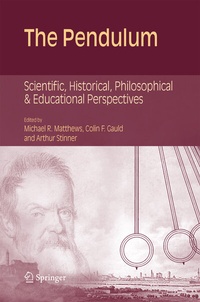
The Pendulum
Description

The pendulum is a universal topic in primary and secondary schools, but its full potential for learning about physics, the nature of science, and the relationships between science, mathematics, technology, society and culture is seldom realised.
Contributions to this 32-chapter anthology deal with the science, history, methodology and pedagogy of pendulum motion. There is ample material for the richer and more cross-disciplinary treatment of the pendulum from elementary school to high school, and through to advanced university classes.
Scientists will value the studies on the physics of the pendulum; historians will appreciate the detailed treatment of Galileo, Huygens, Newton and Foucault's pendulum investigations; psychologists and educators will learn from the papers on Piaget; teachers will welcome the many contributions to pendulum pedagogy.
All readers will come away with a new awareness of the importance of the pendulum in the foundation and development of modern science; and for its centrality in so many facets of society and culture.
More details
Other editions
Additional editions
Persons
Michael Matthews is an associate professor in the School of Education at the University of New South Wales. He has degrees in science, philosophy, psychology, history and philosophy of science, and education. He publishes in the fields of science education, history and philosophy of science, and philosophy of education. He is the author of five books, the editor of six anthologies, and the Foundation Editor of the journal Science & Education.
Colin Gauld is a Visiting Fellow at the University of New South Wales. After taking a PhD in physics, he taught high school physics, lectured in physics education, and was senior examiner of physics in the state of New South Wales. He researches the role of history and philosophy of science in science teaching, and the relationship between religion and science.
Arthur Stinner is a professor of science education in the Faculty of Education, University of Manitoba. He holds undergraduate degrees in physics, modern languages and education, an MSc in physics, and a PhD in science education. His research interests are focused on relating the history and philosophy of science to science teaching, and the development of large context problems in physics.
