

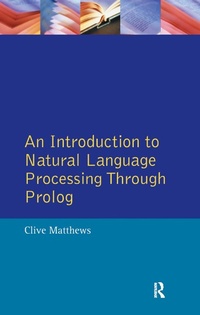
An Introduction to Natural Language Processing Through Prolog
Published on 1. July 2016
318 pages
978-1-317-89834-4 (ISBN)
Description

Research into Natural Language Processing - the use of computers to process language - has developed over the last couple of decades into one of the most vigorous and interesting areas of current work on language and communication. This book introduces the subject through the discussion and development of various computer programs which illustrate some of the basic concepts and techniques in the field. The programming language used is Prolog, which is especially well-suited for Natural Language Processing and those with little or no background in computing.
Following the general introduction, the first section of the book presents Prolog, and the following chapters illustrate how various Natural Language Processing programs may be written using this programming language. Since it is assumed that the reader has no previous experience in programming, great care is taken to provide a simple yet comprehensive introduction to Prolog. Due to the 'user friendly' nature of Prolog, simple yet effective programs may be written from an early stage. The reader is gradually introduced to various techniques for syntactic processing, ranging from Finite State Network recognisors to Chart parsers. An integral element of the book is the comprehensive set of exercises included in each chapter as a means of cementing the reader's understanding of each topic. Suggested answers are also provided.
An Introduction to Natural Language Processing Through Prolog is an excellent introduction to the subject for students of linguistics and computer science, and will be especially useful for those with no background in the subject.
Following the general introduction, the first section of the book presents Prolog, and the following chapters illustrate how various Natural Language Processing programs may be written using this programming language. Since it is assumed that the reader has no previous experience in programming, great care is taken to provide a simple yet comprehensive introduction to Prolog. Due to the 'user friendly' nature of Prolog, simple yet effective programs may be written from an early stage. The reader is gradually introduced to various techniques for syntactic processing, ranging from Finite State Network recognisors to Chart parsers. An integral element of the book is the comprehensive set of exercises included in each chapter as a means of cementing the reader's understanding of each topic. Suggested answers are also provided.
An Introduction to Natural Language Processing Through Prolog is an excellent introduction to the subject for students of linguistics and computer science, and will be especially useful for those with no background in the subject.
More details
Series
Language
English
Place of publication
London
United Kingdom
Publishing group
Taylor & Francis Ltd
Target group
Professional and scholarly
File size
8,78 MB
ISBN-13
978-1-317-89834-4 (9781317898344)
Copyright in bibliographic data and cover images is held by Nielsen Book Services Limited or by the publishers or by their respective licensors: all rights reserved.
Schweitzer Classification
Other editions
Additional editions
Book
02/2017
1st Edition
Routledge
€215.41
Shipment within 10-20 days
Book
07/1998
1st Edition
Longman
€111.90
Shipment within 10-20 days
Person
Clive Matthews is a lecturer in Linguistics at the University of East Anglia.
Content
Preface
Part I: Introduction
1. Natural Language Processing
1.1 Natural Language Interfaces
1.2 The Linguistic Application of NLP
1.3 NLP as a Tool for Linguistic Research
1.4 Further Reading
2. The Challenge of Natural Language Processing
2.1 Knowledge of the Linguistic Structure
2.2 Ambiguity and Contextual Knowledge
2.3 The Process of Language Understanding
2.4 Psycholinguistics and NLP
2.5 Further Reading
Part II: The Fundamentals of Prolog Programming
3. Facts
3.1 Facts
3.2 Asking Simple Questions in Prolog
3.3 Compound Questions
3.4 Questions and Variables
3.5 Finding Alternative Answers: Backtracking
3.6 Using Variables in Facts
3.7 Further Reading
4. Rules and Complex Names
4.1 Rules
4.2 How Prolog Answers Questions Using Rules
4.3 Structured Objects
5. Lists and Recursive Structures
5.1 Lists
5.2 Recursive Rules
6. Developing Prolog Programs
6.1 The Meaning of Prolog Programs
6.2 Designing Programs
6.3 Laying Out Programs
6.4 Search Trees
6.5 Search Strategies
6.6 Tracing a Proof
6.7 Some Common Programming Errors
7. Built-In Predicates
7.1 Input and Output
7.2 fail
7.3 consult and reconsult
7.4 Modifying a Database
7.5 Defining Operators
7.6 The 'cut'
7.7 Program Listing
Part III: Natural Language Processing with Prolog
8. Sentence Recognition And Finite State Grammars
8.1 Sentence Frame Grammars
8.2 A Sentence Frame Grammar-based Recognisor
8.3 An Alternative Notation for Sentence Frame Grammars
8.4 An FSG-Based Recognisor
8.5 Extending The Range of Finite State Grammars
8.6 Further Reading
8.7 Program Listings
9. Recursive Transition Networks
9.1 Constituent Structure
9.2 Extending the Network Notation
9.3 An RTN-Based Recognisor
9.4 Implementing an RTN Recognisor in Prolog
9.5 Extending the RTN Notation
9.6 Further Reading
9.7 Program Listings
10. Phrase Structure Grammars
10.1 Phrase Structure Grammars
10.2 A Simple Phrase Structure Recognisor
10.3 Directly Representing Phrase Structure Grammars in Prolog
10.4 Efficiency
10.5 Difference Lists
10.6 The Grammar Rule Notation
10.7 Further Reading
10.8 Program Listings
11. Definite Clause Grammars
11.1 Grammar Symbols as Complex Terms
11.2 Procedure Calls
11.3 Further Reading
11.4 Program Listings
12. Alternative Parsing Strategies
12.1 A Top-Down Interpreter
12.2 Problems with Top-Down Parsing
12.3 A Bottom-Up Interpreter
12.4 A Left-Corner Interpreter
12.5 Deterministic Parsing
12.6 Chart Parsing
12.7 Further Reading
12.8 Program Listings
Solutions to Exercises
Glossary of Terms
Bibliography
Index
Part I: Introduction
1. Natural Language Processing
1.1 Natural Language Interfaces
1.2 The Linguistic Application of NLP
1.3 NLP as a Tool for Linguistic Research
1.4 Further Reading
2. The Challenge of Natural Language Processing
2.1 Knowledge of the Linguistic Structure
2.2 Ambiguity and Contextual Knowledge
2.3 The Process of Language Understanding
2.4 Psycholinguistics and NLP
2.5 Further Reading
Part II: The Fundamentals of Prolog Programming
3. Facts
3.1 Facts
3.2 Asking Simple Questions in Prolog
3.3 Compound Questions
3.4 Questions and Variables
3.5 Finding Alternative Answers: Backtracking
3.6 Using Variables in Facts
3.7 Further Reading
4. Rules and Complex Names
4.1 Rules
4.2 How Prolog Answers Questions Using Rules
4.3 Structured Objects
5. Lists and Recursive Structures
5.1 Lists
5.2 Recursive Rules
6. Developing Prolog Programs
6.1 The Meaning of Prolog Programs
6.2 Designing Programs
6.3 Laying Out Programs
6.4 Search Trees
6.5 Search Strategies
6.6 Tracing a Proof
6.7 Some Common Programming Errors
7. Built-In Predicates
7.1 Input and Output
7.2 fail
7.3 consult and reconsult
7.4 Modifying a Database
7.5 Defining Operators
7.6 The 'cut'
7.7 Program Listing
Part III: Natural Language Processing with Prolog
8. Sentence Recognition And Finite State Grammars
8.1 Sentence Frame Grammars
8.2 A Sentence Frame Grammar-based Recognisor
8.3 An Alternative Notation for Sentence Frame Grammars
8.4 An FSG-Based Recognisor
8.5 Extending The Range of Finite State Grammars
8.6 Further Reading
8.7 Program Listings
9. Recursive Transition Networks
9.1 Constituent Structure
9.2 Extending the Network Notation
9.3 An RTN-Based Recognisor
9.4 Implementing an RTN Recognisor in Prolog
9.5 Extending the RTN Notation
9.6 Further Reading
9.7 Program Listings
10. Phrase Structure Grammars
10.1 Phrase Structure Grammars
10.2 A Simple Phrase Structure Recognisor
10.3 Directly Representing Phrase Structure Grammars in Prolog
10.4 Efficiency
10.5 Difference Lists
10.6 The Grammar Rule Notation
10.7 Further Reading
10.8 Program Listings
11. Definite Clause Grammars
11.1 Grammar Symbols as Complex Terms
11.2 Procedure Calls
11.3 Further Reading
11.4 Program Listings
12. Alternative Parsing Strategies
12.1 A Top-Down Interpreter
12.2 Problems with Top-Down Parsing
12.3 A Bottom-Up Interpreter
12.4 A Left-Corner Interpreter
12.5 Deterministic Parsing
12.6 Chart Parsing
12.7 Further Reading
12.8 Program Listings
Solutions to Exercises
Glossary of Terms
Bibliography
Index
