

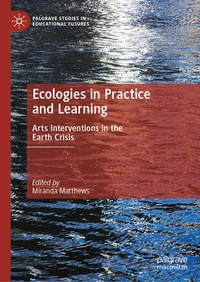
Ecologies in Practice and Learning
Description

This edited collection brings together arts educators, practice researchers, curators and artists to explore ecological approaches to learning, gathering awareness and assembling protest in times of Earth crisis. Each chapter contributes new understandings of different arts processes that have the potential for enabling lifelong and future-changing reparative interventions. Readers are encouraged in their own regenerative creative processes, by authors who have developed ecologies in practice research in universities, with schools, with visitors to theatres, gallery and museum audiences, and arts practice in community settings. The book intends to assist equitable educational practice in environments that have been compromised, and increasingly devastated, by the effects of the Anthropocene. It will be of interest to academics, practice researchers and students developing ecological arts projects.
More details
Other editions
Additional editions
Person
Miranda Matthews is an artist educator and researcher who has directed the Centre for Arts and Learning at Goldsmiths, University of London, UK, for several years. Miranda co-chairs the Goldsmiths Practice Research Group, and is an editor for the International Journal of Art and Design Education.
Content
Chapter 1: Introduction.-Part I: Addressing climate injustice.- Chapter 2: Saving Eloubalire: An educational journey of environmental learning and knowing otherwise.- Chapter 3: Compound 13 Lab, Mumbai: learning through waste ecologies.- Chapter 4: Dokkhina Sundari': A local story of climate emergency in Bangladesh.- Part II: Practice research and arts activism in universities.- Chapter 5: Arts methods in the Earth crisis: Empowering and learning from youth voice.- Chapter 6: How can we help young people improve their local environments? How can they become agents of change? .- Chapter 7: Ecologies of CARE: Reflecting on an Erasmus+ research project.- Chapter 8:An ecology of the in-between: Liminalities in practice research and material studio pedagogies.- Part III: Eco-pedagogies in site-specific practice and collaboration.- Chapter 9: A Space for ecology: An exploration of the role art and design education can play in supporting environmental and ecological issues.- Chapter 10: What is collaborative ecological pedagogy?.- Chapter 11: Ecological pedagogies for planetary health: New ways of thinking in higher education.- Part IV: Sustainable arts practice: Arts educators in museums, galleries and community spaces.- Chapter 12: How can artful learning help young people in the context of the Earth crisis?.- Chapter 13: Residents: Re-wilding the gallery.- Chapter 14: Forest of Imagination and the Living Tree.- Part V: Artists and arts collectives: Taking action in the Earth crisis.- Chapter 15: Art's waste: The wasteful handling of art's potential and resources.- Chapter 16: A seed towards regenerative filmmaking.- Chapter 17: Diaspora ecology: A medicine.- Part VI: Ecosophy and aesthetic imaginaries.- Chapter 18: 100 Acres.- Chapter 19: Aesthoecology and the Earth crisis: At the intersection of aesthetics, ecology and ethics.- Chapter 20: Cosmopedagogies.
