

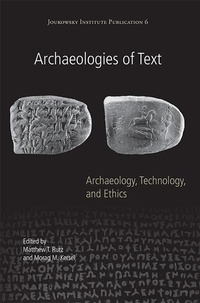
Archaeologies of Text
Archaeology, Technology and Ethics
Published on 20. March 2015
269 pages
978-1-78297-769-8 (ISBN)
Description

Scholars working in a number of disciplines - archaeologists, classicists, epigraphers, papyrologists, Assyriologists, Egyptologists, Mayanists, philologists, and ancient historians of all stripes - routinely engage with ancient textual sources that are either material remains from the archaeological record or historical products of other connections between the ancient world and our own.
Examining the archaeology-text nexus from multiple perspectives, contributors to this volume discuss current theoretical and practical problems that have grown out of their work at the boundary of the division between archaeology and the study of early inscriptions. In 12 representative case-studies drawn from research in Asia, Africa, the Mediterranean, and Mesoamerica, scholars use various lenses to critically examine the interface between archaeology and the study of ancient texts, rethink the fragmentation of their various specialized disciplines, and illustrate the best in current approaches to contextual analysis.
The collection of essays also highlights recent trends in the development of documentation and dissemination technologies, engages with the ethical and intellectual quandaries presented by ancient inscriptions that lack archaeological context, and sets out to find profitable future directions for interdisciplinary research.
Examining the archaeology-text nexus from multiple perspectives, contributors to this volume discuss current theoretical and practical problems that have grown out of their work at the boundary of the division between archaeology and the study of early inscriptions. In 12 representative case-studies drawn from research in Asia, Africa, the Mediterranean, and Mesoamerica, scholars use various lenses to critically examine the interface between archaeology and the study of ancient texts, rethink the fragmentation of their various specialized disciplines, and illustrate the best in current approaches to contextual analysis.
The collection of essays also highlights recent trends in the development of documentation and dissemination technologies, engages with the ethical and intellectual quandaries presented by ancient inscriptions that lack archaeological context, and sets out to find profitable future directions for interdisciplinary research.
More details
Language
English
Place of publication
Havertown
United States
File size
17,19 MB
ISBN-13
978-1-78297-769-8 (9781782977698)
Copyright in bibliographic data and cover images is held by Nielsen Book Services Limited or by the publishers or by their respective licensors: all rights reserved.
Schweitzer Classification
Other editions
Additional editions
Book
11/2014
Oxbow Books
€57.14
Shipment within 3-4 weeks
Content
- Cover
- Title Page
- Copyright Page
- Contents
- List of Figures
- List of Tables
- Notes on Contributors
- Contributor Addresses
- Acknowledgments
- Chatper 1: Introduction: No Discipline is an Island Morag M. Kersel and Matthew T. Rutz
- Chapter 2: Case in Point: The Persepolis Fortification Archive Matthew W. Stolper
- Chapter 3: Space, Time, and Texts: A Landscape Approach to the Classic Maya Hieroglyphic Record Nicholas P. Carter
- Chapter 4: Now You See It, Now You Don't: The Dynamics of Archaeological and Epigraphic Landscapes from Coptic Egypt Scott Bucking
- Chapter 5: Articulating Neo-Assyrian Imperialism at Tell Tayinat Timothy P. Harrison
- Chapter 6: The Archaeology of Mesopotamian Extispicy: Modeling Divination in the Old Babylonian Period Matthew T. Rutz
- Chapter 7: The Ernest K. Smith Collection of Shang Divination Inscriptions at Columbia University and the Evidence for Scribal Training at Anyang Adam Smith
- Chapter 8: Tracing Networks of Cuneiform Scholarship with Oracc, GKAB, and Google Earth Eleanor Robson
- Chapter 9: Ancient Relationships, Modern Intellectual Horizons: The Practical Challenges and Possibilities of Encoding Greek and Latin Inscriptions Lisa Anderson and Heidi Wendt
- Chapter 10: Forging History: From Antiquity to the Modern Period Christopher A. Rollston
- Chapter 11: WikiLeaks, Text, and Archaeology: The Case of the Schøyen Incantation Bowls Neil J. Brodie and Morag M. Kersel
- Chapter 12: Do Restrictions on Publication of Undocumented Texts Promote Legitimacy? Patty Gerstenblith
- Chapter 13: Publishing Undocumented Texts: Editorial Perspectives John F. Cherry
- Index
