

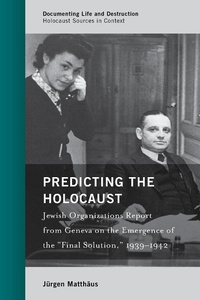
Predicting the Holocaust
Jewish Organizations Report from Geneva on the Emergence of the "Final Solution," 1939-1942
Published on 14. December 2018
240 pages
978-1-5381-2168-9 (ISBN)
Description

Published in association with the United States Holocaust Memorial Museum
Historians long have analyzed the emergence of the "final solution of the Jewish question" primarily on the basis of German documentation, devoting much less attention to wartime Jewish perceptions of the growing threat. Jürgen Matthäus fills this critical gap by showcasing the highly insightful reports compiled during the first half of World War II by two Geneva-based offices: those of Richard Lichtheim representing the Jewish Agency for Palestine and of Gerhart Riegner's World Jewish Congress office. Since the first days of war, Lichtheim's predictions of Jewish dead ran in the millions and increased progressively with the rising tide of Nazi rule over Europe. His and Riegner's perceptions of German anti-Jewish policy resulted from shared goals and personal experiences as well as from their bureaus' range of functions and the massive problems that impacted the gathering and communicating of information on the unfolding Holocaust in German-controlled Europe. Beyond the specifics of the wartime Geneva setting, these sources show how human cognition works in times of extreme crisis and contribute to a better understanding of the potential inherent in Jewish sources for gauging perpetrator actions. The reports and contextual information featured here reflect the first narratives on the Holocaust, their emergence, evolution, and importance for post-war historiography.
Historians long have analyzed the emergence of the "final solution of the Jewish question" primarily on the basis of German documentation, devoting much less attention to wartime Jewish perceptions of the growing threat. Jürgen Matthäus fills this critical gap by showcasing the highly insightful reports compiled during the first half of World War II by two Geneva-based offices: those of Richard Lichtheim representing the Jewish Agency for Palestine and of Gerhart Riegner's World Jewish Congress office. Since the first days of war, Lichtheim's predictions of Jewish dead ran in the millions and increased progressively with the rising tide of Nazi rule over Europe. His and Riegner's perceptions of German anti-Jewish policy resulted from shared goals and personal experiences as well as from their bureaus' range of functions and the massive problems that impacted the gathering and communicating of information on the unfolding Holocaust in German-controlled Europe. Beyond the specifics of the wartime Geneva setting, these sources show how human cognition works in times of extreme crisis and contribute to a better understanding of the potential inherent in Jewish sources for gauging perpetrator actions. The reports and contextual information featured here reflect the first narratives on the Holocaust, their emergence, evolution, and importance for post-war historiography.
More details
Series
Language
English
Place of publication
New York
United States
Publishing group
Bloomsbury Publishing Plc
Target group
Professional and scholarly
Illustrations
5 b/w illustrations; 2 maps
File size
2,55 MB
ISBN-13
978-1-5381-2168-9 (9781538121689)
Copyright in bibliographic data and cover images is held by Nielsen Book Services Limited or by the publishers or by their respective licensors: all rights reserved.
Schweitzer Classification
Other editions
Additional editions
Juergen Matthaeus
Predicting the Holocaust
Jewish Organizations Report from Geneva on the Emergence of the "Final Solution," 1939-1942
Book
12/2018
Rowman & Littlefield Publishers
€73.23
Shipment within 3-4 weeks
Person
Jürgen Matthäus is director of the Applied Research Division at the Jack, Joseph and Morton Mandel Center for Advanced Holocaust Studies of the United States Holocaust Memorial Museum.
Content
Maps
Abbreviations
Editor's Note
PART I Introduction
Nazi anti-Jewish violence and the view from GenevaLichtheim, Riegner, and the "Jewish question"Adjusting to warUnderstanding the "final solution" as a processMaking sense of mass violencePART II SELECT DOCUMENTS
German "vacillating policy" (September 1939 - October 1940)"Local actions" as a policy pattern (November 1940 - July 1941)"Method in this madness" (August 1941 - February 1942)"So little hope left" (March - August 1942)List of Documents
Bibliography
Index
Abbreviations
Editor's Note
PART I Introduction
Nazi anti-Jewish violence and the view from GenevaLichtheim, Riegner, and the "Jewish question"Adjusting to warUnderstanding the "final solution" as a processMaking sense of mass violencePART II SELECT DOCUMENTS
German "vacillating policy" (September 1939 - October 1940)"Local actions" as a policy pattern (November 1940 - July 1941)"Method in this madness" (August 1941 - February 1942)"So little hope left" (March - August 1942)List of Documents
Bibliography
Index
