

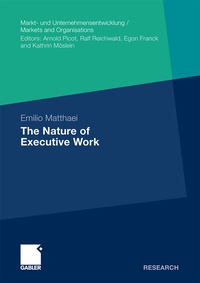
The Nature of Executive Work
A Case Study.
1st Edition
Published on 10. May 2010
XVIII, 247 pages
978-3-8349-8626-9 (ISBN)
Description

More than 30 years ago, Henry Mintzberg reported on upper level management in large US corporations. His resulting work, "The Nature of Managerial Work", - ceived much attention. Expanding on earlier research, Mintzberg's 1973 study was able to show that the work situation at the topmost levels of leadership is charact- ized by extreme stress; critical factors include the accountability to others such as the board and shareholders, time pressure, and permanent work overload, the latter ra- ing particularly critical questions regarding the quality of decision making - a sign- icant risk for the long-term survival of organizations. In today's economic crisis - which is at the same time a crisis of the management profession as a whole - the research focus and results of Henry Mintzberg's study are more relevant than ever. Rigorous studies in the field, however, are still rare. In the present research study, "The Nature of Executive Work", Emilio Matthaei builds on and reaches far beyond the earlier works of the so-called Work Activity School of management research (e. g. Sune Carlson, Leonard Sayles, Rosemary Stewart, Henry Mintzberg, Ralf Reichwald and John Kotter). His exploratory journey from intensively studying twelve senior executives of large global corporations int- duces a fresh perspective on executive work. Emilio Matthaei's data cover the work of twelve executives of the uppermost level of large organizations, each for one month using calendar transcripts and interview records.
More details
Series
Language
English
Place of publication
Wiesbaden
Germany
Publishing group
Betriebswirtschaftlicher Verlag Gabler
Target group
Professional and scholarly
Illustrations
XVIII, 247 p.
File size
2,30 MB
ISBN-13
978-3-8349-8626-9 (9783834986269)
DOI
10.1007/978-3-8349-8626-9
Schweitzer Classification
Other editions
Additional editions
Emilio Matthaei
The Nature of Executive Work
Book
03/2010
1st Edition
Springer Gabler
€53.49
Shipment within 7-9 days
Person
Dr. Emilio Matthaei has been a researcher / lecturer in Leipzig, Nuremberg and Oxford. Today, he works and lives in London.
Content
Literature Review.- Case Study Methodology.- Results and Discussion.- Reflection.
Chapter V Reflection (S. 181-182)
1 Contributions and Limitations
"I am sure that you will try to find a couple of typologies, but at the end of the day, each executive is a separate project. I hope for you that you will find some common ground other than going to the bathroom. But at the end of the day, each executive is a separate project. That makes your study more difficult, and leads you into dangerous waters, because others always want typologies." (citation 1) The thesis accounts for two sources of contributions and limitations.
First, the literature review has given an overview of the Work Activity School and has specific limitations that are pointed out. Second, the research case study contributes with a novel methodological approach to an new understanding of executive work. Apart from its contribution the limitations will also be acknowledged. This focus on the contributions and limitations of this thesis will help readers to view the results appropriately as well as to perceive the implications in the investigated perspective.
1.1 Literature Review
The literature review provides a systematic study of prior contributions of the Work Activity School. While a precise body of the literature has made a reference to a selected number of research studies in the management literature, this literature review is the first systematic overview of published empirical contributions questioning "What does the manager/the executive do?" In so doing, the literature review reports on seventy five empirical studies through the last six decades, and clearly presents an overview of the methods used, days studied of each manager/executive, number of managers/executives studied, management level studied, sector studied, and country studied by the Work Activity School.
Following the systematic review of the empirical design of the Work Activity School, the literature review presents the empirical research along the dimensions (1) job, (2) object, and (3) activity. In line with the three dimensions, this literature conceptualizes all seventy five contributions into a literature map, which provides researchers an understanding of the Work Activity School. Finally, the literature review depicts the foundational findings and contributors of the Work Activity School. Here, the literature review gives insights about the motivation, background, and contribution of research scholars that have helped shape the Work Activity School to date.
The literature review has limitations that deserve to be acknowledged. The first limitation is related to the focus employed in the data gathering. In this context, the literature review focused predominantly on empirical studies of the Work Activity School published in high-ranking academic journals. Only a small part of the set of analyzed studies was book publications. Unpublished empirical studies (for example, unpublished dissertations and working papers), empirical work published in languages other than English and German, and articles presented at conferences or submitted to journals for review were not considered.
While this is advantageous for ensuring the high relevance and academic impact of the observed studies of the Work Activity School, it also suggests a strong bias toward published research, for which multiple rounds of peer review and significant publishing time lags are typical. In a sense, it may be argued that this literature review also reflects editors' and reviewers' perceptions of what constitutes "relevant" research on managerial/executive work (see also Lim, Richardson, and Roberts, 2004).
1 Contributions and Limitations
"I am sure that you will try to find a couple of typologies, but at the end of the day, each executive is a separate project. I hope for you that you will find some common ground other than going to the bathroom. But at the end of the day, each executive is a separate project. That makes your study more difficult, and leads you into dangerous waters, because others always want typologies." (citation 1) The thesis accounts for two sources of contributions and limitations.
First, the literature review has given an overview of the Work Activity School and has specific limitations that are pointed out. Second, the research case study contributes with a novel methodological approach to an new understanding of executive work. Apart from its contribution the limitations will also be acknowledged. This focus on the contributions and limitations of this thesis will help readers to view the results appropriately as well as to perceive the implications in the investigated perspective.
1.1 Literature Review
The literature review provides a systematic study of prior contributions of the Work Activity School. While a precise body of the literature has made a reference to a selected number of research studies in the management literature, this literature review is the first systematic overview of published empirical contributions questioning "What does the manager/the executive do?" In so doing, the literature review reports on seventy five empirical studies through the last six decades, and clearly presents an overview of the methods used, days studied of each manager/executive, number of managers/executives studied, management level studied, sector studied, and country studied by the Work Activity School.
Following the systematic review of the empirical design of the Work Activity School, the literature review presents the empirical research along the dimensions (1) job, (2) object, and (3) activity. In line with the three dimensions, this literature conceptualizes all seventy five contributions into a literature map, which provides researchers an understanding of the Work Activity School. Finally, the literature review depicts the foundational findings and contributors of the Work Activity School. Here, the literature review gives insights about the motivation, background, and contribution of research scholars that have helped shape the Work Activity School to date.
The literature review has limitations that deserve to be acknowledged. The first limitation is related to the focus employed in the data gathering. In this context, the literature review focused predominantly on empirical studies of the Work Activity School published in high-ranking academic journals. Only a small part of the set of analyzed studies was book publications. Unpublished empirical studies (for example, unpublished dissertations and working papers), empirical work published in languages other than English and German, and articles presented at conferences or submitted to journals for review were not considered.
While this is advantageous for ensuring the high relevance and academic impact of the observed studies of the Work Activity School, it also suggests a strong bias toward published research, for which multiple rounds of peer review and significant publishing time lags are typical. In a sense, it may be argued that this literature review also reflects editors' and reviewers' perceptions of what constitutes "relevant" research on managerial/executive work (see also Lim, Richardson, and Roberts, 2004).
