

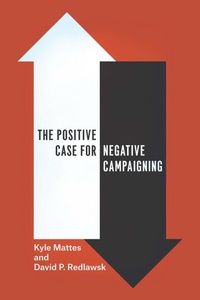
The Positive Case for Negative Campaigning
Published on 22. December 2022
256 pages
978-0-226-20233-4 (ISBN)
Description

Turn on the television or sign in to social media during election season and chances are you'll see plenty of negative campaigning. For decades, conventional wisdom has held that Americans hate negativity in political advertising, and some have even argued that its pervasiveness in recent seasons has helped to drive down voter turnout. Arguing against this commonly held view, Kyle Mattes and David P. Redlawsk show not only that some negativity is accepted by voters as part of the political process, but that negative advertising is necessary to convey valuable information that would not otherwise be revealed.
The most comprehensive treatment of negative campaigning to date, The Positive Case for Negative Campaigning uses models, surveys, and experiments to show that much of the seeming dislike of negative campaigning can be explained by the way survey questions have been worded. By failing to distinguish between baseless and credible attacks, surveys fail to capture differences in voters' receptivity. Voters' responses, the authors argue, vary greatly and can be better explained by the content and believability of the ads than by whether the ads are negative. Mattes and Redlawsk continue on to establish how voters make use of negative information and why it is necessary. Many voters are politically naïve and unlikely to make inferences about candidates' positions or traits, so the ability of candidates to go on the attack and focus explicitly on information that would not otherwise be available is crucial to voter education.
The most comprehensive treatment of negative campaigning to date, The Positive Case for Negative Campaigning uses models, surveys, and experiments to show that much of the seeming dislike of negative campaigning can be explained by the way survey questions have been worded. By failing to distinguish between baseless and credible attacks, surveys fail to capture differences in voters' receptivity. Voters' responses, the authors argue, vary greatly and can be better explained by the content and believability of the ads than by whether the ads are negative. Mattes and Redlawsk continue on to establish how voters make use of negative information and why it is necessary. Many voters are politically naïve and unlikely to make inferences about candidates' positions or traits, so the ability of candidates to go on the attack and focus explicitly on information that would not otherwise be available is crucial to voter education.
More details
Other editions
Additional editions
Kyle Mattes | David P. Redlawsk
The Positive Case for Negative Campaigning
Book
02/2015
University of Chicago Press
€99.04
Article exhausted; check different version
Persons
Kyle Mattes is assistant professor of political science at the University of Iowa.
David P. Redlawsk is professor of political science at the Eagleton Institute's Center for Public Interest Polling at Rutgers University. He is coauthor of several books, including
Why Iowa?, also published by the University of Chicago Press.
Content
- Intro
- Contents
- Acknowledgments
- Chapter 1. Introduction
- Chapter 2. Voters and Negativity, and Why the Media Can't Help, with Stefan Mancevski
- Chapter 3. What Do Voters Think? Social Desirability and Attitudes about Negativity
- Chapter 4. Examining Voter Response to Real Campaign Ads
- Chapter 5. Modeling Negativity
- Chapter 6. That Ad Said What? The Importance of Ad Credibility
- Chapter 7. How the Possibility of Lies Damages Voter Confidence in Negativity
- Chapter 8. Conclusion
- Appendix A: Details of Video Ads Used in Study 4
- Appendix B: Appendix to Chapter 5
- Notes
- References
- Index
