

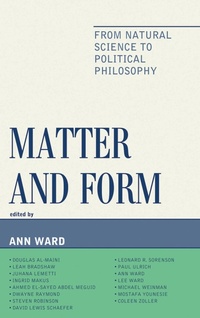
Matter and Form
From Natural Science to Political Philosophy
Lexington Books (Publisher)
1st Edition
Published on 29. October 2009
256 pages
979-8-216-28583-0 (ISBN)
Description

Matter and Form explores the relationship that has long existed between natural science and political philosophy. Plato's Socrates articulates the Ideas or Forms as an account of the ultimate source of causality in the cosmos. Aristotle's natural philosophy had a significant impact on his political philosophy: he argues that humans are by nature political animals, having their natural end in the city whose regime is hierarchically structured based on differences in moral and intellectual capacity. Medieval theorists attempt to synthesize classical natural and political philosophy with the revealed truths of scripture; they argue that divine reason structures an ordered universe, the awareness of which allows for psychic and political harmony among human beings.
Enlightenment thinkers challenge the natural philosophy of classical and medieval philosophers, ushering in a more liberal political order. For example, for Hobbes, there is no rest in nature as there are no Aristotelian forms or natural places that govern matter. Hobbes applies his mechanistic understanding of material nature to his understanding of human nature: individuals are by nature locked in an endless pursuit of power until death. However, from this mechanistic understanding of humanity's natural condition, Hobbes develops a social contract theory in which civil and political society is constituted from consent. Later thinkers, such as Locke and Rousseau, modify this Hobbesian premise in their pursuit of the protection of rights and a free society. Nevertheless, materialist conceptions of the cosmos have not always given rise to liberal democratic philosophies. Historicist influence on scientific inquiry in the nineteenth century is connected to Darwin's theory of evolution; Darwin reasoned that over time the process of natural selection produces ever newer and more highly adapted species. Reflecting a form of social Darwinism, Nietzsche envisions an aristocratic order that draws its inspiration from art rather than the rationalism
Enlightenment thinkers challenge the natural philosophy of classical and medieval philosophers, ushering in a more liberal political order. For example, for Hobbes, there is no rest in nature as there are no Aristotelian forms or natural places that govern matter. Hobbes applies his mechanistic understanding of material nature to his understanding of human nature: individuals are by nature locked in an endless pursuit of power until death. However, from this mechanistic understanding of humanity's natural condition, Hobbes develops a social contract theory in which civil and political society is constituted from consent. Later thinkers, such as Locke and Rousseau, modify this Hobbesian premise in their pursuit of the protection of rights and a free society. Nevertheless, materialist conceptions of the cosmos have not always given rise to liberal democratic philosophies. Historicist influence on scientific inquiry in the nineteenth century is connected to Darwin's theory of evolution; Darwin reasoned that over time the process of natural selection produces ever newer and more highly adapted species. Reflecting a form of social Darwinism, Nietzsche envisions an aristocratic order that draws its inspiration from art rather than the rationalism
More details
Edition
1. Auflage
Language
English
Place of publication
United States
Publishing group
Bloomsbury Publishing Plc
Target group
Professional and scholarly
ISBN-13
979-8-216-28583-0 (9798216285830)
Copyright in bibliographic data and cover images is held by Nielsen Book Services Limited or by the publishers or by their respective licensors: all rights reserved.
Schweitzer Classification
Other editions
Additional editions
Book
10/2009
Lexington Books
€138.30
Shipment within 10-20 days
Persons
Ann Ward is associate professor of philosophy and classics-political studies at Campion College at the University of Regina; she is also author of Herodotus and the Philosophy of Empire, editor of Socrates: Reason or Unreason as the Foundation of European Identity, and co-editor with Lee Ward of The Ashgate Research Companion to Federalism.
Content
Chapter 1 Introduction
Part 2 Part I. Ancient Science, Natural Teleology, and the Order of Politics
Chapter 3 Chapter 1. The Polis Philosophers
Chapter 4 Chapter 2. The Immortality of the Soul and the Origin of the Cosmos in Plato's Phaedo
Chapter 5 Chapter 3. Plato's Science of Living Well
Chapter 6 Chapter 4. Understanding Aristotle's Politics through Form and Matter
Part 7 Part II. Heavenly Perfection and Psychic Harmony
Chapter 8 Chapter 5. Making "men see clearly": Physical Imperfection and Mathematical Order in Ptolemy's Syntaxis
Chapter 9 Chapter 6. Liberalism in the Naturalistic-Psychological Roots of Averroes' Critique of Plato's Republic
Part 10 Part III. Skepticism, Mechanism, and the New Politics
Chapter 11 Chapter 7. Skepticism, Science, and Politics in Montaigne's Essays
Chapter 12 Chapter 8. Parmenidean Intuitions in Descartes's Theory of the Heart's Motion
Chapter 13 Chapter 9. Hobbes's Natural Condition and his Natural Science of the Mind in Leviathan
Chapter 14 Chapter 10. Hobbes and Aristotle: Science and Politics
Chapter 15 Chapter 11. From Metaphysics to Ethics and Beyond: Hobbes's Reaction to Aristotelian Essentialism
Chapter 16 Chapter 12. Hobbes and Aristotle on Biology, Reason and Reproduction
Part 17 Part IV. The Scientific Roots of Liberalism and Contemporary "Biopolitics"
Chapter 18 Chapter 13. Locke and the Problematic Relation between Natural Science and Moral Philosophy
Chapter 19 Chapter 14. Rousseau's Botanical-Political Problem: On the Nature of Nature and Political Philosophy
Chapter 20 Chapter 15. Contrasting Biological and Humanistic Approaches to the Evolution of Political Morality
Chapter 21 Dialogue of the Sciences and the Humanities
Part 2 Part I. Ancient Science, Natural Teleology, and the Order of Politics
Chapter 3 Chapter 1. The Polis Philosophers
Chapter 4 Chapter 2. The Immortality of the Soul and the Origin of the Cosmos in Plato's Phaedo
Chapter 5 Chapter 3. Plato's Science of Living Well
Chapter 6 Chapter 4. Understanding Aristotle's Politics through Form and Matter
Part 7 Part II. Heavenly Perfection and Psychic Harmony
Chapter 8 Chapter 5. Making "men see clearly": Physical Imperfection and Mathematical Order in Ptolemy's Syntaxis
Chapter 9 Chapter 6. Liberalism in the Naturalistic-Psychological Roots of Averroes' Critique of Plato's Republic
Part 10 Part III. Skepticism, Mechanism, and the New Politics
Chapter 11 Chapter 7. Skepticism, Science, and Politics in Montaigne's Essays
Chapter 12 Chapter 8. Parmenidean Intuitions in Descartes's Theory of the Heart's Motion
Chapter 13 Chapter 9. Hobbes's Natural Condition and his Natural Science of the Mind in Leviathan
Chapter 14 Chapter 10. Hobbes and Aristotle: Science and Politics
Chapter 15 Chapter 11. From Metaphysics to Ethics and Beyond: Hobbes's Reaction to Aristotelian Essentialism
Chapter 16 Chapter 12. Hobbes and Aristotle on Biology, Reason and Reproduction
Part 17 Part IV. The Scientific Roots of Liberalism and Contemporary "Biopolitics"
Chapter 18 Chapter 13. Locke and the Problematic Relation between Natural Science and Moral Philosophy
Chapter 19 Chapter 14. Rousseau's Botanical-Political Problem: On the Nature of Nature and Political Philosophy
Chapter 20 Chapter 15. Contrasting Biological and Humanistic Approaches to the Evolution of Political Morality
Chapter 21 Dialogue of the Sciences and the Humanities
