

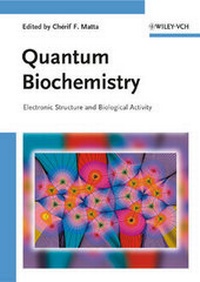
Quantum Biochemistry
Electronic Structure and Biological Activity
1st Edition
Published on 14. January 2010
LVIII, 920 pages
978-3-527-62922-0 (ISBN)
Description

Divided into five major parts, the two volumes of this ready reference cover the tailoring of theoretical methods for biochemical computations, as well as the many kinds of biomolecules, reaction and transition state elucidation, conformational flexibility determination, and drug design. Throughout, the chapters gradually build up from introductory level to comprehensive reviews of the latest research, and include all important compound classes, such as DNA, RNA, enzymes, vitamins, and heterocyclic compounds.
The result is in-depth and vital knowledge for both readers already working in the field as well as those entering it. Includes contributions by Prof. Ada Yonath (Nobel Prize in Chemistry 2009) and Prof. Jerome Karle (Nobel Prize in Chemistry 1985).
The result is in-depth and vital knowledge for both readers already working in the field as well as those entering it. Includes contributions by Prof. Ada Yonath (Nobel Prize in Chemistry 2009) and Prof. Jerome Karle (Nobel Prize in Chemistry 1985).
More details
Other editions
Additional editions
Cherif F. Matta
Quantum Biochemistry
Software
06/2010
Wiley-VCH
€512.18
No shipping information available
Chérif F. Matta
Quantum Biochemistry
Book
02/2010
1st Edition
Wiley-VCH
€372.00
Article exhausted; check different version
Person
Chérif F. Matta is Associate Professor at the Department of Chemistry and Physics, Mount Saint Vincent University and an Honorary Adjunct Professor at the Department of Chemistry, Dalhousie University, both in Halifax, Canada. He obtained his BSc from Alexandria University, Egypt, in 1987 and gained his PhD in theoretical chemistry from McMaster University, Canada, in 2002. He was then a postdoctoral fellow at the University of Toronto, Canada, before being awarded an I. W. Killam Fellowship at Dalhousie University. In addition to his current academic appointments, which started in 2006, he has held adjunct/visiting Professorships at McMaster University and at the Université Henri Poincaré (UHP), Nancy Université - 1. In 2009, he received the HDR (Habilitation) degree from the UHP.
Professor Matta has published more than 50 research papers and book chapters, and edited the Quantum Theory of Atoms in Molecules: From Solid State to DNA and Drug Design (Wiley-VCH, 2007) with Russell J. Boyd. He is the recipient of the Molecular Graphics and Molecular Simulation Society Silver Jubilee Prize for 2009 and won the John C. Polanyi Prize in Chemistry in 2004. His research is in theoretical and computational chemistry with a focus on the analysis of molecular electron densities and its applications.
Professor Matta has published more than 50 research papers and book chapters, and edited the Quantum Theory of Atoms in Molecules: From Solid State to DNA and Drug Design (Wiley-VCH, 2007) with Russell J. Boyd. He is the recipient of the Molecular Graphics and Molecular Simulation Society Silver Jubilee Prize for 2009 and won the John C. Polanyi Prize in Chemistry in 2004. His research is in theoretical and computational chemistry with a focus on the analysis of molecular electron densities and its applications.
Content
VOLUME ONE
PART I: Novel Theoretical , Computational, and Experimental Methods and Techniques
QUANTUM KERNELS AND QUANTUM CRYSTALLOGRAPHY: APPLICATIONS IN BIOCHEMISTRY
Introduction
Origins of Quantum Crystallography (QCr)
Beginnings of Quantum Kernels
Kernel Density Matrices Led to Kernel Energies
Summary and Conclusions
GETTING THE MOST OUT OF ONIOM: GUIDELINES AND PITFALLS
Introduction
QM/MM
ONIOM
Guidelines for the Application of ONIOM
Use of Point charges
Conclusions
MODELING ENZYMATIC REACTIONS IN METALLOENZYMES AND PHOTOBIOLOGY BY QUANTUM MECHANICS (QM) AND QUANTUM MECHANICS/MOLECULAR MECHANICS (QM/MM) CALCULATIONS
Introduction
Computational Strategies (Methods and Models)
Metalloenzymes
Photobiology
Conclusion
FROM MOLECULAR ELECTROSTATIC POTENTIALS TO SOLVATION MODELS AND ENDING WITH BIOMOLECULAR PHOTOPHYSICAL PROCESSES
Introduction
The Molecular Electrostatic Potential and Noncovalent Interactions among Molecules
Solvation: The "Continuum Model"
Applications of the PCM Method
THE FAST MARCHING METHOD FOR DETERMINING CHEMICAL REACTION MECHANISMS IN COMPLEX SYSTEMS
Motivation
Background
Fast Marching Method
Quantum Mechanics/Molecular Mechanics (QM/MM) Methods Applied to Enzyme-Catalyzed Reactions
Summary
PART II: Nucleic Acids, Amino Acids, Peptides and Their Interactions
CHEMICAL ORIGIN OF LIFE: HOW DO FIVE HCN MOLECULES COMBINE TO FORM ADENINE UNDER PREBIOTIC AND INTERSTALLAR CONDITIONS
Introduction
Prebiotic Chemistry: Experimental Endeavor to Synthesize the Building Blocks of Biopolymers
Computational Investigation
Conclusion
HYDROGEN BONDING AND PROTON TRANSFER IN IONIZED DNA BASE PAIRS, AMINO ACIDS AND PEPTIDES
Introduction
Methodological Aspects
Ionization of DNA Base Pairs
Ionization of Amino Acids
Ionization of Peptides
Conclusions
TO NANO-BIOCHEMISTRY: PICTURE OF THE INTERACTIONS OF DNA WITH GOLD
Introductory Nanoscience Background
DNA-Gold Bonding Patterns: Some Experimental Facts
Adenine-Gold Interaction
Guanine-Gold Interaction
Thymine-Gold Interactions
Cytosine-Gold Interactions
Basic Trends of DNA Base-Gold Interaction
Interaction of Watson-Crick DNA Base Pairs with Gold Clusters
Summary and Perspectives
QUANTUM MECHANICAL STUDIES OF NONCOVALENT DNA-PROTEIN INTERACTIONS
Introduction
Computational Approaches for Studying Noncovalent Interactions
Hydrogen-Bonding Interactions
Interactions between Aromatic DNA-Protein Components
Cation-pi Interactions between DNA-Protein Components
Conclusions
THE VIRIAL FIELD AND TRANSFERABILITY IN DNA BASE-PAIRING
A New Theorem Relating the Density of an Atom in a Molecule to the Energy
Computations
Chemical Transferability and the One-Electron Density Matrix
Changes in Atomic Energies Encountered in DNA Base Pairing
Energy Changes in the WC Pairs GC and AT
Discussion
AN ELECTRON DENSITY-BASED APPROACH TO THE ORIGIN OF STACKING INTERACTIONS
Introduction
Computational Method
Charge-Transfer Complexes: Quinhydrone
pi-pi Interactions in Hetero-Molecular Complexes: Methyl Gallate-Caffeine Adduct
pi-pi Interactions between DNA Base Pair Steps
pi-pi Interactions in Homo-Molecular Complexes: Catechol
C-H/pi Complexes
Provisional Conclusions and Future Research
POLARIZABILITIES OF AMINO ACIDS: ADDITIVE MODELS AND AB INITIO CALCULATIONS
Introduction
Models of Polarizability
Polarizabilities of the Amino Acids
Concluding Remarks
METHODS IN BIOCOMPUTATIONAL CHEMISTRY: A LESSON FROM THE AMINO ACIDS
Introduction
Conformers, Rotamers and Physicochemical Variables
QTAIM Side Chain Polarizations and the Theoretical Classification of Amino Acids
Quantum Mechanical Studies of Peptide-Host Interactions
Conclusions
FROM ATOMS IN AMINO ACIDS TO THE GENETIC CODE AND PROTEIN STABILITY, AND BACKWARDS
Context of the Work
The Electron Density rho(r) as an Indirectly Measurable Dirac Observable
Brief Review of Some Basic Concepts of the Quantum Theory of Atoms in Molecules
Computational Approach and Level of Theory
Empirical Correlations of QTAIM Atomic Properties of Amino Acid Side Chains w
PART I: Novel Theoretical , Computational, and Experimental Methods and Techniques
QUANTUM KERNELS AND QUANTUM CRYSTALLOGRAPHY: APPLICATIONS IN BIOCHEMISTRY
Introduction
Origins of Quantum Crystallography (QCr)
Beginnings of Quantum Kernels
Kernel Density Matrices Led to Kernel Energies
Summary and Conclusions
GETTING THE MOST OUT OF ONIOM: GUIDELINES AND PITFALLS
Introduction
QM/MM
ONIOM
Guidelines for the Application of ONIOM
Use of Point charges
Conclusions
MODELING ENZYMATIC REACTIONS IN METALLOENZYMES AND PHOTOBIOLOGY BY QUANTUM MECHANICS (QM) AND QUANTUM MECHANICS/MOLECULAR MECHANICS (QM/MM) CALCULATIONS
Introduction
Computational Strategies (Methods and Models)
Metalloenzymes
Photobiology
Conclusion
FROM MOLECULAR ELECTROSTATIC POTENTIALS TO SOLVATION MODELS AND ENDING WITH BIOMOLECULAR PHOTOPHYSICAL PROCESSES
Introduction
The Molecular Electrostatic Potential and Noncovalent Interactions among Molecules
Solvation: The "Continuum Model"
Applications of the PCM Method
THE FAST MARCHING METHOD FOR DETERMINING CHEMICAL REACTION MECHANISMS IN COMPLEX SYSTEMS
Motivation
Background
Fast Marching Method
Quantum Mechanics/Molecular Mechanics (QM/MM) Methods Applied to Enzyme-Catalyzed Reactions
Summary
PART II: Nucleic Acids, Amino Acids, Peptides and Their Interactions
CHEMICAL ORIGIN OF LIFE: HOW DO FIVE HCN MOLECULES COMBINE TO FORM ADENINE UNDER PREBIOTIC AND INTERSTALLAR CONDITIONS
Introduction
Prebiotic Chemistry: Experimental Endeavor to Synthesize the Building Blocks of Biopolymers
Computational Investigation
Conclusion
HYDROGEN BONDING AND PROTON TRANSFER IN IONIZED DNA BASE PAIRS, AMINO ACIDS AND PEPTIDES
Introduction
Methodological Aspects
Ionization of DNA Base Pairs
Ionization of Amino Acids
Ionization of Peptides
Conclusions
TO NANO-BIOCHEMISTRY: PICTURE OF THE INTERACTIONS OF DNA WITH GOLD
Introductory Nanoscience Background
DNA-Gold Bonding Patterns: Some Experimental Facts
Adenine-Gold Interaction
Guanine-Gold Interaction
Thymine-Gold Interactions
Cytosine-Gold Interactions
Basic Trends of DNA Base-Gold Interaction
Interaction of Watson-Crick DNA Base Pairs with Gold Clusters
Summary and Perspectives
QUANTUM MECHANICAL STUDIES OF NONCOVALENT DNA-PROTEIN INTERACTIONS
Introduction
Computational Approaches for Studying Noncovalent Interactions
Hydrogen-Bonding Interactions
Interactions between Aromatic DNA-Protein Components
Cation-pi Interactions between DNA-Protein Components
Conclusions
THE VIRIAL FIELD AND TRANSFERABILITY IN DNA BASE-PAIRING
A New Theorem Relating the Density of an Atom in a Molecule to the Energy
Computations
Chemical Transferability and the One-Electron Density Matrix
Changes in Atomic Energies Encountered in DNA Base Pairing
Energy Changes in the WC Pairs GC and AT
Discussion
AN ELECTRON DENSITY-BASED APPROACH TO THE ORIGIN OF STACKING INTERACTIONS
Introduction
Computational Method
Charge-Transfer Complexes: Quinhydrone
pi-pi Interactions in Hetero-Molecular Complexes: Methyl Gallate-Caffeine Adduct
pi-pi Interactions between DNA Base Pair Steps
pi-pi Interactions in Homo-Molecular Complexes: Catechol
C-H/pi Complexes
Provisional Conclusions and Future Research
POLARIZABILITIES OF AMINO ACIDS: ADDITIVE MODELS AND AB INITIO CALCULATIONS
Introduction
Models of Polarizability
Polarizabilities of the Amino Acids
Concluding Remarks
METHODS IN BIOCOMPUTATIONAL CHEMISTRY: A LESSON FROM THE AMINO ACIDS
Introduction
Conformers, Rotamers and Physicochemical Variables
QTAIM Side Chain Polarizations and the Theoretical Classification of Amino Acids
Quantum Mechanical Studies of Peptide-Host Interactions
Conclusions
FROM ATOMS IN AMINO ACIDS TO THE GENETIC CODE AND PROTEIN STABILITY, AND BACKWARDS
Context of the Work
The Electron Density rho(r) as an Indirectly Measurable Dirac Observable
Brief Review of Some Basic Concepts of the Quantum Theory of Atoms in Molecules
Computational Approach and Level of Theory
Empirical Correlations of QTAIM Atomic Properties of Amino Acid Side Chains w
