

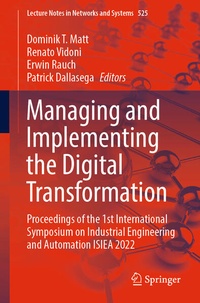
Managing and Implementing the Digital Transformation
Description

This book shows how companies can practically implement the advantages of Industry 4.0 and digitalization and also addresses the current challenges with regard to engineering education for Industry 4.0. In this book, we collect the contributions of the 1st Symposium on Industrial Engineering and Automation (ISIEA 2022), which took place from June 21-22, 2022 at the Free University of Bolzano. The contributions cover three basic areas: (1) best practice examples and technical solutions for the implementation of Industry 4.0 in production and logistics, (2) management-oriented approaches for the digital transformation in companies, and (3) addressing Industry 4.0 in engineering education. The book targets different readers. Researchers find approaches to current research topics regarding Industry 4.0. Practitioners find valuable examples for technological implementations as well as management approaches for introducing digitalization. Students and lecturers find hints on how Industry4.0 can be integrated into university teaching.
More details
Other editions
Additional editions
Persons
Content
- Intro
- Organization
- Chairs
- Chair
- Co-chairs
- Special Session Chair
- International Scientific Committee
- Organizing Committee
- Organization Co-chair
- Organizing Committee
- Contents
- Smart Manufacturing
- Transformability in Material Flow Systems: Towards an Improved Product Development Process
- 1 Introduction
- 2 Research Methodology
- 3 State of the Art
- 3.1 Development and Product Life Cycle of MFS
- 3.2 Retrofits
- 3.3 Transformability
- 3.4 Consistency Management
- 4 Results: Requirements for a Transformability-Driven Product Development Framework
- 5 Conclusions
- References
- Mechatronic Handling Solution for a Robotized Pizza-Chef Assistant
- 1 Introduction
- 2 Evaluation of End-Effector Technologies
- 2.1 Grasping Principles for Food Manipulation
- 2.2 Gripper Selection for Pizza Topping
- 3 Gripper Evaluation
- 3.1 Experimental Set-Up
- 3.2 Experimental Test Results and Discussion
- 4 Conclusion
- References
- Mechanical Property Degradation of Polylactic Acid (PLA) 3D Printed Parts under Ultraviolet Radiation
- 1 Background and Introduction
- 2 Methods and Materials
- 3 Experimental Results
- 4 Discussion and Conclusions
- References
- Two Different Numerical Approaches for Supporting Vibration-Based Structural Health Monitoring of Gear Train Systems
- 1 Introduction
- 2 Gearbox System
- 3 Dynamic Model
- 3.1 Lumped Parameter Method (LPM)
- 3.2 Numerical Analysis
- 3.3 Analytical Calculation
- 4 Results
- 5 Conclusion
- References
- AI and Data Analysis in Manufacturing
- Information Model to Advance Explainable AI-Based Decision Support Systems in Manufacturing System Design
- 1 Introduction
- 2 Theoretical Background
- 2.1 Current Status of AI in Manufacturing
- 2.2 AI-Based Decision Support Systems in Manufacturing
- 3 Research Questions
- 4 Information Model to Express System Design Requirements and Alternative Solutions
- 4.1 Systems According to IEEE 42010
- 4.2 The Role of Ontology of the Decision-Making Process for System Design
- 4.3 Proposed Information Model
- 5 Contribution of the Proposed Information Model
- 5.1 Contribution for Explainable DSS
- 5.2 Contribution for Lifecycle Adapting DSS
- 6 Discussion and Implications
- 7 Conclusions and Outlook
- References
- Classification Framework for Machine Learning Support in Manufacturing
- 1 Introduction
- 2 Background on ML Algorithms Used in Manufacturing
- 3 Research Methodology
- 4 Classification Framework for ML in Manufacturing
- 4.1 Applications in the Design Stage Oriented to Manufacturability and Material Properties
- 4.2 Material Selection Stage
- 4.3 Testing Stage
- 4.4 Decision-Making Stage
- 5 Conclusions
- References
- Development of a System for the Analysis of Surface Defects in Die-Cast Components Using Machine Vision
- 1 Introduction
- 2 Problem Description and Used Tools
- 2.1 Description of the Analyzed Aluminum Component
- 2.2 MVS Industrial Evaluation: 2D vs 3D Systems
- 2.3 MVS Inspection Methodology
- 2.4 Preprocessing
- 2.5 Software AI Approach
- 3 Development and Testing
- 3.1 Setting of the Test in the First Attempt Configuration: Step1
- 3.2 Verification of the Usability of the Acquired Images
- 3.3 AI Software Training
- 3.4 Semi-automatic Configuration Set Up: Step 2
- 3.5 Initial Results
- 4 Conclusions and Future Work
- References
- Performance Prediction of Thin-Walled Tube Energy Absorbers Using Machine Learning
- 1 Introduction
- 2 Numerical Model and Verification
- 2.1 Finite Element Model
- 2.2 Verification of the Finite Element Model
- 3 Design of Experiments (DOE)
- 4 Parametric Study of Tube Absorber Performance
- 4.1 The Effect of Tube Thickness
- 4.2 The Effect of the Cross-Section Ratio
- 4.3 The Effect of Taper Angle
- 4.4 The Effect of Tube Material
- 5 Machine Learning Algorithm
- 5.1 Model Validation
- 5.2 Sensitivity Analysis
- 6 Conclusion
- References
- Digital Twin and Simulation
- Digital Twin in a Dairy Factory
- 1 Introduction
- 2 Literature Review
- 2.1 Industry 4.0 and Industry 5.0
- 2.2 Simulation and Digital Twin
- 2.3 Simulation and Digital Twin Applications
- 3 Case Study
- 3.1 Case Description
- 3.2 Simulation Model
- 3.3 Validation, Verification and Results
- 4 Conclusion and Future Research
- References
- A Digital Twin Approach to Automotive Wheel Flow Forming Process
- 1 Introduction
- 2 Literature Review
- 3 Experimental Tests
- 4 FEM Digital Model
- 5 Results and Discussion
- 6 Conclusions
- References
- Simulation of Heavy-Duty Vehicles for the Use in Digital Twins
- 1 Introduction and Literature Review
- 2 System Structure and Foundations
- 3 Mathematical Foundations
- 3.1 Drivetrains Mathematical Model
- 3.2 Vehicle Control Architecture
- 4 Results
- 5 Conclusions
- References
- Development of a FEM Model for the Digital Twin Application and the Monitoring of Cor-Ten Road Barriers in the Autonomous Province of Bozen/Bolzano
- 1 Introduction and Theoretical Background
- 2 Methodology
- 2.1 Model Definition
- 2.2 Meshing
- 2.3 Simulation
- 3 Results
- 3.1 Deformations and Forces
- 3.2 Absorbed Energy
- 4 Conclusions
- References
- Introducing and Implementing Industry 4.0
- Development of Knowledge Capability Model for Industry 4.0: A Thai SMEs Perspective
- 1 Introduction
- 2 Research Background
- 2.1 Industry 4.0 and Organizational Learning
- 2.2 Industry 4.0 and SMEs
- 2.3 Knowledge Capability and Indicators
- 3 Research Design and Methodology
- 3.1 Sample Selection and Questionnaire Development
- 3.2 Data Collection
- 3.3 Construct Validity and Reliability
- 4 Results
- 5 The Synthesis of Organizational Learning Indicators for Industry 4.0
- 6 KC Model Case Application
- 6.1 Knowledge Capability Indicators
- 6.2 Example of Application
- 7 Discussion
- 8 Conclusions
- References
- Haze Problem Solving for Resilience Living Society in Northern Thailand: A Case Study
- 1 Introduction
- 2 Literature Reviews
- 2.1 Burning in Northern Thailand and Sufficiency Economy Theory as Haze Solution
- 2.2 Law, Rules, Regulations and Policy for Haze Management in Thailand
- 3 Methodology
- 4 Results
- 4.1 Current Source of Burning
- 4.2 Haze Management in Nine Provinces of Northern Thailand by Quadruple Partnerships
- 4.3 The Sustainable Model of Solving Problems
- 5 Conclusion and Discussion
- References
- Industry 4.0 in Family Firms
- 1 Introduction
- 2 Theoretical Background
- 2.1 Family Firm Definition, Heterogeneity, and Multigenerationality
- 2.2 Industry 4.0
- 3 Innovation and Industry 4.0 in Family Firms
- 4 Conclusions
- References
- Industry 4.0: from Illusion to Revolution through Digital Transformation
- 1 Introduction
- 2 State of the Art of Industry 4.0
- 3 Industry 4.0 Inconsistencies
- 3.1 Automobile Industry
- 3.2 Education System
- 3.3 Energy Sustainability
- 4 Hybrid Systems
- 5 Digital Transformation
- 6 Conclusions
- References
- Advanced Scheduling and Optimization
- Applying Grey Relational Analysis Based Multi-response Optimization of Husker Process Parameters in Paddy Husking Machine
- 1 Introduction
- 2 Experimental Procedure
- 2.1 Materials and Method
- 2.2 Grey Relational Analysis (GRA)
- 2.3 Grey Relational Coefficient and Grey Relational Grade
- 3 Results
- 3.1 Multi-objective Optimization Using Grey Relational Analysis
- 3.2 Implementation of Methodology to Find Multi-response Parametric Optimization
- 4 Conclusion
- References
- Scheduling Optimization for Mass Customized Production Using Simulation Tool
- 1 Introduction
- 2 Problem Description and Methodology
- 3 Proposed Method Using a Real Case
- 4 Conclusion
- References
- The Impact of Technological Implementation Decisions on Job-Shop Scheduling Simulator Performance Using Secondary Storage and Parallel Processing
- 1 Introduction
- 2 Literature Review
- 3 Scheduling Heuristic Description
- 4 Technological Implementation Details and Scheduling Scenarios Description
- 5 Results and Discussion
- 6 Conclusions
- References
- A Systematic Review of Manufacturing Scheduling for the Industry 4.0
- 1 Introduction
- 2 Manufacturing Scheduling in the Industry 4.0
- 2.1 Dynamic Scheduling
- 2.2 Distributed and Decentralized Scheduling
- 2.3 Parallel Scheduling
- 2.4 Predictive and Intelligent Scheduling
- 2.5 Real-Time Scheduling
- 3 Manufacturing Scheduling Systematic Literature Review
- 3.1 Literature Review Process
- 3.2 Main Results
- 4 Discussion
- 5 Conclusion
- References
- Key Competencies and Skills Training in Engineering Education
- Personnel and Area Assessment Models for Thailand Provincial Industry Office Toward Industry 4.0
- 1 Introduction
- 1.1 Ministry of Industry and the Industrial Provincial Office
- 1.2 Industry Development Policy of Thailand
- 2 Assessment Model Development
- 2.1 Personnel Assessment Model
- 2.2 Area Assessment
- 3 Methodology
- 4 Preliminary Result - Model Testing
- 5 Discussion
- References
- ETAT Pedagogical Modules for Automation 4.0 Training Program Structure in Training Centres in Thailand
- 1 Introduction
- 2 Methodology
- 3 Preliminary Data from ETAT Project
- 3.1 Automation 4.0
- 3.2 New and Updated Curricula
- 3.3 Technological Process
- 4 Procedure for Didactic Modules Definition
- 4.1 Needs Analysis
- 4.2 Concept of ETAT Smart Labs
- 4.3 Topics and Hours in Curricula
- 4.4 Didactic Modules Distribution
- 4.5 Preparation of Didactic Modules
- 5 Next Steps in ETAT Project
- 5.1 Matching Didactic Modules and Courses
- 5.2 Deployment and Implementation of Training Activities
- 5.3 Validation, Quality Control and Improvement
- 5.4 Training Accreditation
- 6 Conclusions and Outlook
- References
- Competence-Based Realignment of Engineering Education at Higher Education Institutions: Using the Example of Industrial Logistics Engineering Project "CoR-ILog"
- 1 Introduction
- 2 Theoretical Conceptualization of the Competence-Based Realignment of Engineering Education Exemplified by the Lecture Logistics System Design and Material Flow Management
- 2.1 Learning Outcomes at Program Level
- 2.2 Assessment Criteria
- 2.3 Duration, Structure, and Scope
- 3 Expected Outcomes as a Result of the Competency-Based Realignment of Engineering Education
- 4 Conclusion and Outlook
- References
- ICARUS Pedagogical Methodologies Framework, or Reference Model
- 1 Introduction
- 2 Pedagogical Methodologies within the Frameworks of Education 1.0 & 2.0 & 3.0 Paradigms
- 3 Building Pedagogical Framework, or Reference Model
- 4 ICARUS Pedagogical Framework, or Reference Model
- 5 Towards Formalization of the Framework
- 6 Conclusions - Exploitation Plan and Future Work
- References
- An Innovative Higher Education Institution Training Toolbox to Effectively Address Industry 4.0 Skills Gap and Mismatches
- 1 Introduction
- 2 Literature Review
- 3 Methodology for the Development of Open and Digital Training Toolbox
- 4 Stakeholder Requirement Analysis
- 5 An Innovative Higher Education Institution Training Toolbox for Industry 4.0
- 6 Implementation of the ICARUS Digital Training Toolbox
- 6.1 An Industry 4.0 Mobile Training Unit
- 7 Conclusions
- References
- Lab and Learning Factory Design for Engineering Education
- Learning Based on SmartTechLab for I4.0
- 1 Introduction
- 2 Vision and Identification Systems
- 3 Collaborative Work Cell
- 4 Discussion and Conclusions
- References
- Hands-on PLC Training Approach for IT Students Using Virtual Reality
- 1 Introduction
- 2 State of the Art
- 2.1 Virtual-Reality-Enabled Remote Lab with Equipment Connection
- 2.2 Virtual-Reality-Enabled Hands-on Training
- 2.3 Virtual Contents with Specific Didactics
- 3 The Proposed PLC Virtual Training System
- 3.1 Overview of the System
- 3.2 Instructional Design
- 3.3 3D Models
- 3.4 Training Environment and Setup
- 4 Results and Discussion
- 5 Conclusion and Outlook
- References
- Network Architecture of ETAT Education and Training Centers for Automation 4.0
- 1 Introduction
- 2 Overall Architecture and Network of ETAT Education and Training Centers
- 2.1 Overview
- 2.2 Factory Simulation at Burapha University (BUU)
- 2.3 Robotics at Rajamangala University of Technology Tawan-ok (RMUTTO)
- 2.4 Smart Farming at Rajabhat Rajanagarindra University (RRU)
- 2.5 Material Handling and Transportation at King Mongkut's University of Technology North Bangkok (KMUTNB)
- 2.6 Industrial Data Analytics at Kasetsart University (KU)
- 2.7 Smart City and Smart Home at King Mongkut's Institute of Technology Ladkrabang (KMITL)
- 3 Conclusions
- References
- Design and Implementation of the ICARUS Industry 4.0 Mobile Training Unit
- 1 Introduction
- 2 State of the Art of Industry 4.0 Training Units
- 3 A Methodology for Developing an Industry 4.0 Mobile Training Unit
- 4 The ICARUS Industry 4.0 Mobile Training Unit
- 4.1 Problem Analysis
- 4.2 Solution Synthesis
- 4.3 Cobot Simulation
- 5 Implementation and Evaluation of the ICARUS Industry 4.0 Mobile Training Unit
- 5.1 Risk Assessment
- 5.2 Implementation of the ICARUS Industry 4.0 Mobile Training Unit
- 5.3 Conformance to Requirements
- 6 Conclusions
- References
- A Contribution to the Learning Factory Architecture Implementations for Engineering Education
- 1 Introduction
- 2 Learning Factory Concept
- 3 Learning Factory Architectures - Some Examples from Literature
- 4 A Learning Factory Architecture Proposed
- 4.1 Physical Stationary Infrastructure
- 4.2 Physical Mobile Infrastructure
- 4.3 Internet-Based Infrastructure
- 4.4 Blended Infrastructure
- 5 Learning Factory Implementation Framework
- 6 Application of the Learning Factory Architecture in an Industrial Engineering Course
- 7 Conclusions
- References
- Author Index
