

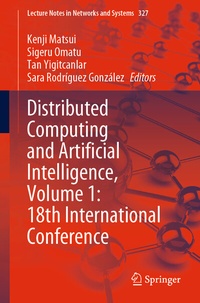
Distributed Computing and Artificial Intelligence, Volume 1: 18th International Conference
Description

This book offers the exchange of ideas between scientists and technicians from both the academic and industrial sector which is essential to facilitate the development of systems that can meet the ever-increasing demands of today's society. The 18th International Symposium on Distributed Computing and Artificial Intelligence 2021 (DCAI 2021) is a forum to present the applications of innovative techniques for studying and solving complex problems in artificial intelligence and computing areas. The present edition brings together past experience, current work, and promising future trends associated with distributed computing, artificial intelligence, and their application in order to provide efficient solutions to real problems.
This year's technical program presents both high quality and diversity, with contributions in well-established and evolving areas of research. Specifically, 55 papers were submitted to main track and special sessions, by authors from 24 different countries, representing a truly "wide area network" of research activity. The DCAI'21 technical program has selected 21 papers, and, as in past editions, it will be special issues in ranked journals such as Electronics, Sensors, Systems, Robotics, Mathematical Biosciences and ADCAIJ. These special issues cover extended versions of the most highly regarded works. Moreover, DCAI'21 special sessions have been a very useful tool to complement the regular program with new or emerging topics of particular interest to the participating community.
More details
Other editions
Additional editions
Content
- Intro
- Preface
- Organization
- Honorary Chairman
- Advisory Board
- Program Committee Chairs
- Organizing Committee Chair
- Workshop Chair
- Program Committee
- Organizing Committee
- DCAI 2021 Sponsors
- Contents
- A Theorem Proving Approach to Formal Verification of a Cognitive Agent
- 1 Introduction
- 2 Related Work
- 3 Logic Framework
- 4 Cognitive Agents
- 5 Agent Capabilities
- 6 Hoare Logic for Actions
- 7 Specifying Agent Programs
- 8 Concluding Remarks
- References
- Parallelization of the Poisson-Binomial Radius Distance for Comparing Histograms of n-grams
- 1 Introduction
- 2 Method
- 2.1 Sequential Computation of the PBR Distance
- 2.2 Parallel Computation of the PBR Distance for GPU
- 3 Experiments
- 4 Conclusion
- References
- CVAE-Based Complementary Story Generation Considering the Beginning and Ending
- 1 Introduction
- 2 Related Works
- 3 Technical Background
- 3.1 Hierarchical Recurrent Encoder Decoder
- 3.2 Variational Hierarchical Recurrent Encoder Decoder
- 3.3 Variational Hierarchical Conversation RNN
- 4 Complementary Story Generation
- 4.1 Story Generator Concatenating Two Stories
- 4.2 Story Generator Considering the Beginning and Ending
- 5 Evaluation Experiment
- 5.1 Dataset
- 5.2 Hyper-parameters
- 5.3 Evaluation Metrics
- 5.4 Results and Analysis
- 6 Conclusion
- References
- A Review on Multi-agent Systems and Virtual Reality
- 1 Introduction
- 2 Research Methodology
- 2.1 Planning
- 2.2 Development of the Study
- 2.3 Mapping Report
- 3 Mapping
- 4 Discussion
- 5 Results
- 5.1 What Applications Have Been Developed Combining VR and MAS?
- 5.2 What Benefits Does the Combined Use of These Technologies Bring?
- 6 Conclusions
- References
- Malware Analysis with Artificial Intelligence and a Particular Attention on Results Interpretability
- 1 Introduction
- 1.1 State of Art
- 1.2 Contributions and Paper Plan
- 2 Dataset and Preprocessing
- 2.1 Description of Binaries Dataset
- 2.2 Is the Malware Modified?
- 2.3 Image-Based Malware Transformation
- 3 Detection Based on Static Methods
- 3.1 Algorithms on Binary Files
- 3.2 Algorithms on Grayscale Images
- 3.3 Algorithms on RGB Images
- 4 Modified Binary Analysis and Attention Mechanism
- 4.1 Modified Binaries
- 4.2 Interpretibility of Results and Most Important Bytes
- 5 Conclusion and Results
- References
- Byzantine Resilient Aggregation in Distributed Reinforcement Learning
- 1 Introduction
- 2 Related Work
- 3 Background
- 4 Problem Formulation
- 5 Resilient Aggregation in Distributed RL
- 6 Evaluation
- 6.1 Simulation Setup
- 6.2 Simulation Results
- 7 Conclusion
- References
- Utilising Data from Multiple Production Lines for Predictive Deep Learning Models
- 1 Introduction
- 2 Background
- 3 Method
- 3.1 Data
- 3.2 Model
- 3.3 Experiment
- 4 Result
- 5 Discussion and Conclusion
- References
- Optimizing Medical Image Classification Models for Edge Devices
- 1 Background
- 1.1 Motivation
- 1.2 Overview of Compression Techniques
- 2 Method
- 2.1 Dataset
- 2.2 Baseline FP32 Model
- 2.3 Quantization of the Model
- 2.4 Hardware Specifications and Costs
- 2.5 Measuring Accuracy and Inference Latency
- 2.6 Code Repository
- 3 Results and Discussion
- 3.1 Model Accuracy
- 3.2 Model Size
- 3.3 Inference Latency
- 4 Conclusion
- 5 Future Work
- References
- Song Recommender System Based on Emotional Aspects and Social Relations
- 1 Introduction
- 2 Related Work
- 3 Methods
- 3.1 Architecture
- 3.2 Classifier of Emotions
- 3.3 Song Recommendation Methodology
- 3.4 Recommendations to Groups
- 4 Results
- 4.1 Evaluation Dataset
- 4.2 Experiments
- 5 Conclusions
- References
- Non-isomorphic CNF Generation
- 1 Introduction
- 2 Related Work
- 3 Preliminaries and Problems Definitions
- 4 The Algorithm
- 5 Conclusion
- References
- A Search Engine for Scientific Publications: A Cybersecurity Case Study
- 1 Introduction
- 2 Related Work
- 3 Proposed Solution
- 3.1 Pipeline Description
- 4 Case Study
- 4.1 Results
- 5 Conclusion
- References
- Prediction Models for Coronary Heart Disease
- 1 Introduction
- 2 Methodology
- 2.1 Business Understanding
- 2.2 Data Understanding
- 2.3 Data Preparation
- 2.4 Modeling
- 2.5 Evaluation
- 3 Results and Discussion
- 4 Conclusion
- References
- Soft-Sensors for Monitoring B.Thuringiensis Bioproduction
- 1 Introduction
- 2 Material and Methods
- 2.1 Organism and Culture Media
- 2.2 Fermentation Conditions
- 2.3 Total Cell and Spores Count
- 2.4 Dry Matter
- 2.5 Quantification of Delta Endotoxins Production
- 2.6 Sugar Analysis
- 3 Support Vector Machine
- 4 Results
- 5 Conclusions
- References
- A Tree-Based Approach to Forecast the Total Nitrogen in Wastewater Treatment Plants
- 1 Introduction
- 2 State of the Art
- 3 Materials and Methods
- 3.1 Data Collection
- 3.2 Data Exploration
- 3.3 Data Preparation
- 3.4 Evaluation Metrics
- 3.5 Decision Trees
- 3.6 Random Forests
- 4 Experiments
- 5 Results and Discussion
- 6 Conclusions
- References
- Machine Learning for Network-Based Intrusion Detection Systems: An Analysis of the CIDDS-001 Dataset
- 1 Introduction
- 2 Related Work
- 3 Materials and Methods
- 3.1 Dataset Description
- 3.2 Dataset Labelling
- 3.3 Dataset Preprocessing and Sampling
- 3.4 Models
- 4 Results and Discussion
- 4.1 Label Comparison
- 4.2 Discussion
- 5 Conclusion
- References
- Wind Speed Forecasting Using Feed-Forward Artificial Neural Network
- 1 Introduction
- 2 Related Works
- 3 Feed-Forward Artificial Neural Network
- 4 Database
- 5 Results
- 6 Conclusions
- References
- A Multi-agent Specification for the Tetris Game
- 1 Introduction
- 2 Background
- 3 Video Games and Specification as MAS
- 4 Case Study: Tetris
- 5 Results and Discussion
- 6 Conclusions
- References
- Service-Oriented Architecture for Data-Driven Fault Detection
- 1 Introduction
- 2 Background
- 2.1 Service-Oriented Architecture
- 2.2 Isolation Forest
- 3 System Architecture
- 4 Case Study
- 4.1 Predictive Maintenance Methodology
- 4.2 Experimental Results
- 5 Conclusion
- References
- Distributing and Processing Data from the Edge. A Case Study with Ultrasound Sensor Modules
- 1 Introduction
- 2 Related Work
- 3 Distributing Data for Intelligent Control
- 3.1 Changing the Distributed Data Model
- 3.2 Control Node Characterisation at the Edge Level
- 4 Case Study
- 5 Experiments and Results
- 6 Conclusions
- References
- Bike-Sharing Docking Stations Identification Using Clustering Methods in Lisbon City
- 1 Introduction
- 1.1 Lisbon Bicycles
- 1.2 Related Work
- 2 Methodology
- 2.1 Data
- 2.2 Process
- 3 Discussion and Results
- 3.1 Parque das Nações
- 3.2 Beato and Marvila
- 4 Conclusion
- References
- Development of Mobile Device-Based Speech Enhancement System Using Lip-Reading
- 1 Introduction
- 2 Lip-Reading Method Using VAE
- 3 Recognition Performance Study Regarding Users, Vocabulary Size, and Speaking Style
- 4 Development of Lip-Reading System Using Mobile-Phone
- 5 Discussion
- 6 Conclusion
- References
- Author Index
