

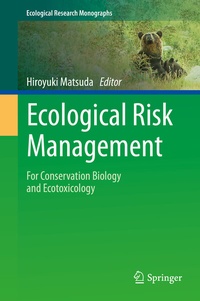
Ecological Risk Management
Description

This book introduces the theory and practice of ecological risk management. Using recent and live case studies in Japan, the book explains the use of basic mathematical techniques in extinction risk, adaptive population management, avian collision risk in wind farms, potential biological removal for marine mammals, and ecological risk assessment of heavy metals. The focus of this book is on case studies of nature conservation in Japan, including internationally renowned topics of Japanese fisheries, Shiretoko World Heritage, Fukushima Daiichi Nuclear Power Plant accident. It also covers the adaptive risk management of the new coronavirus disease.
The book comprises four parts covering ecotoxicology, fisheries, wildlife management and conservation, and ecosystem-based management. It differs from other books in having its primary interest in human impacts on animals, plant, and ecosystems, while existing works in this area concentrate on the fate of toxic substances in the environments and their effects on humans. This book is unique in that it indicates various environmental issues that the theoretical ecology is potentially applicable without concentrating into any particular subject such as ecotoxicology or conservation biology.
Primary readers are undergraduate/graduate students, staffs of environmental consultant companies and environmental NPOs, and journalists. Readers will find this book useful for its abundant information on case studies of ecological risk management and consensus building in Japan.
More details
Other editions
Additional editions
Person
Content
Chapter 1. Introduction: What is risk science?.- Chapter 2. How to determine the relief target for Minamata disease.- Chapter 3. Risk of radioactive contamination caused by the Accident of Fukushima Daiichi Nuclear Power Plant.- Chapter 4. How to assess ecological risks of trace metals in environment.- Chapter 5. Impact of reactive nitrogen and nitrogen footprint.- Chapter 6. Adaptive risk management of new coronavirus disease.- Chapter 7. How to convince purse seiners for sustainable fishery.- Chapter 8. Why is the tuna critically endangered and still sold in the market?- Chapter 9. Red List of Japanese vascular plants and Environmental Impact Assessment.- Chapter 10. Adaptive risk management of sika deer.- Chapter 11. Risk of avian collisions in wind turbines.- Chapter 12. Resource economics of exotic mongoose control.- Chapter 13. Beyond dichotomy in the protection and management of marine mammals.- Chapter 14. Management of human-bear conflict.- 15. Effects of dams on ecologicalrisk of inland fishes.- Chapter 16. Marine co-management plan of Shiretoko World Heritage.- Chapter 17. Marine co-management plan of Shiretoko World Heritage.- Chapter 18. Multi-species fisheries management.
