
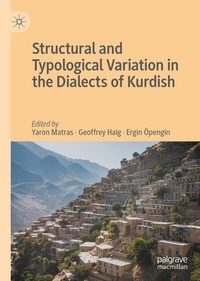
Structural and Typological Variation in the Dialects of Kurdish
Description
Alles über E-Books | Antworten auf Fragen rund um E-Books, Kopierschutz und Dateiformate finden Sie in unserem Info- & Hilfebereich.
More details
Other editions
Additional editions
Persons
Yaron Matras
is former Professor of Linguistics at the University of Manchester, UK. He led the research project on Structural and Typological Variation in the Dialects of Kurdish (2014-2017) and the creation of the Manchester Database of Kurdish Dialects. His research interests include contact linguistics and urban multilingualism, and the linguistics of Romani and of languages of the Middle East.
Geoffrey L. J. Haig is Professor of General Linguistics at the University of Bamberg, Germany. He has published extensively on Kurdish and neighbouring languages, focussing on diachrony and areal linguistics, and is the co-founder of Multi-CAST, an online accessible resource for corpus-based typology.
Ergin Opengin is a Lecturer at the University of Kurdistan-Hewle^r, Iraq. His research focuses on the structural and sociolinguistic aspects of Kurdish. He is the author of The Mukri Variety of Central Kurdish (Reichert Verlag, 2016), and co-editor of Current Issues in Kurdish Linguistics (Bamberg University Press, 2019).Content

System requirements
File format: PDF
Copy protection: Watermark-DRM (Digital Rights Management)
System requirements:
- Computer (Windows; MacOS X; Linux): Use the free software Adobe Reader, Adobe Digital Editions, or any other PDF viewer of your choice (see eBook Help).
- Tablet/Smartphone (Android; iOS): Install the free app Adobe Digital Editions or another reading app for eBooks, e.g., PocketBook (see eBook Help).
- E-reader: Bookeen, Kobo, Pocketbook, Sony, Tolino and many more (only limited: Kindle).
The file format PDF always displays a book page identically on any hardware. This makes PDF suitable for complex layouts such as those used in textbooks and reference books (images, tables, columns, footnotes). Unfortunately, on the small screens of e-readers or smartphones, PDFs are rather annoying, requiring too much scrolling.
This eBook uses Watermark-DRM, a „soft” copy protection. This means that there are no technical restrictions to prevent illegal distribution. However, there is a personalised watermark embedded in the eBook that can be used to identify the purchaser of the eBook in the event of misuse and to provide evidence for legal purposes.
For more information, see our eBook Help page.