

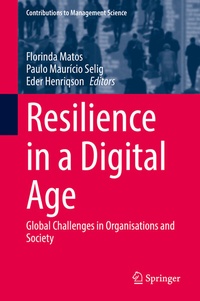
Resilience in a Digital Age
Description

In recent years, decision-makers from all sectors have been using 'resilience' as a keyword for managing societal turbulences. But what is resilience? How can we benefit from integrating digital transformation and resilience?
In this book, some of the world's leading experts on resilience explore the issue and discuss possible answers to these questions. The editors of this book believe that resilience is the master key for the future. However, they also remind us that people are at the base of any process of resilience and, only by placing people at the center of transformation, can we aspire to have resilient organizations and a resilient society.
More details
Other editions
Additional editions
Persons
Florinda Matos is the founder and president of ICAA - Intellectual Capital Association and an associate member of the New Club of Paris. She holds a PhD in social sciences and organizational behaviour studies from University of Lisbon, Portugal. She is a Professor of Management at Iscte - University Institute of Lisbon and a researcher at DINÂMIA'CET-IUL - Centre for Socioeconomic and Territorial Studies. She was also a postdoctoral researcher with a focus on the social impacts of additive manufacturing at NOVA University of Lisbon.
Paulo Maurício Selig was president of the Brazilian Production Engineering Association, and a professor, co-founder and first coordinator of the graduate programme in knowledge engineering and management at the Federal University of Santa Catarina (UFSC, Brazil). He is an intellectual capital researcher and consultant, and permanent chairman of the International Conference on Knowledge and Innovation (ciKi). Currently, he is active in the research project dealing with the effects of human factors and resilience engineering on integrated operations
Éder Henriqson is a professor of human factors and system safety in the School of Business, Pontifícia Universidade Católica do Rio Grande do Sul (PUCRS), Brazil. He has a PhD in production engineering and his research areas include complex sociotechnical systems, human factors, system safety, safety culture, cognitive systems engineering and decision making, and resilience engineering
