

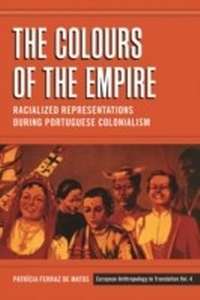
The Colours of the Empire
Racialized Representations during Portuguese Colonialism
1st Edition
Published on 1. February 2013
308 pages
978-0-85745-763-9 (ISBN)
Description

The Portuguese Colonial Empire established its base in Africa in the fifteenth century and would not be dissolved until 1975. This book investigates how the different populations under Portuguese rule were represented within the context of the Colonial Empire by examining the relationship between these representations and the meanings attached to the notion of 'race'. Colour, for example, an apparently objective criterion of classification, became a synonym or near-synonym for 'race', a more abstract notion for which attempts were made to establish scientific credibility. Through her analysis of government documents, colonial propaganda materials and interviews, the author employs an anthropological perspective to examine how the existence of racist theories, originating in the eighteenth and nineteenth centuries, went on to inform the policy of the Estado Novo (Second Republic, 1933-1974) and the production of academic literature on 'race' in Portugal. This study provides insight into the relationship between the racist formulations disseminated in Portugal and the racist theories produced from the eighteenth century onward in Europe and beyond.
Reviews / Votes
"The translation of this work from Portuguese to English is an important contribution to the study of national traditions in anthropology, frequently overlooked by scholarly research that tends to focus more on the English, American, and French cases." ? Journal of Royal Anthropological Institute"...makes a contribution to the growing weight and relevance of the Portuguese archive to colonial and imperial studies. It covers particularly the 1930s and 1940s as apogee decades of dictator Antonio de Oliveira Salazar's fascist type regime, the longest of its kind in Europe (1926-1974)." ? American Anthropologist
"...a unique volume that traces discourse and representation on 'race' and racism within Portugal and the 'overseas territories'. An exemplar of the new vigour with which the Portuguese academy has developed over the last decade... this is an important book on the history of the concept of 'race' in Portugal and the uses made of it with respect to concepts of the nation and for the political and economic rationales of the Salazar state." ? Journal of Iberian and Latin American Studies
"(...) a most worthy volume, that Portuguese and non-Portuguese scholars alike with an interest in issues of race and representation will appreciate." ? Journal of Tourism and Cultural Change
"[This book] offers an impressive inventory of colonial movies, exhibitions, speeches and writings that will be of great use. Readers interested in the history of colonial ideas and the role of anthropological knowledge in the colonial enterprise will find in this work a complete, well-documented case." ? Social Anthropology/Anthropologie sociale
More details
Series
Language
English
Place of publication
Oxford
United Kingdom
Target group
College/higher education
Illustrations
Bibliography; Index; 26 Illustrations; 26 Tables, unspecified
File size
2,53 MB
ISBN-13
978-0-85745-763-9 (9780857457639)
DOI
10.3167/9780857457622
Copyright in bibliographic data and cover images is held by Nielsen Book Services Limited or by the publishers or by their respective licensors: all rights reserved.
Schweitzer Classification
Other editions
Additional editions
Patricia Ferraz de Matos
The Colours of the Empire
Racialized Representations during Portuguese Colonialism
Book
02/2013
1st Edition
Berghahn Books
€148.40
Shipment within 15-20 days
Person
Patricia Ferraz de Matos is an anthropologist whose work focuses on the history of Portuguese anthropology and Portuguese colonialism. She received the Victor de Sa Prize of Contemporary History 2005 from the Cultural Council of the University of Minho, Portugal, when this work was first published in Portuguese. Her doctoral thesis was devoted to analyzing the work of the Portuguese anthropologist Mendes Correia and the production of the Anthropology School of Porto. At present she is a post doctoral researcher in the Institute of Social Sciences at the University of Lisbon where she works on the international networks underlying the forging of scientific knowledge.
Content
Tables and illustrations
Acknowledgements
Acronyms and abbreviations
Introduction
Chapter 1. Origins of a prejudice:the roots of racial discrimination
The discovery of human variety:early formulations
The emergence of 'modern' racism
Racialism under attack
Chapter 2. Discourse, images, knowledge:the place of the colonies and their populations in the Portuguese Colonial Empire
The formation of Portuguese colonialism and 'colonial knowledge'
The Colonial Act and the 'creation' of the Indigena
Colonial propaganda:'marketing the empire'
Colonial representations in primary and secondary school readers
Cinema and colonialism in action:moving pictures on colonial themes (1928-53)
Recurrent images and prejudices
The production of 'anthropological knowledge' of the colonies
Racial purity, miscegenation and the appropriation of myths
Chapter 3. Exhibiting the empire, imagining the nation:representations of the colonies and the overseas Portuguese in the great exhibitions
The age of the great exhibitions
Representations of the Portuguese colonies, 1924-31
A 'Guinean village' at the Lisbon Industrial Exhibition (1932)
The Portuguese Colonial Exhibition of 1934:concept and objectives
Representations of the Portuguese colonies, 1934-39
The Exhibition of the Portuguese World (1940):concept and objectives
Colonial representations in Portugal dos Pequenitos
The status of the colonized populations at the exhibitions: the exotic vs. the familiar
Conclusions
Appendix I: Film
Appendix II: Texts from the padroes of Portugal dos Pequenitos
Bibliography
Acknowledgements
Acronyms and abbreviations
Introduction
Chapter 1. Origins of a prejudice:the roots of racial discrimination
The discovery of human variety:early formulations
The emergence of 'modern' racism
Racialism under attack
Chapter 2. Discourse, images, knowledge:the place of the colonies and their populations in the Portuguese Colonial Empire
The formation of Portuguese colonialism and 'colonial knowledge'
The Colonial Act and the 'creation' of the Indigena
Colonial propaganda:'marketing the empire'
Colonial representations in primary and secondary school readers
Cinema and colonialism in action:moving pictures on colonial themes (1928-53)
Recurrent images and prejudices
The production of 'anthropological knowledge' of the colonies
Racial purity, miscegenation and the appropriation of myths
Chapter 3. Exhibiting the empire, imagining the nation:representations of the colonies and the overseas Portuguese in the great exhibitions
The age of the great exhibitions
Representations of the Portuguese colonies, 1924-31
A 'Guinean village' at the Lisbon Industrial Exhibition (1932)
The Portuguese Colonial Exhibition of 1934:concept and objectives
Representations of the Portuguese colonies, 1934-39
The Exhibition of the Portuguese World (1940):concept and objectives
Colonial representations in Portugal dos Pequenitos
The status of the colonized populations at the exhibitions: the exotic vs. the familiar
Conclusions
Appendix I: Film
Appendix II: Texts from the padroes of Portugal dos Pequenitos
Bibliography
