

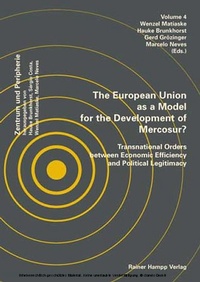
The European Union as a Model for the Development of Mercosur?
1st Edition
Published on 1. January 2007
205 pages
978-3-86618-112-0 (ISBN)
Description

It is rarely questioned that the European Union can be considered a model for other world regions. Comparable initiatives elsewhere are much less integrated, and up until now less successful, even if like Mercosur they are based on the European model. Although elements of the democratic rule of law in the EU are more developed than in all comparable projects and organisations, the model character of the EU is highly questionable in terms of democratic theory, and we should ask what scholars concerned with the European Union can learn from similar experiments in other world regions. Perhaps experience from the Merco-sur countries with deliberative citizen democracy at the local level, the double perspective of the still ongoing transition from a 'nominalistic' to a 'normative' constitutional regime within nation states, and the simultaneous continental net-working of law, economics, and policy could also be instructive for the current EU with its new problems in the realm of democracy and rights. Transcontinen-tal social capital can only build-up if the learning processes are opened in both directions. The individual contributions to this volume move between the poles 'effectiveness' and 'democracy'. It is the result of an international workshop or-ganized by scholars from Flensburg University and from the Fundação Getúlio Vargas in Sao Paulo.
More details
Other editions
Additional editions
Wenzel Matiaske | Hauke Brunkhorst | Gerd Grözinger
The European Union as a Model for the Development of Mercosur?
Transnational Orders between Economic Efficiency and Political Legitimacy
Book
01/2007
Edition Rainer Hampp
€22.80
Article exhausted; check different version
Content
1 - Contents [Seite 6]
2 - Introduction [Seite 8]
3 - Political Development and Comparative Issues with EU [Seite 14]
3.1 - 1. Origins [Seite 14]
3.2 - 2. The Nature of Political Institutions [Seite 17]
3.2.1 - 2.1 The Social Market Economy: An Economical Christian Project [Seite 31]
3.2.2 - 2.2 The Economic Constitution: "Authoritarian Liberalism" Revisited? [Seite 32]
3.2.3 - 2.3 Ordo-liberalism in the European Community: the Decoupling of Economic Integration from the Welfare State and its Social Policy [Seite 34]
3.3 - 3. Two Meanings of Deepening and Widening [Seite 20]
3.3.1 - 3.1 "Invasions of the Market"? [Seite 37]
3.3.2 - 3.2 Erosions of the Market? [Seite 40]
3.3.3 - 3.3 Rules versus Politics? Monetary Union, the Maastricht Judgment and the Stability Pact [Seite 40]
3.4 - 4. Are we About to Bring the Law to Trial? Some Queries with the Open Method of Co-ordination [Seite 45]
3.4.1 - 4.1 The Career of the Concept [Seite 45]
3.4.2 - 4.2 Output Legitimacy? [Seite 48]
3.4.3 - 4.3 Normative Queries [Seite 49]
3.5 - 5. A Resumé [Seite 54]
3.5.1 - 5.1 The Constitutional Treaty [Seite 54]
3.5.2 - 5.2 Constitutionalization as Process [Seite 56]
4 - European Democratic Legitimation after the Failure of the Constitution [Seite 58]
4.1 - Introduction [Seite 58]
4.2 - 1. Functional constitutionalism [Seite 61]
4.3 - 2. Rule of law constitutionalism [Seite 62]
4.4 - 3. Democratic Constitutionalism [Seite 65]
4.4.1 - 3.1 Terms related to "civil society" and usage in official documents [Seite 88]
4.4.2 - 3.2 Empirical application of the terms: limits and critical points [Seite 90]
4.4.3 - 3.3 Synthesis and observations [Seite 95]
4.5 - 4. Forms of participation in the Mercosur decision-making process [Seite 96]
4.5.1 - 4.1 Information as a condition for participation [Seite 97]
4.5.2 - 4.2 Consultation as a proposal for dialogue [Seite 100]
4.5.3 - 4.3 Cooperation: a deepening interaction [Seite 104]
4.5.4 - 4.4 Synthesis and observations [Seite 104]
4.6 - Books and articles [Seite 107]
4.7 - Official Mercosur Documents [Seite 109]
4.8 - Internet Websites [Seite 110]
4.9 - Appendix [Seite 111]
5 - "People's" Position in Regional Integration: an Alternative to the Theory of Consensus [Seite 68]
5.1 - 1. Generalization of the inclusion principle in the economic system and its effect on politics and law [Seite 68]
5.2 - 2. Law and politics as means of regional integration [Seite 71]
5.3 - 3. Crises of legitimacy and attachment to values: the notion of a " European people" as a solution? [Seite 73]
5.4 - 4. From bi-dimensionality to tri-dimensionality of power: overcoming the " people" value with the self- referentiality of the political system [Seite 74]
5.5 - 5. People as an environment of the political system [Seite 77]
5.6 - 6. The European Constitution as a reconstruction of legal and political autonomy in the supranational sphere [Seite 78]
5.7 - Bibliography [Seite 80]
6 - Civil Society Participation in Mercosur: Some Critical Points [Seite 82]
6.1 - Abstract [Seite 82]
6.2 - 1. Introduction [Seite 82]
6.3 - 2. Participation and representation mechanisms in Mercosur [Seite 84]
6.4 - 3. The concept of "civil society" in Mercosur and concerned interests [Seite 88]
6.5 - 4. Forms of participation in the Mercosur decision-making process [Seite 96]
6.6 - 5. Final notes [Seite 106]
6.7 - Bibliography and other references [Seite 107]
7 - The European Union's Social Capital [Seite 118]
7.1 - 1. Introduction [Seite 118]
7.2 - 2. Theoretical and Political Aspects of Social Capital [Seite 119]
7.2.1 - 2.1 The EU Policy Framework [Seite 120]
7.3 - 3. Generalised Reciprocity [Seite 121]
7.3.1 - 3.1 Social Trust [Seite 121]
7.3.2 - 3.2 Commitment [Seite 123]
7.4 - 4. Social Connectedness [Seite 124]
7.4.1 - 4.1 Formal Memberships [Seite 125]
7.4.2 - 4.2 Informal Social Networks [Seite 127]
7.5 - 5. Summary [Seite 128]
7.6 - Literature [Seite 129]
8 - From the 'Nomos der Erde' to a Unified European Defense System [Seite 176]
8.1 - 1. Partition of the World [Seite 177]
8.2 - 2. Jus Publicum Europeum [Seite 177]
8.3 - 3. Occupation of the New World [Seite 178]
8.3.1 - 3.1 Two different approaches [Seite 178]
8.3.2 - 3.2 The Right to Occupy? [Seite 179]
8.3.3 - 3.3 Thinking in global lines [Seite 179]
8.4 - 4. A spatial regime centered on Europe [Seite 179]
8.4.1 - 4.1 Balance between Land and Ocean [Seite 180]
8.4.2 - 4.2 Revolution and Restoration [Seite 181]
8.4.3 - 4.3 End of the European era [Seite 182]
8.5 - 5. The American Century [Seite 183]
8.6 - 6. The European Integration [Seite 184]
8.6.1 - 6.1 Economic Community [Seite 185]
8.6.2 - 6.2 Monetary Union [Seite 186]
8.6.3 - 6.3 Defence Community [Seite 186]
8.7 - 7. Europe and the USA: Strategic Partnership or Open Rivalry? [Seite 187]
8.8 - Bibliography [Seite 189]
9 - The Future of Latin America: Can the EU Help? [Seite 190]
9.1 - 1. The Ever Changing World Order [Seite 190]
9.2 - 2. "Democracy" vs. "Sovereignty" [Seite 196]
9.3 - 3. A Time for Nation Building? [Seite 197]
9.4 - 4. What, a New Imperialism? [Seite 198]
9.5 - 5. The Resistance to Assume Further Responsibilities [Seite 199]
9.6 - 6. Am I Idealizing the EU? [Seite 201]
9.7 - 7. Exports and Subsidies [Seite 204]
9.8 - 8. The Merits of EU Participation in Regional and World Public Governance [Seite 205]
10 - Authors [Seite 206]
2 - Introduction [Seite 8]
3 - Political Development and Comparative Issues with EU [Seite 14]
3.1 - 1. Origins [Seite 14]
3.2 - 2. The Nature of Political Institutions [Seite 17]
3.2.1 - 2.1 The Social Market Economy: An Economical Christian Project [Seite 31]
3.2.2 - 2.2 The Economic Constitution: "Authoritarian Liberalism" Revisited? [Seite 32]
3.2.3 - 2.3 Ordo-liberalism in the European Community: the Decoupling of Economic Integration from the Welfare State and its Social Policy [Seite 34]
3.3 - 3. Two Meanings of Deepening and Widening [Seite 20]
3.3.1 - 3.1 "Invasions of the Market"? [Seite 37]
3.3.2 - 3.2 Erosions of the Market? [Seite 40]
3.3.3 - 3.3 Rules versus Politics? Monetary Union, the Maastricht Judgment and the Stability Pact [Seite 40]
3.4 - 4. Are we About to Bring the Law to Trial? Some Queries with the Open Method of Co-ordination [Seite 45]
3.4.1 - 4.1 The Career of the Concept [Seite 45]
3.4.2 - 4.2 Output Legitimacy? [Seite 48]
3.4.3 - 4.3 Normative Queries [Seite 49]
3.5 - 5. A Resumé [Seite 54]
3.5.1 - 5.1 The Constitutional Treaty [Seite 54]
3.5.2 - 5.2 Constitutionalization as Process [Seite 56]
4 - European Democratic Legitimation after the Failure of the Constitution [Seite 58]
4.1 - Introduction [Seite 58]
4.2 - 1. Functional constitutionalism [Seite 61]
4.3 - 2. Rule of law constitutionalism [Seite 62]
4.4 - 3. Democratic Constitutionalism [Seite 65]
4.4.1 - 3.1 Terms related to "civil society" and usage in official documents [Seite 88]
4.4.2 - 3.2 Empirical application of the terms: limits and critical points [Seite 90]
4.4.3 - 3.3 Synthesis and observations [Seite 95]
4.5 - 4. Forms of participation in the Mercosur decision-making process [Seite 96]
4.5.1 - 4.1 Information as a condition for participation [Seite 97]
4.5.2 - 4.2 Consultation as a proposal for dialogue [Seite 100]
4.5.3 - 4.3 Cooperation: a deepening interaction [Seite 104]
4.5.4 - 4.4 Synthesis and observations [Seite 104]
4.6 - Books and articles [Seite 107]
4.7 - Official Mercosur Documents [Seite 109]
4.8 - Internet Websites [Seite 110]
4.9 - Appendix [Seite 111]
5 - "People's" Position in Regional Integration: an Alternative to the Theory of Consensus [Seite 68]
5.1 - 1. Generalization of the inclusion principle in the economic system and its effect on politics and law [Seite 68]
5.2 - 2. Law and politics as means of regional integration [Seite 71]
5.3 - 3. Crises of legitimacy and attachment to values: the notion of a " European people" as a solution? [Seite 73]
5.4 - 4. From bi-dimensionality to tri-dimensionality of power: overcoming the " people" value with the self- referentiality of the political system [Seite 74]
5.5 - 5. People as an environment of the political system [Seite 77]
5.6 - 6. The European Constitution as a reconstruction of legal and political autonomy in the supranational sphere [Seite 78]
5.7 - Bibliography [Seite 80]
6 - Civil Society Participation in Mercosur: Some Critical Points [Seite 82]
6.1 - Abstract [Seite 82]
6.2 - 1. Introduction [Seite 82]
6.3 - 2. Participation and representation mechanisms in Mercosur [Seite 84]
6.4 - 3. The concept of "civil society" in Mercosur and concerned interests [Seite 88]
6.5 - 4. Forms of participation in the Mercosur decision-making process [Seite 96]
6.6 - 5. Final notes [Seite 106]
6.7 - Bibliography and other references [Seite 107]
7 - The European Union's Social Capital [Seite 118]
7.1 - 1. Introduction [Seite 118]
7.2 - 2. Theoretical and Political Aspects of Social Capital [Seite 119]
7.2.1 - 2.1 The EU Policy Framework [Seite 120]
7.3 - 3. Generalised Reciprocity [Seite 121]
7.3.1 - 3.1 Social Trust [Seite 121]
7.3.2 - 3.2 Commitment [Seite 123]
7.4 - 4. Social Connectedness [Seite 124]
7.4.1 - 4.1 Formal Memberships [Seite 125]
7.4.2 - 4.2 Informal Social Networks [Seite 127]
7.5 - 5. Summary [Seite 128]
7.6 - Literature [Seite 129]
8 - From the 'Nomos der Erde' to a Unified European Defense System [Seite 176]
8.1 - 1. Partition of the World [Seite 177]
8.2 - 2. Jus Publicum Europeum [Seite 177]
8.3 - 3. Occupation of the New World [Seite 178]
8.3.1 - 3.1 Two different approaches [Seite 178]
8.3.2 - 3.2 The Right to Occupy? [Seite 179]
8.3.3 - 3.3 Thinking in global lines [Seite 179]
8.4 - 4. A spatial regime centered on Europe [Seite 179]
8.4.1 - 4.1 Balance between Land and Ocean [Seite 180]
8.4.2 - 4.2 Revolution and Restoration [Seite 181]
8.4.3 - 4.3 End of the European era [Seite 182]
8.5 - 5. The American Century [Seite 183]
8.6 - 6. The European Integration [Seite 184]
8.6.1 - 6.1 Economic Community [Seite 185]
8.6.2 - 6.2 Monetary Union [Seite 186]
8.6.3 - 6.3 Defence Community [Seite 186]
8.7 - 7. Europe and the USA: Strategic Partnership or Open Rivalry? [Seite 187]
8.8 - Bibliography [Seite 189]
9 - The Future of Latin America: Can the EU Help? [Seite 190]
9.1 - 1. The Ever Changing World Order [Seite 190]
9.2 - 2. "Democracy" vs. "Sovereignty" [Seite 196]
9.3 - 3. A Time for Nation Building? [Seite 197]
9.4 - 4. What, a New Imperialism? [Seite 198]
9.5 - 5. The Resistance to Assume Further Responsibilities [Seite 199]
9.6 - 6. Am I Idealizing the EU? [Seite 201]
9.7 - 7. Exports and Subsidies [Seite 204]
9.8 - 8. The Merits of EU Participation in Regional and World Public Governance [Seite 205]
10 - Authors [Seite 206]
Civil Society Participation in Mercosur: Some Critical Points (S. 77-78)
Michelle Ratton Sanchez
Abstract
The Mercosur Council Working Program 2004-2006 (MERCOSUR/CMC/DEC no 26/03) employs the term "civil society" with the purpose of increasing its participation in the institutional structure of Mercosur. As such an expression has never been applied in any formal document of that regional integration process, in this article firstly I intend to investigate the concepts related to "civil society" in Mercosur, identifying the groups of actors that have participated during recent years. The analysis also comprehends an evaluation of the Mercosur institutional channels for "civil society" participation, which might be revised according to Ouro Preto 2nd Round Decisions.
1. Introduction
Due to the increasing complexity of economic relations in regional integration processes, with more interaction between the productive chains and a greater scope and technicality in the regulation of social and economic life, new forms of representation and participation are required on the different levels of political decision. Currently Mercosur is undergoing a process of questioning its economic and political viability. Among the factors that have been identified are its weak institutionalization and the poor social cohesion of the bloc.
In this article I intend to analyze the relation between these two factors. Decision No. 09/95 of the Common Market Council (CMC) - the Mercosur 1995-2000 Action Program -foresaw in paragraph 3.2 that: The strengthening of the integration process requires a more intensive participation on the part of society. To this end, the Joint Parliamentary Commission (JPC) and the Economic and Social Advisory Forum (ESAF) shall ensure the due participation of the sectors involved. After the Mercosur Relaunching Project in 2000 and its Institutional Strengthening Project in 2001, the 2004-2006 Mercosur Work Program was finally launched in 2003.1 This work program defines lines of action for affirming and expanding the integration project, articulating for the first time the idea of participation on the part of "civil society" (paragraph 2.1 of the 2004- 2006 Mercosur Work Program).
Two points are worth noting in the mentioned documents: one is the fact that in the 1995-2000 Action Program reference is made to mechanisms for both representation (JPC) and direct participation (ESAF), the other point is the employment, beginning with the 2004-2006 Mercosur Work Program, of the term "civil society." Attention is called to the use of the expression "civil society" in an official Mercosur document considering that a detailed search for its content:
(i) defines the group of interests involved (and represented), and (ii) establishes lines to identify its interlocutors. I understand that this exercise is essential when applying the concept of "civil society" in international or regional fora. In spite of there being a terminological coincidence with respect to the theory of the modern State, the political structure on which the new usage is based is distinct. Moreover, the term has been applied with specific content in each international forum. Considering the proposal for revising the institutional structure of Mercosur - known as "Ouro Preto II" and which defines the participation of "civil society" as one of its central elements -, it has yet to be confirmed if the institutional reform indeed favors the participation of "civil society."
Michelle Ratton Sanchez
Abstract
The Mercosur Council Working Program 2004-2006 (MERCOSUR/CMC/DEC no 26/03) employs the term "civil society" with the purpose of increasing its participation in the institutional structure of Mercosur. As such an expression has never been applied in any formal document of that regional integration process, in this article firstly I intend to investigate the concepts related to "civil society" in Mercosur, identifying the groups of actors that have participated during recent years. The analysis also comprehends an evaluation of the Mercosur institutional channels for "civil society" participation, which might be revised according to Ouro Preto 2nd Round Decisions.
1. Introduction
Due to the increasing complexity of economic relations in regional integration processes, with more interaction between the productive chains and a greater scope and technicality in the regulation of social and economic life, new forms of representation and participation are required on the different levels of political decision. Currently Mercosur is undergoing a process of questioning its economic and political viability. Among the factors that have been identified are its weak institutionalization and the poor social cohesion of the bloc.
In this article I intend to analyze the relation between these two factors. Decision No. 09/95 of the Common Market Council (CMC) - the Mercosur 1995-2000 Action Program -foresaw in paragraph 3.2 that: The strengthening of the integration process requires a more intensive participation on the part of society. To this end, the Joint Parliamentary Commission (JPC) and the Economic and Social Advisory Forum (ESAF) shall ensure the due participation of the sectors involved. After the Mercosur Relaunching Project in 2000 and its Institutional Strengthening Project in 2001, the 2004-2006 Mercosur Work Program was finally launched in 2003.1 This work program defines lines of action for affirming and expanding the integration project, articulating for the first time the idea of participation on the part of "civil society" (paragraph 2.1 of the 2004- 2006 Mercosur Work Program).
Two points are worth noting in the mentioned documents: one is the fact that in the 1995-2000 Action Program reference is made to mechanisms for both representation (JPC) and direct participation (ESAF), the other point is the employment, beginning with the 2004-2006 Mercosur Work Program, of the term "civil society." Attention is called to the use of the expression "civil society" in an official Mercosur document considering that a detailed search for its content:
(i) defines the group of interests involved (and represented), and (ii) establishes lines to identify its interlocutors. I understand that this exercise is essential when applying the concept of "civil society" in international or regional fora. In spite of there being a terminological coincidence with respect to the theory of the modern State, the political structure on which the new usage is based is distinct. Moreover, the term has been applied with specific content in each international forum. Considering the proposal for revising the institutional structure of Mercosur - known as "Ouro Preto II" and which defines the participation of "civil society" as one of its central elements -, it has yet to be confirmed if the institutional reform indeed favors the participation of "civil society."
