

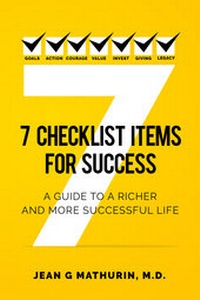
7 Checklist Items for Success
Description

KIRKUS REVIEW
A U.S. Navy physician shares his secrets for a more successful life in this self-help work.
Mathurin conceived of his debut book when he realized how critical checklists are in the worlds of naval aviation and medicine. Itemized lists, he says, help avoid flight mishaps and operating room errors, so he wondered, "Why not apply this same concept to people's lives to help them achieve their highest potential?" That epiphany resulted in this book-a kind of instruction manual for living that breaks achievement into seven "checklist items": "Goals," "Take Action," "Courage to Consistently Commit," "Value Resources," "Investing in Yourself and Others," "Giving Back," and "Create a Legacy of Service to Others." An introductory section helpfully explains each of the core concepts, in brief, and these same blocks of text are repeated at the beginning of each of seven chapters. The items themselves are unlikely to be new to most readers, as many of the ideas are common in self-help literature (such as "Have the courage to go the extra mile with everything that you do, each and every time"). But the presentation of the material feels more novel, as the overarching checklist concept isn't taken literally; the book's merit derives from the idea that one can systematically address several broad areas in the quest for a fuller life. At the very least, this notion gives the book a highly focused structure that makes it easy for readers to navigate.
Unsurprisingly, given the author's military and medical background, there's a sense of logic and precision to this book. Each chapter's content is uniformly positive and always emphasizes proactivity, but it's also clear that the book isn't intended to highlight step-by-step procedure. Instead, it offers a wide-ranging, general discussion of each list item, using examples and personal anecdotes to illustrate specific points. To that end, Mathurin writes from a very personal perspective-sharing, for example, how he grew up in poverty in Haiti-and he explains with some eloquence how he used the principles that he lays out in his book to "transform [his] life from famine to abundance." He writes with a great deal of insight, as well, offering not only accounts of his own experiences, but also the wisdom of others, such as investor Warren Buffett and the late self-help authors Zig Ziglar and Napoleon Hill. Mathurin's style often takes an inspirational tone, as he exudes a sense of confidence in his approach to life: "Success," writes Mathurin, "is only ten percent intention and ninety percent action." About leading others, he writes, "always strive to be the leader you would want to follow; strive to be the calm voice in the midst of the chaos, and-while you are at it-strive to be the change that you want to see." Finally, Mathurin stresses that you can "lay the path to your legacy by focusing on giving back the acts of kindness you have received along the way."
A book of noble, sincere, and expressive advice for living.
All prices
More details
Other editions
Additional editions
Content
PREFACE
Thank you for picking up this book. What you will undoubtedly notice is that the 7 Checklist Items for Success is not a book for everyone. It is not a book for the timid or for those who consider themselves passengers enjoying the ride of life, with no significant purpose and no desire to leave this world a little better than they found it. This book was written for those of you who know and believe at your core that you were created for something bigger than your current situation or circumstance in life. This book is for those who ask why, and want to find a way to make something happen. You crave a way to realize your full potential. The why of your existence is your core belief about why you are here on this earth. If you believe you are such a person, then this book is for you. As you read, you'll soon find this book will show you the how of these whys.
I wrote this book because I wish I had found such a book when I was fifteen. It took years for me to establish a cogent list that can help anyone, from any walk of life, and achieve greater success in life.
You might be in a rough spot, wondering how you can possibly make it out. You might also be wondering: "How can this book help me succeed?" "Will this be a waste of my time?" "Is this book even worth the money I paid for it?" While my intention is not to answer these questions for you, I do believe you will find this book extremely valuable by the time you finish reading it.
Let me begin by sharing something that got my attention during my first year of residency in aerospace medicine in the United States Navy. I was introduced multiple times to a graph that many in the aviation industry are quite familiar with: The graph shows the decrease of the Naval Aviation Mishap Rate from the 1950s to present. During their first year of training, many aerospace residents would often mutter under their breath that they hoped the professors would stop showing the graph because they believed the point had been made.
They thought they got it. Naval Aviation Mishap Rate has decreased a whole lot. Yet what this graph showed me went beyond how mishaps (aircraft accidents leading to fatalities) have decreased over time in the Navy. I intuitively understood that we were shown this graph again and again so that we understood that the decrease owes to the culture of safety in Naval Aviation.
While I was taking my introductory courses in Aviation, I was also introduced to something that I believed may have made the biggest contribution in reducing aircraft mishaps: a checklist in aviation. Going through the checklist items is a crucial aspect of what the pilot does from preflight to turning off the aircraft engine. This concept has been so successful in Aviation that it has also been used in the operating room.
The big question I asked myself was: If this checklist has proven to be so valuable in Aviation and now the surgical operating room, why not apply this same concept to people's lives to help them achieve their highest potential?
As a kid who grew up in poverty in Haiti, nothing would have been more beneficial to me than to pick up a textbook with some pointers that-if followed carefully, step-by-step-could bring me any success I could desire. When I started to research and ask around if such a checklist existed, one that when and if applied helped anyone to be successful in life, the answer was no. I set out to create one, so started reading all of the textbooks I could find on the subject of personal achievement. I also started to talk with some of the smartest people I know in different fields of study involving the mind (psychiatry, psychology) and those who have achieved the highest success in their various fields. Most of them told me that it would be hard to write a single book that would appeal to everyone. Many others have simply said that such an endeavor would be impossible because, even though most people do want to be successful, everyone responds to different stimuli at a different time of their life. The likelihood that anyone would follow through with a checklist on a daily basis for many years seemed low. Thus I was told that such a project would not be successful. These statements of impossibility resonated with me because, since I was a child, I had heard these words spoken to me many, many times.
In second grade, for example, my teacher told me that I was from a dumb family and that I would not amount to anything. Later, when I told some friends I wanted to become a physician, they said it was not possible. I was fortunate that my family believed in me, and with their support I have overcome many challenges. Perhaps it is because my desire for a more successful life was rooted so deeply that mere words of discouragement were not enough to derail me. Maybe my childhood challenges have made me more resilient, or maybe my desire for success goes beyond satisfying just my curiosity. Maybe I'm just stubborn. After my second-grade teacher told me that I was from a dumb family and would not amount to anything, I made up my mind right then and there that I would be a physician-just to prove her wrong.
While I was a dishwasher working at a casino, two months after I migrated to the United States from Haiti, one of my co-workers-after I told him that my goal was to become a physician-insisted that it was impossible for someone like me (with limited English and no money) to study medicine. He said it was impossible given my circumstances. During the eighteen months I worked at that casino, my co-worker never failed to make fun of my dream of becoming a physician. His favorite joke was that Jesus would come before I ever became a doctor. His pessimism further invigorated my desire to become a physician, and ten years later, I not only achieved my goal, but I also have the greatest privilege of being a medical officer in the United States Navy.
My blessings have gone beyond even my wildest dreams and all I think of, knowing now that everything is possible, is that I should have dreamed of even more. If someone had told me as a young child that I would be able to reach this level of success in a foreign land called America, I honestly would have thought she was lying.
What you choose to believe in life about yourself can either break you down or build you up. In my case, I chose to believe my family. My challenges in life were also a blessing in disguise. They inspired me to start reading self-help books at the age of 15. During that time, most of my friends were focusing on the latest trends in clothes and how to be popular. My focus was different. I was more focused on how to improve my circumstances and the circumstances of those around me.
Now that my life has improved beyond belief, I hope this book will help improve your life-and those of others around you. I believe all that I have accomplished has only been possible thanks to the physician who saved my mother's life. I believe to this day that he did not only save my mother's life, but also saved the lives of my mother's eight children. Credit for my success in life, and credit for any benefits that you or anyone else might gain from reading and applying the ideas in this book, should go to that unnamed compassionate physician, and this should be proof enough of the circle of goodness and the passion of giving back more than one has received. This is a circle that I choose to believe and participate in, and I hope that you will also join. Please don't forget to write me if this book has helped you, because your experience may help someone else.
As a kid, I used to think that whenever I treated a future patient, I would want to receive a live turkey as my remuneration (more to come about that story later). Luckily for you, I have lowered my standards to just a few lines on the companion website for 7 Checklist Items for Success. Please take advantage and log on once you finish this book; spare yourself the hassle of mailing a live turkey. On a more serious note, while the meaning of success may be different for different people, it is my hope this book will help everyone looking for a guide to follow in their quest to attain their highest, noblest ideals-and a more successful life.
Presented within this book are ideas that helped me transform my life from famine to abundance-and, more importantly, ideas that have helped me to be more successful in every aspect of life. These ideas will also help you transform your life and the lives and those around you. I have read as many books as I could find about self-help in the last 25 years and, despite all the blessings I have received in life, I believe the ideas from these books have played the biggest role in transforming my life from a shy, poor Haitian kid to a board-certified physician and Naval Medical Officer in the United States.
My achievements can be attributed to grit, resilience, and delayed gratification. A tiny part of the credit goes to the motivation I gained from those who ridiculed my dreams, but the majority of my success is from the encouragement I received from those around me who believed in me and constantly prayed for my success and well-being. In case you have not yet been as lucky as I have been, this book is for you. I can say I have, for many years, recognized this desire to help improve people's lives by helping them focus on the opportunities around them instead of focusing on their misfortune.
My aspirations for writing a book stem from my faith in the limitless potential power we have as humans. I truly believe, if given the opportunity, we will choose good...
