

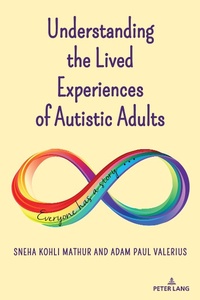
Understanding the Lived Experiences of Autistic Adults
Description

Research related to transition and support needs for autistic adults remains limited. The purpose of this study was to understand the hopes, dreams, aspirations, challenges, and lived experiences of autistic adults. Academic literature has largely emphasized autism as a medical deficit, and use of first-person narratives to understand needs of people on the autism spectrum is rare. To fill this gap, this narrative study was conducted through a social model of disability lens and centered voices of autistic individuals. This research recognized that only someone who is autistic can be considered a true expert on autism; thus, it is imperative researchers consult with and collaborate with autistic individuals to develop the most useful support services possible. By including autistic people in research design, implementation, and support services, academics and therapists can learn from the neurodivergent about problems that the social and cultural worlds present them with, thereby moving toward a more socially just society.
This study included both academic literature and autobiographies written by autistic authors. The coauthor in this study is also an autistic adult who presented his life experiences for a central narrative. In contrast to the Diagnostic and Statistical Manual of Mental Disorders (DSM), which conceptualizes autism as a list of deficits, a number of powerful themes emerged from analysis of autistic authors' lives: Isolation, Influence of Parents, Differences in Needs: Education and Employment, Empowerment, and Relationships. These themes were contextualized via theories of neurodiversity paradigm, monotropism theory, and the double empathy problem, to better understand autistic experiences and needs.
"Mathur and Valerius provide an articulate view into the lived experiences of individuals diagnosed with autism spectrum disorder. As an ABA practitioner and scholar, it made me think deeply about how clinicians may go about the implementation of compassionate ABA services. This book is a timely and significant contribution relevant for anyone with that goal in mind."-Adel C. Najdowski, PhD, BCBA-D, Program Director, MS Applied Behavior Analysis, Pepperdine University, Los Angeles, California
"Adam and Sneha have created a beautiful and very much-needed book. Reading this book brings me hope. While my lived experience is different than that of Adam, I see so many recurring themes in my own life and in the lives of the learners who I support. The combination of narrative and research is engaging and makes a convincing argument for qualitative, lived-experience research. This work is mirrored by current and emerging research on Community-Informed Practice and Neurodiversity Affirming Practice. It is my opinion that this book needs to be included as essential reading for any person, autistic and allistic, who interacts with autistics (which really is everyone). But this book should be included in the required reading for any person who provides support for autistics in any setting."-Brian Middleton, M.Ed., IBA, BCBA, LBA, The "Bearded Behaviorist," Autistic Advocate
"Dr. Mathur and Mr. Valerius have crafted a critical and engaging book that amplifies the voices of autistics through vibrant qualitative research. As a psychologist, I found this to be enlightening, highly educational and a vital contribution to the literature as it addresses the lack of representation of autistic voices. It's an insightful and useful tool and an essential addition to any clinician's library. As a mother of an autistic child and consumer of ABA services, this encouraging book resonates with me on a personal level, and I believe it is required reading for anyone who loves, works with and supports autistics, particularly if ABA is part of their journey."-Madeeha Mir, Ph.D., Counseling Psychologist and Instructor, New York University
More details
Other editions
Additional editions

Persons
Sneha Kohli Mathur, Ph.D., BCBA is a faculty member in the Psychology Department of the University of Southern California. Sneha started Spectrum Success, LLC in order to support individuals on the autism spectrum, while educating "neuro typicals" on how to create a socially inclusive community. What makes Sneha's research, teaching, and consulting unique is her expertise in two very distinct areas, applied behavior analysis and disabilities studies.
Adam Paul Valerius, Autistic Advocate, is a young adult who was diagnosed with Asperger Syndrome at the age of 12. Enthusiastic, keen to learn, and very insightful as to how his Asperger Syndrome effects his struggles with employment, Adam is excited for the opportunity to help others on the Autism Spectrum.
Content
List of Tables - List of Figure - List of Abbreviations - Acknowledgments - Introduction - Methodology and Theoretical Framework - Childhood Memories - Adolescence - Transitioning to Adulthood - Life in Orange County, California - A Thematic Analysis of Adam's Story and Autobiographical Accounts - Findings - Discussion and Conclusion - References - About the Authors.
