

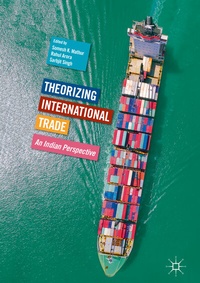
Theorizing International Trade
Description

This book discusses the developments in trade theories, including new-new trade models that account for firm level trade flows, trade growth accounting using inverse gravity models (including distortions in gravity models), the impact of trade liberalization under the aegis of regional and multilateral liberalization efforts of economies using partial and general equilibrium analysis, methodologies of constructing ad valorem equivalents of non-tariff barriers, volatility spillover effects of financial and exchange rate markets. The main purpose of the book is to guide researchers working in the area of international trade, especially focused on empirical analysis of trade policy issues by updating their knowledge on issues related to trade theory, empirical methods, and their applications. The book would prove useful for policy makers, academicians, and researchers.
More details
Other editions
Additional editions

Persons
Somesh K. Mathur is Professor of Economics in the Department of Humanities and Social Sciences at Indian Institute of Technology Kanpur, India. He has published in journals like Review of International Economics, World Economy, Geneva Papers on Risk and Insurance, Economic and Political Weekly, Journal of Quantitative Economics, Global Economy Journal, and more.
Rahul Arora is a Ph.D. student in Economics in the Department of Humanities and Social Sciences, Indian Institute of Technology Kanpur, India. His broader area of research is Quantitative analysis of International Trade.
Sarbjit Singh is a Ph.D. student in Economics in the Department of Humanities and Social Sciences, Indian Institute of Technology Kanpur, India. His broader area of research is Quantitative analysis of International Trade.
