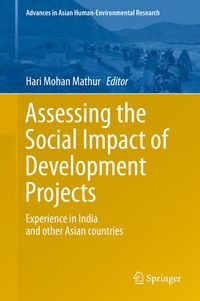
Assessing the Social Impact of Development Projects
Description

This book shows how social impact assessment (SIA), which emerged barely five decades ago, as a way to anticipate and manage potentially negative social impacts of building dams, power stations, urban infrastructure, highways, industries, mining and other development projects, is now widely in use as a planning tool, especially in developed countries. Although SIA has still not gained much acceptance among development planners in Asia, the situation is gradually changing. In India, SIA initially mandated as a policy guideline in 2007 is now a legal requirement. SIA in China has also recently become obligatory for certain types of development projects. Bangladesh, Laos, Nepal, Pakistan and Sri Lanka are other Asian countries that provide examples from a variety of externally funded projects illustrating the use of social impact analysis in project planning to improve development outcomes. With contributions from an array of leading experts, this book is a valuable resource on SIA, indispensable for policymakers, planners, and practitioners in government, international development agencies, private-sector industry, private banks, consultants, teachers, researchers and students of social sciences and development studies, also NGOs everywhere, not in Asia alone.
Reviews / Votes
"The aims of this book include discussing the complex relationships among physical landscapes, natural resources, and their modification by human land use in various Asian environments. . This publication is a useful resource for governments, multilateral development agencies, policymakers, development planners, practitioners, researchers, trainers, environmentalists, social scientists, consultants, academic activists and others who are increasingly beginning to see SIA as a tool for planning better development." (Lina María Rosales, E&U Environment & Urbanization, environmentandurbanization.org, January, 2016)
More details
Other editions
Additional editions