

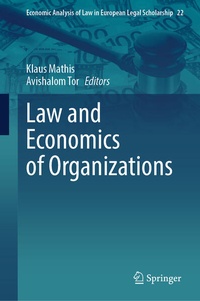
Law and Economics of Organizations
Description

This book brings together legal and economic perspectives to examine how organizational structures, incentives and behavioural factors shape the actions of firms and their decision-makers. It covers principal agent problems, corporate criminal and civil liability,sustainability and ESG governance, as well as emerging questions related to decentralization,DLT and blockchain. Further chapters address organisational challenges in corporate law, behavioural barriers in governance and practical financial decision-making. Overall, the volume highlights how law and economics jointly contribute to understanding and improving organisational behaviour.
More details
Other editions
Additional editions
Persons
Klaus Mathis is full professor of Public Law, Law of the Sustainable Economy, and Philosophy of Law at the University of Lucerne. He is Director of the International Network for Law and Economics - lucernaforum, Director of the Institute for Interdisciplinary Legal Studies - lucernaiuris, and Director of the Center for Law and Sustainability (CLS). His particular fields of expertise are Swiss Constitutional Law, Law and Economics, Law of Sustainable Development, and Philosophy of Law.
Avishalom Tor is Professor of Law and Director of the Notre Dame Program on Law and Economics and the Notre Dame Research Program on Law and Market Behavior. His primary research fields are Behavioural Law and Economics, Antitrust Law, Behavioural Regulation, and the Psychology of Judgment and Decision Making.
Content
Part i principalagent problemsbehavioral agency problems and solutionsa research agenda for organizational law and beyond.-Behavioral economics and corporate cultureaddressing principalagent problems through behavioral interventions.-Part ii criminal and civil liability of corporations criminal liability of the corporation and its employee legal and economic analysis.- A theory of the crimeadjacent firm.- D&o liability in switzerland the case for statutory limitations of liability.- Part iii sustainability and esgthe swiss legislative process in the light of public choice theory and behavioural economics considerations under the co2 act and climate and innovation act.- Sustainable finance a law and economics perspective of the role of banks and financial institutions in south africa.- Caremark and beyond board accountability for esg risks.- Pride prejudice and quotas gender diversity in the european boardrooms.- Part iv decentralized organizationdlt and blockchain does decentralization lead to a new nature of organizations.-Governing the chain unlocking blockchain's potential through institutional design and trust.-Law and economics addressing non performance in smart contracts.- Navigating jurisdictional challengesthe role of law and economics in the decisions of the brazilian supreme court against big tech.- Part v organizational challenges in corporate law entrepreneurs in corporate law an austrian view of entrepreneurship ownership and corporate law.- Reconsidering the role of the firm in an economy full of rents.- Behavioural barriers in corporate governance overcoming biases in insolvency initiation.-Savvy financial approaches in capital budgeting case north macedonia.
