

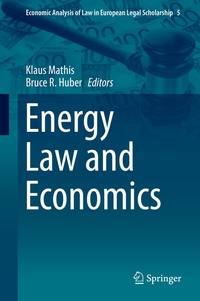
Energy Law and Economics
Description

This book offers an edited volume for all readers who wish to gain an in-depth grasp of the economic analysis of recent developments in energy law and policy in Europe and the United States. In response to waning resources and heightened environmental awareness, many countries are now seeking to redefine their energy mix. Several energy sources are available: coal and oil, natural gas, and a variety of renewables. Yet which of them are capable of addressing core energy-related concerns? Reliability, security, affordability, fairness, and sustainability all have to be taken into account. Further, once a target mix has been identified, two challenges remain for legal scholars: what role does the law play in achieving a specified energy mix, and, how can the law best fulfill that role? The essential energy concerns are just as important in defining the way we shape our energy mix as they are in defining the mix itself.
An example of current challenges in energy law and policy canbe seen in the pursuit by the German and Swiss governments of the so-called "Energiewende" (energy transition). These policies are intended to enable the transition from a non-sustainable use of fossil and nuclear energy to a more sustainable approach based on renewable energies. On the one hand, the goal is to achieve a decarbonization of the energy economy by reducing the use of fossil energy sources such as petroleum, carbon and natural gas. On the other, and in response to the Fukushima nuclear accident, a phase out is intended to eliminate the dangers of nuclear technologies. Achieving these goals poses tremendous challenges for the two countries' energy policies - partly because the energy transition will not only affect energy production, but also energy consumption.
From a Law and Economics perspective, a number of questions arise: to what extent is it justifiable to rely on markets and continued technological innovation, especially with regard to the present exploitation of scarce resources? To what extent is it necessary for states to intervene in energy markets? Regulatory instruments are available to create and maintain more sustainable societies: command and control regulations, restraints, Pigovian taxes, emission certificates, nudging policies, and more. If regulation in a certain legal field is necessary, which policies and methods will most effectively spur the sustainable consumption and production of energy in order to protect the environment while mitigating any potential negative impacts on economic development? Do neoclassical and behavioural economics provide us with a suitable framework for predicting the market's complex reactions to a changing energy policy? This book provides theoretical insights as well as empirical findings in order to answer these vital questions.
More details
Other editions
Additional editions
Persons
Bruce Huber teaches and conducts research in the areas of environmental law, natural resources law, property, and energy law. His particular areas of expertise include energy regulation, public land and resource management, and the interaction between law and politics. His scholarship in these fields has been published in such journals as the California Law Review, the Harvard Environmental Law Review, and The Georgetown Law Journal.
