

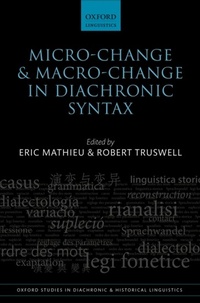
Micro-change and Macro-change in Diachronic Syntax
1st Edition
Published on 20. June 2017
400 pages
978-0-19-106502-6 (ISBN)
Description

The chapters in this volume address the process of syntactic change at different granularities. The language-particular component of a grammar is now usually assumed to be nothing more than the specification of the grammatical properties of a set of lexical items. Accordingly, grammar change must reduce to lexical change. And yet these micro-changes can cumulatively alter the typological character of a language (a macro-change). A central puzzle in diachronic syntax is how to relate macro-changes to micro-changes. Several chapters in this volume describe specific micro-changes: changes in the syntactic properties of a particular lexical item or class of lexical items. Other chapters explore links between micro-change and macro-change, using devices such as grammar competition at the individual and population level, recurring diachronic pathways, and links between acquisition biases and diachronic processes. This book is therefore a great companion to the recent literature on the micro- versus macro-approaches to parameters in synchronic syntax. One of its important contributions is the demonstration of how much we can learn about synchronic linguistics through the way languages change: the case studies included provide diachronic insight into many syntactic constructions that have been the target of extensive recent synchronic research, including tense, aspect, relative clauses, stylistic fronting, verb second, demonstratives, and negation. Languages discussed include several archaic and contemporary Romance and Germanic varieties, as well as Greek, Hungarian, and Chinese, among many others.
More details
Other editions
Additional editions

Eric Mathieu | Robert Truswell
Micro-Change and Macro-Change in Diachronic Syntax
Software
07/2017
Oxford University Press, USA
€122.77
Shipment within 15-20 days
Eric Mathieu | Robert Truswell
Micro-change and Macro-change in Diachronic Syntax
Book
07/2017
Oxford University Press
€170.80
Shipment within 15-20 days
Persons
Eric Mathieu is Associate Professor at the University of Ottawa. He completed his PhD in 2002 at University College London. His research focuses on Modern and Old French, and on the Algonquian language Ojibwe. His work has been published in a number of journals including Linguistic Inquiry, Natural Language and Linguistic Theory, Lingua, Probus, and Linguistic Variation. He is also co-author of The Syntax and Semantics of Split Constructions (Palgrave, 2004) and co-editor of Variation within and across Romance Languages (Benjamins, 2011).
Robert Truswell is a Chancellor's Fellow in the school of Philosophy, Psychology, and Language Science at the University of Edinburgh and Adjunct Professor in the Department of Linguistics at the University of Ottawa. His research covers a range of topics associated with syntax-external influences on syntactic phenomena, and his previous OUP publications are Events, Phrases, and Questions (2011) and Syntax and its Limits (2013, with Raffaella Folli and Christina Sevdali). He is also the editor of the forthcoming Oxford Handbook of Event Structure.
Content
- 1: Eric Mathieu and Robert Truswell: Micro-change and macro-change in diachronic syntax
- 2: Ailís Cournane: In defence of the child innovator
- 3: Nikolas Gisborne and Robert Truswell: Where do relative specifiers come from?
- 4: John Whitman and Yohei Ono: Diachronic interpretations of word order parameter cohesion
- 5: Katalin É. Kiss: The rise and fall of Hungarian complex tenses
- 6: Gertjan Postma: Modelling transient states in language change
- 7: Hezekiah Akiva Bacovcin: Modelling interactions between morphosyntactic changes
- 8: Michelle Troberg and Heather Burnett: From Latin to Modern French: A punctuated shift
- 9: Nikolaos Lavidas: Case in diachrony: Or, why Greek is not English
- 10: Marie Labelle and Paul Hirschbühler: Leftward Stylistic Displacement (LSD) in Medieval French
- 11: Christine Meklenborg Salvesen and George Walkden: Diagnosing embedded V2 in Old English and Old French
- 12: Caitlin Light: The pragmatics of demonstratives in Germanic
- 13: Aaron Ecay and Meredith Tamminga: Persistence as a diagnostic of grammatical status: The case of Middle English negation
- 14: Lieven Danckaert: The origins of the Romance analytic passive: Evidence from word order
- 15: Sarah G. Courtney: Reconciling syntactic and post-syntactic complementizer agreement
- 16: Lukasz Jedrzejowski: On the grammaticalization of temporal-aspectual heads: The case of German versprechen 'promise'
