

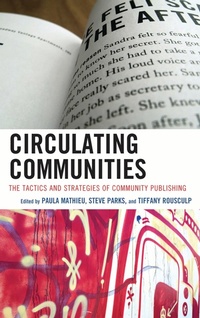
Circulating Communities
The Tactics and Strategies of Community Publishing
1st Edition
Published on 23. December 2011
230 pages
979-8-216-22115-9 (ISBN)
Description

Circulating Communities: The Tactics and Strategies of Community Publishing, edited by Paula Mathieu, Steve Parks, and Tiffany Rousculp, represents the first attempt to gather the myriad of community and college publishing projects, providing not only history and analysis but extended samples of the community writing produced. Rather than feature only the voices of academic scholars, this collection features also the words of writing group participants, community organizers, literacy instructors, librarians, and stay-at-home parents as well.
In libraries, community centers, prisons, and homeless shelters across the US and around the world, people not traditionally understood as writers regularly come together to write, offer feedback, revise, publish-and most importantly circulate-their words. The vast amount of literature that these community-publishing projects create has historically been overlooked by scholars of literature, journalism, and literacy. Over the past decade, however, higher education has moved outward, off campus and into the streets. Many of these efforts build from writing and publication projects that extend back over decades, are grassroots in nature, and are independent of college efforts. Circulating Communities offers a unique glimpse into how neighbor and scholar, teacher and activist, are using writing and publishing to improve the daily lives on the streets they call home.
In libraries, community centers, prisons, and homeless shelters across the US and around the world, people not traditionally understood as writers regularly come together to write, offer feedback, revise, publish-and most importantly circulate-their words. The vast amount of literature that these community-publishing projects create has historically been overlooked by scholars of literature, journalism, and literacy. Over the past decade, however, higher education has moved outward, off campus and into the streets. Many of these efforts build from writing and publication projects that extend back over decades, are grassroots in nature, and are independent of college efforts. Circulating Communities offers a unique glimpse into how neighbor and scholar, teacher and activist, are using writing and publishing to improve the daily lives on the streets they call home.
More details
Series
Edition
1. Auflage
Language
English
Place of publication
United States
Publishing group
Bloomsbury Publishing Plc
Target group
Professional and scholarly
ISBN-13
979-8-216-22115-9 (9798216221159)
Copyright in bibliographic data and cover images is held by Nielsen Book Services Limited or by the publishers or by their respective licensors: all rights reserved.
Schweitzer Classification
Other editions
Additional editions
Paula Mathieu | Steven J. Parks | Tiffany Rousculp
Circulating Communities
The Tactics and Strategies of Community Publishing
Book
12/2011
Lexington Books
€113.50
Article exhausted; check different version
Persons
Paula Mathieu is associate professor of English at Boston College where she teaches courses in composition pedagogy, nonfiction writing, rhetoric, and homeless literature while also directing the First-Year Writing Program and the Writing Fellows Program.
Steve Parks is associate professor of writing and rhetoric at Syracuse University where he teachers entry and advanced courses in composition theory and practice. He also leads seminars on community publishing and community organization.
Tiffany Rousculp is an associate professor in the English Department at Salt Lake Community College in Utah where she teaches composition, linguistics and sociolinguistics courses.
Steve Parks is associate professor of writing and rhetoric at Syracuse University where he teachers entry and advanced courses in composition theory and practice. He also leads seminars on community publishing and community organization.
Tiffany Rousculp is an associate professor in the English Department at Salt Lake Community College in Utah where she teaches composition, linguistics and sociolinguistics courses.
Content
Chapter 1: Making Writing Accessible to All: The Federation of Worker Writers and Community Publishers and The FED, by Nick Pollard and Pat Smart
Chapter 2: The Challenges of Circulation: International Networking of Homeless Publications, by Paula Mathieu
Chapter 3: Respect, Writing, Community: Write Around Portland, by Sara Guest with Hanna Neuschwander and Robyn Steely
Chapter 4: Listen to My Story: The Transformative Possibilities of Storytelling in Immigrant Communities, by Mark Lyons
Chapter 5: Oral Histories as Community Outreach: Toward a Deeper Understanding of a Rural Public Sphere, by Laurie Cella
Chapter 6: Unfinished: A Story of sine cera, a Community Publication in Process, by Rachel Meads
Chapter 7: "Here in this Place": Write On! of Durham, North Carolina, by Kimberly Abels, Kristal Moore Clemons, Julie Wilson, Autumn Winters and Mahogany Woods
Chapter 8: Sharing Space: Collaborative Programming Within and Between Communities, by Mairead Case, Annie Knepler, and Rupal Soni
Chapter 9: Katrina in Their Own Words: Collecting, Creating, and Publishing Writing on the Storm, by Richard Louth
Chapter 10: Writers Speaking Out: The Challenges of Community Publishing from Spaces of Confinement, by Tobi Jacobi and Elliot Johnston, with the SpeakOut! Writing Workshop Facilitators and Writers
Chapter 11: "A Bunch of Us Beg to Differ!": Queer Community Literacy and Rhetorics of Civic Pride, by A.V. Luce
Chapter 2: The Challenges of Circulation: International Networking of Homeless Publications, by Paula Mathieu
Chapter 3: Respect, Writing, Community: Write Around Portland, by Sara Guest with Hanna Neuschwander and Robyn Steely
Chapter 4: Listen to My Story: The Transformative Possibilities of Storytelling in Immigrant Communities, by Mark Lyons
Chapter 5: Oral Histories as Community Outreach: Toward a Deeper Understanding of a Rural Public Sphere, by Laurie Cella
Chapter 6: Unfinished: A Story of sine cera, a Community Publication in Process, by Rachel Meads
Chapter 7: "Here in this Place": Write On! of Durham, North Carolina, by Kimberly Abels, Kristal Moore Clemons, Julie Wilson, Autumn Winters and Mahogany Woods
Chapter 8: Sharing Space: Collaborative Programming Within and Between Communities, by Mairead Case, Annie Knepler, and Rupal Soni
Chapter 9: Katrina in Their Own Words: Collecting, Creating, and Publishing Writing on the Storm, by Richard Louth
Chapter 10: Writers Speaking Out: The Challenges of Community Publishing from Spaces of Confinement, by Tobi Jacobi and Elliot Johnston, with the SpeakOut! Writing Workshop Facilitators and Writers
Chapter 11: "A Bunch of Us Beg to Differ!": Queer Community Literacy and Rhetorics of Civic Pride, by A.V. Luce
