

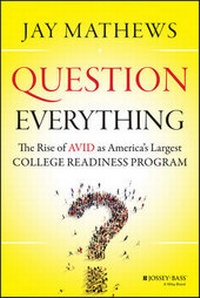
Question Everything
Description

In Question Everything, award-winning education writer Jay Mathews presents the stories and winning strategies behind the Advancement Via Individual Determination program (AVID). With the goal of preparing students for the future - whether that future includes college or not - AVID teaches students the personal management skills that will help them survive and thrive. Focused on time management, presentation, and cooperation, the AVID program leads not only to impressive educational outcomes, but also to young adults prepared for life after school. This book tells the stories of AVID educators, students, and families to illustrate how and why the program works, and demonstrates how teachers can employ AVID's strategies with their own students.
Over the past thirty years, AVID has grown from a single teacher's practice to an organization serving 400,000 middle- and high-school students in 47 states and 16 countries. Question Everything describes the ideas and strategies behind the upward trajectory of both the program and the students who take part.
* Learn which foundational skills are emphasized for future success
* Discover how AVID teaches personal management skills in the academic context
* Contrast AVID student outcomes with national averages
* Consider implementing AVID concepts and techniques into current curricula
As college readiness becomes a top priority for the Federal Government, the Gates Foundation, and other influential organizations, AVID's track record stands out as one of success. By leveling the playing field and introducing "real-world" realities early on, the program teaches students skills that help them in the workplace and beyond.
All prices
More details
Other editions
Additional editions
Person
Content
Taking AVID Home 7
Tortuous Journey of a Teacher's Idea 15
Boise Schools Changed by Love 29
"Prove to Me You Got an A in Everything" 35
Showing America How to Take Notes 43
Teachers Afraid of Tough Courses 47
Asking Rather Than Answering Questions 59
Bringing the Power of Tutoring to El Cajon High 71
Santa Barbara Rejects AVID 79
"Our Teacher Said We Couldn't Take the Test" 87
AVID on 60 Minutes II 91
Changing the Mess at Bell Gardens High 99
Three Days at the Summer Institute: A Crash Course in AVID 105
"I Don't Care If I Have to Haul You Down There Myself" 117
Losing It in Atlanta 125
Inside Tutoring 129
"Don't Give Me That, Akila" 135
Looking for More Mr. Searcys 141
Struggles of an Average AVID Program 147
A Friend, a Teacher, a Mentor 161
Checklist for AVID Greatness 167
All Students Need More of a Challenge 173
Taking AVID to the Other Side of the World 181
New York Site Team's Philadelphia Adventure 189
"Precious Is Making a Big Mistake" 195
Escaping Death, Making AVID Cost-Effective 201
Research Results: Slow Groups Make You Dumb 205
Surprise Leader Creates Giant AVID District 211
Up and Down in Chicago 215
From7-Eleven to AVID 223
Spreading AVID to Elementary School and College .231
A Veteran Superintendent Becomes AVID Leader 239
McKay Wins One in Madison, Indiana 245
Conclusion 251
About the Author 255
Acknowledgments 257
Index 259
Introduction
What works in schools, and what doesn't? For the last three decades, in articles and columns for the Washington Post and in five books, I have focused on that question. Never in my quest for answers have I had as many surprises as in my investigation of the Advancement Via Individual Determination (AVID) program.
I knew a little about AVID before I started this book. I had been invited to speak at one of its conferences in 1999. It seemed to be a thoughtful program based on the work of a terrific teacher, Mary Catherine Swanson. But I had much to learn.
AVID has become the nation's largest college preparatory program by far, with about four hundred thousand students in five thousand schools, in forty-four states and several countries. There are several aspects to this success that I did not initially understand. The excitement and commitment it inspires in teachers are extraordinary, even though AVID is rarely mentioned in our heated national debates over education reform. Once a school adopts AVID, even in a small way with a few classes, teaching practices and standards begin to improve throughout the campus. Students and their parents swear by it, although newspapers and magazines like the ones I write for usually ignore it.
What's going on?
This book was written to answer that question. Before I explain how Swanson created this extraordinary challenge to the usual ways of educating average students, let me outline the central tenets of the AVID program:
- Teaching and enforcing orderly learning-keeping well-organized binders, making time for homework, cooperating with other students-can reap enormous benefits.
- Students can and should be taught how to take notes, one of the most neglected skills in education.
- Learning standards should eventually take all students, including average ones, to the most challenging courses in high school, such as Advanced Placement and International Baccalaureate. Every child deserves a taste of what college demands.
- In order to push learning beyond memorization and repetition, students must see each concept as a response to an important question. They should practice inquiry-based learning, using it with each other so that it will be second nature once they get to college.
- Regular access to well-trained tutors is essential. This is the only practical way to bring average students to the point where they can handle the demands of college and the workplace. Tutors should focus not on answering questions but on showing students how to arrive at the answers themselves.
- The demanding college-level courses and tests that have become the measure of high school quality won't raise standards unless students have support in dealing with them. Educators must be there daily to make sure that students are managing their time, taking notes, benefiting from tutors, and asking the right questions.
- Applying for college or other training after high school, particularly for average students, cannot be left to overloaded counselors. Writing essays, preparing forms, seeking financial aid, visiting colleges, and choosing extracurricular activities should be a part of a regular class.
- Programs work best when both teachers and students feel that they are part of a free-thinking family. AVID students bond with each other and their teachers. The teachers are free to be creative in their lessons and to advocate for their students outside the classroom. That motivates and excites them as they head for school each morning.
It took me some time to comprehend what AVID does. I knew that requiring students to take notes, keep their papers in order, be tutored regularly, and apply for college were best practices proven to boost achievement. I thought that was the essence of AVID: because the AVID program did those things, it was good.
I am still embarrassed by my simplemindedness. I was startled to discover that those approaches had a depth unlike anything I had seen in other school programs. AVID teaching was inquiry based. The Cornell notes invented by Walter Pauk and required by AVID, and the intricate tutoring procedures AVID founder Swanson developed, forced students not only to absorb new information but also to ask questions that got to the conceptual root of their lessons.
AVID students learn not just by remembering what is taught but by conceiving what vital questions are at the heart of their lessons. This is something I rarely had to do as a California public school student, or even as a Harvard College undergraduate. I memorized as much as I could and almost never tried to turn the content into conceptual questions until I was asked to do so on an exam.
I missed out on a better way of learning, and I am not alone. It is difficult to find anyone in this country who has ever been taught how to take good notes. AVID students write down the important points and facts, but they also jot down what appear to be the questions the lecture or book is answering. They learn to discuss the subject with others and link the lesson to other reading. That helps them remember the material and use it intelligently on exams and in life.
The question-making demanded by the AVID tutoring process goes even further. I was skeptical that average high school students could do it. But as I watched carefully, interviewing many teachers and students, it became clear that AVID kids were getting the idea. As a former tutor in Washington DC-area schools, I felt sorry that my tutees had received such inadequate assistance from me. Some top-rate private tutors do what AVID does, but they are rare.
Tutoring sessions, usually every Tuesday and Thursday, are the core of AVID. Most of the money spent for the program goes to pay the tutors. The process is unlike anything I have ever seen in thirty years of education reporting. Each tutor works with no more than seven students. They are trained to stifle their instinct to help struggling students by giving them the answer. In an AVID tutorial, that is the worst thing you can do. Instead, the tutor nudges students toward the questions that will suggest the answer. The students themselves employ that question-making more often than the tutor does.
Inquiry-based tutorials are difficult to do. It takes months for students to get the hang of it. Some AVID tutorials are ragged and disorganized, but even the weaker ones I saw appeared to be more enlightening than the non-AVID tutorials I have observed and participated in over the years.
Emory University English professor Mark Bauerlein has pointed out the fallacy of our popular notion that the best way to improve high schools is to make the teaching livelier and more relevant to students' lives. There is nothing wrong with doing that, but it isn't enough. As Bauerlein, who teaches college freshman composition, points out, college courses like his are inevitably going to be boring and off-putting to a large number of students. He has to teach rules of grammar, organization, and usage, not fun for many students. High school students must learn to deal with courses they don't find engaging if they are going to succeed in college. AVID's frequent lessons on time management and its tutorial emphasis on what to do when stuck on a problem prepare students for such challenges.
In a way, this book is my attempt at question-making. How did AVID evolve into a national movement? Why hasn't it received more public notice? Why are the teachers, principals, and counselors in AVID so passionate about it? How much further will it go? Does research on its results back up the enthusiasm of its participants?
Those of us immersed in the raging national debate over how to improve our schools should note that AVID has little to do with the issues on which we so often disagree. The program doesn't tell us if it is OK to assess and pay teachers based on student test scores. It doesn't care if the students it serves are in traditional public schools, charters, or private schools. It is unrelated to school vouchers or teacher tenure or corporate motivational techniques or test security or competing curriculums. The fact that such hotly debated issues are largely irrelevant to this powerful program explains in part why it has become so influential while remaining little known. It also makes me wonder if our big arguments are as important as we think they are.
AVID is trying to grow and improve. It now reaches elementary schools as well as colleges. Its teachers want to involve many more students than they do now, and to move beyond AVID's emphasis on average students to a schoolwide approach. That requires more experience with students who don't fit the AVID profile and with the many school district administrators who have trouble, as I did, understanding what AVID does. The program also wants to bring its methods into more large urban districts. The collapse of an ambitious AVID program in Chicago shows that such growth will take time, hard work, and some luck.
AVID's great strength is its popularity with teachers, who see it as an exceptional way to engage students and deepen their learning. They and their students sense from the beginning the unusual nature of the enterprise. Teachers can be creative in the classroom and advocate for their students outside the classroom when old rules and procedures are denying students the challenges they need. AVID teachers like the focus on preparing students for college rather than just raising state test scores, a numbers game they distrust.
The power of what Mary...
