

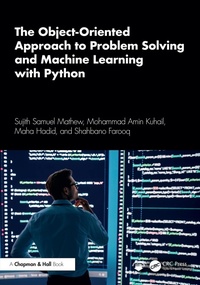
The Object-Oriented Approach to Problem Solving and Machine Learning with Python
1st Edition
Published on 12. May 2025
314 pages
978-1-040-29606-6 (ISBN)
Description

This book is a comprehensive guide suitable for beginners and experienced developers alike. It teaches readers how to master object-oriented programming (OOP) with Python and use it in real-world applications.
Start by solidifying your OOP foundation with clear explanations of core concepts such as use cases and class diagrams. This book goes beyond theory as you get practical examples with well-documented source code available in the book and on GitHub.
This book doesn't stop at the basics. Explore how OOP empowers fields such as data persistence, graphical user interfaces (GUIs), machine learning, and data science, including social media analysis. Learn about machine learning algorithms for classification, regression, and unsupervised learning, putting you at the forefront of AI innovation.
Each chapter is designed for hands-on learning. You'll solidify your understanding with case studies, exercises, and projects that apply your newfound knowledge to real-world scenarios. The progressive structure ensures mastery, with each chapter building on the previous one, reinforced by exercises and projects.
Numerous code examples and access to the source code enhance your learning experience. This book is your one-stop shop for mastering OOP with Python and venturing into the exciting world of machine learning and data science.
Start by solidifying your OOP foundation with clear explanations of core concepts such as use cases and class diagrams. This book goes beyond theory as you get practical examples with well-documented source code available in the book and on GitHub.
This book doesn't stop at the basics. Explore how OOP empowers fields such as data persistence, graphical user interfaces (GUIs), machine learning, and data science, including social media analysis. Learn about machine learning algorithms for classification, regression, and unsupervised learning, putting you at the forefront of AI innovation.
Each chapter is designed for hands-on learning. You'll solidify your understanding with case studies, exercises, and projects that apply your newfound knowledge to real-world scenarios. The progressive structure ensures mastery, with each chapter building on the previous one, reinforced by exercises and projects.
Numerous code examples and access to the source code enhance your learning experience. This book is your one-stop shop for mastering OOP with Python and venturing into the exciting world of machine learning and data science.
More details
Edition
1. Auflage
Language
English
Place of publication
London
United Kingdom
Publishing group
Taylor & Francis Ltd
Target group
College/higher education
Professional and scholarly
Illustrations
19 Tables, black and white; 61 Line drawings, color; 37 Line drawings, black and white; 5 Halftones, color; 66 Illustrations, color; 37 Illustrations, black and white
File size
35,88 MB
ISBN-13
978-1-040-29606-6 (9781040296066)
Copyright in bibliographic data and cover images is held by Nielsen Book Services Limited or by the publishers or by their respective licensors: all rights reserved.
Schweitzer Classification
Other editions
Additional editions
Sujith Samuel Mathew | Mohammad Amin Kuhail | Maha Hadid
The Object-Oriented Approach to Problem Solving and Machine Learning with Python
Book
05/2025
1st Edition
Chapman & Hall/CRC
€72.70
Shipment within 10-20 days
Sujith Samuel Mathew | Mohammad Amin Kuhail | Maha Hadid
The Object-Oriented Approach to Problem Solving and Machine Learning with Python
Book
05/2025
1st Edition
Chapman & Hall/CRC
€131.10
Shipment within 10-20 days

Sujith Samuel Mathew
The Object-Oriented Approach to Problem Solving and Machine Learning with Python
Book
03/2025
CRC Press
Unfortunately, price unknown
Available (delivery time upon request)
Persons
Sujith Samuel Mathew holds a PhD in computer science from the University of Adelaide, Australia. He is an associate professor at Zayed University, UAE. He specializes in ubiquitous and distributed computing, focusing on the Internet of Things and related Smart City applications.
Mohammad Amin Kuhail holds an MSc in software engineering from the University of York and a PhD in software development from IT University of Copenhagen. He is an associate professor at Zayed University, specializing in human-computer interaction and software engineering, and he researches chatbot technology, user behavior, and education.
Maha Hadid holds an MSc in Information Sciences and Systems from the University of Marseille in France. She is an instructor at Zayed University, UAE, with experience in undergraduate courses and instructional design and delivery for blended and classroom-based courses.
Shahbano Farooq holds an MSc in computer science from the University of Calgary. She is an instructor at Zayed University, UAE, specializing in human-computer interaction and machine learning.
Mohammad Amin Kuhail holds an MSc in software engineering from the University of York and a PhD in software development from IT University of Copenhagen. He is an associate professor at Zayed University, specializing in human-computer interaction and software engineering, and he researches chatbot technology, user behavior, and education.
Maha Hadid holds an MSc in Information Sciences and Systems from the University of Marseille in France. She is an instructor at Zayed University, UAE, with experience in undergraduate courses and instructional design and delivery for blended and classroom-based courses.
Shahbano Farooq holds an MSc in computer science from the University of Calgary. She is an instructor at Zayed University, UAE, specializing in human-computer interaction and machine learning.
Content
Chapter 1 Introduction to Object-Oriented Programming
Chapter 2 Python Data Structures
Chapter 3 Exception Handling
Chapter 4 Fundamentals of Object-Oriented Analysis
Chapter 5 Fundamentals of Object-Oriented Design
Chapter 6 File Handling, Object Serialization, and Data Persistence
Chapter 7 Graphical User Interface with Tkinter
Chapter 8 Machine Learning with Python
Chapter 9 Natural Language Processing and Text Mining with Python
Appendix A Installing Python and Environment Setup
Appendix B Choosing an IDE
Appendix C Debugging Your Python Program
Appendix D PEP Style Guide-Coding Standard and Conventions
Chapter 2 Python Data Structures
Chapter 3 Exception Handling
Chapter 4 Fundamentals of Object-Oriented Analysis
Chapter 5 Fundamentals of Object-Oriented Design
Chapter 6 File Handling, Object Serialization, and Data Persistence
Chapter 7 Graphical User Interface with Tkinter
Chapter 8 Machine Learning with Python
Chapter 9 Natural Language Processing and Text Mining with Python
Appendix A Installing Python and Environment Setup
Appendix B Choosing an IDE
Appendix C Debugging Your Python Program
Appendix D PEP Style Guide-Coding Standard and Conventions
