

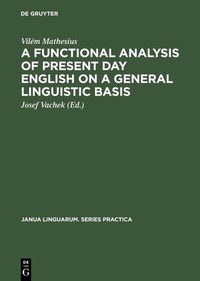
A Functional Analysis of Present Day English on a General Linguistic Basis
Functional Analysis of Present Day English on a General Linguistic Basis
1st Edition
Published on 5. July 2013
228 pages
978-3-11-081329-6 (ISBN)
Description

No detailed description available for "A Functional Analysis of Present Day English on a General Linguistic Basis".
More details
Series
Edition
Reprint 2013
Language
English
Place of publication
Berlin/Boston
Germany
Publishing group
de Gruyter Mouton
Target group
Professional and scholarly
US School Grade: College Graduate Student
Illustrations
6 Abbildungen
6 ill.
File size
8,74 MB
ISBN-13
978-3-11-081329-6 (9783110813296)
Schweitzer Classification
Other editions
Additional editions
Vilém Mathesius | Josef Vachek
A Functional Analysis of Present Day English on a General Linguistic Basis
Book
01/1975
1st Edition
De Gruyter Mouton
€119.95
Shipment within 10-20 days
Vilém Mathesius | Josef Vachek
A Functional Analysis of Present Day English on a General Linguistic Basis
Book
01/1975
1st Edition
De Gruyter Mouton
€169.95
Article exhausted; check different version
Content
- Intro
- Introduction : On the scientific study of language
- 1. Currents of linguistic research
- 2. Plan of the present analysis
- 3. Encoding
- A. Functional onomatology
- I. The meaning of the naming unit
- 1. The essence and character of the naming unit
- 2. Components of the naming unit
- II. The form of the naming unit
- 1. Simple and descriptive naming units
- 2. The word. General considerations
- 3. Non-compound words
- 4. Compound words
- a) Definition of compound words
- b) Types of compounds
- c) Features of collocations
- d) Verbal compounds and collocations in English
- 5. Shortening of words and coining of new naming units
- III. Classification of naming units
- 1. The problem of the parts of speech (word categories)
- 2. Formal differences between the word categories in English
- 3. The relation between substantives and adjectives in English
- 4. The relation between nouns and verbs in English
- 5. The relation between adjectives and adverbs in English
- IV. Classification within the word categories
- 1. Formal classification, aspectual modifications and categorial transitions
- 2. Formal classification and aspectual modifications of nouns
- a) Gender of nouns
- b) Aspectual modification of grammatical number
- c) Aspectual modification of definiteness (Uses of the articles)
- 3. Categorial transitions of nouns
- 4. Formal classification and aspectual modifications of adjectives
- 5. Categorial transitions of adjectives
- 6. Formal categories and aspectual modifications of verbs
- a) Formal categories of the verb
- b) Aspectual modifications of the verb
- a) General survey
- ß) Tense
- ?) Remarks on the problems of tense in English
- d) Verbal aspect
- e) Mood
- 7. Categorial transitions of the verb in English
- a) The relation of the action to the subject
- b) The relation of the action to the object
- a) Subjective and objective verbs
- ß) Reflexive verbs
- B. Functional syntax
- I. Definition of the sentence
- II. Functional sentence analysis
- 1. The basis and the nucleus of a statement
- 2. One-element and two-element sentences from the point of view of functional sentence perspective
- 3. Functional and formal analysis of the sentence
- III. Formal analysis of simple sentences
- 1. General remarks
- 2. One-element verbless thetic sentences
- 3. One-element verbless predicative sentences
- 4. Two-element verbless sentences
- 5. Apposition
- 6. Absolute construction
- 7. Verbal sentences
- a) General remarks
- b) Grammatical person
- 8. The function of the subject in English
- 9. Predication in English
- a) Actional predication from the formal point of view
- b) Actional predication from the semantic point of view: active predication
- c) Types of passive actional predication
- d) Qualifying predication
- e) Other types of predication
- 10. The object in English
- a) General remarks
- b) Object of the accusative type
- c) Object of the dative type
- d) Object of the genitive type
- e) Other types of object
- 11. The attribute in English
- a) Adjectival attribute
- b) Substantival attribute
- 12. Adverbials in English
- a) General remarks
- b) Expression of adverbials in English
- IV. The English sentence as a whole
- 1. Means of complex condensation
- a) General remarks
- b) English participles
- c) The infinitive and the gerund in English
- d) Complex constructions
- 2. The word order of the English sentence
- a) Principles determining the order of words in a language
- b) Other problems of English word order
- 3. Strengthening and emphasis
- 4. Notes on negation
- V. Notes on other problems of functional syntax
- 1. Compound and complex sentences
- 2. The uses of moods and tenses
- Notes
- Bibliography
- Editor's postscript to the original Czech edition (1961)
- Postscript to the English translation (1973)
- Index of persons
- Index of subjects
- Index of words
