

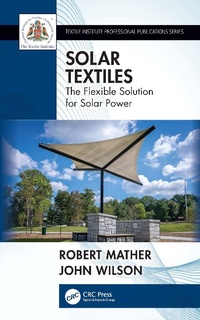
Solar Textiles
The Flexible Solution for Solar Power
1st Edition
Published on 21. November 2022
123 pages
978-1-000-78288-2 (ISBN)
Description

Most photovoltaic (PV) installations utilise heavy conventional glass or polycarbonate panels, and even newly developed thin plastic or metal films for PV cell use may fracture during both construction and application. Textile fabrics, the most widespread flexible materials in everyday use, offer a solution to the need for lightweight, flexible solar PV generators. Solar Textiles: The Flexible Solution for Solar Power is about the incorporation and operation of solar cells on textile fabrics. The combination of textile manufacturing and solar PV cell technology opens up further avenues for both the textile and semiconductor industries. Thus, this book reflects the progressively increasing commercial interest in PV cell technology and the versatility that their integration in textiles provides.
Discusses textiles as electrical substrates
Explains the photovoltaic effect and associated parameters
Offers special consideration of solar cells on textiles
Compares fibres and fabrics and how to implement PV activity on a textile
Describes manufacturing methods outside of semiconductor technology
Includes applications open only to textiles
This work is aimed at textile technologists, electronic engineers, solar technologists, civil engineers and designers in building fabrics and architecture.
Discusses textiles as electrical substrates
Explains the photovoltaic effect and associated parameters
Offers special consideration of solar cells on textiles
Compares fibres and fabrics and how to implement PV activity on a textile
Describes manufacturing methods outside of semiconductor technology
Includes applications open only to textiles
This work is aimed at textile technologists, electronic engineers, solar technologists, civil engineers and designers in building fabrics and architecture.
More details
Series
Edition
1. Auflage
Language
English
Place of publication
London
United Kingdom
Publishing group
Taylor & Francis Ltd
Target group
Professional and scholarly
Illustrations
2 Tables, black and white; 27 Line drawings, black and white; 19 Halftones, black and white; 46 Illustrations, black and white
ISBN-13
978-1-000-78288-2 (9781000782882)
Copyright in bibliographic data and cover images is held by Nielsen Book Services Limited or by the publishers or by their respective licensors: all rights reserved.
Schweitzer Classification
Other editions
Additional editions
Book
11/2022
1st Edition
CRC Press
€120.70
Shipment within 15-20 days
Book
11/2022
1st Edition
CRC Press
€296.70
Shipment within 15-20 days
Persons
Robert Mather's involvement with textiles began when he joined the staff at the Scottish College of Textiles (SCOT) in Galashiels in 1983. He had previously worked for ten years at Ciba-Geigy Pigments in Paisley, following two spells of postdoctoral work at Imperial College and Brunel University in London. At SCOT, which subsequently became part of Heriot-Watt University, Robert acquired his interest in technical textiles and established a profile in the processing of polypropylene fibres. He also worked on three-dimensional woven engineering products.
His current R&D interests include the incorporation of solar cells on textiles, and Power Textiles Limited was formed in 2012 with John Wilson as co-Director to promote solar textiles. Robert also has an interest in gas plasma treatments for textiles. He was Director for five years of the newly established Technical Textiles and Polymer Innovation Unit at Galashiels, set up with funds from the UK Department of Trade and Industry. During this period, the Unit successfully undertook projects for a variety of companies, and Robert was contracted to write on the technical textile industry in Scotland for a briefing paper for the Scottish Executive. The Unit was eventually subsumed into the UK TechniTex Faraday Partnership, and he became responsible for technology transfer in the Partnership's organisation. He has also been Director of the Biomedical Textiles Research Centre at Heriot-Watt University.
He is the author of over 90 technical papers and in recent years has contributed chapters to a number of books on technical textiles. Together with a co-author, he wrote a book on textile chemistry for the Royal Society of Chemistry in 2011. A second, updated edition was published in 2015, and a third edition is currently in preparation.
Professional memberships held include:
Fellow of the Royal Society of Chemistry, CChem
Fellow of the Textile Institute, CTex
John Wilson was Professor of Materials Processing at Heriot-Watt University, Physics, from 1996 until 2012. His first post there was Wolfson Research Fellow 1975, following a similar appointment at St Andrews University. At Heriot-Watt University, John was Academic Head of Physics (2002-5 and 2010-2012), setting up several degree programmes, and supervising over 30 PhD and MSc students, including a collaboration with Chinese Ph.D. students from Beijing Jiaotong University. His publications include a book on solar energy, encyclopaedia and book chapters, and over 200 scientific papers.
His interests in the applications of solar energy span over 40 years of research, from thin-film II-VI cells for his PhD thesis, later pioneering the UK amorphous silicon solar cell research, and to current work on flexible solar cells. Through Rotary, he worked with a small group at The Turing Trust to design and deliver a solar-powered, off-grid, computer laboratory for Malawi. He has been a consultant to the UN and to UK companies and institutions throughout the world (e.g. Romania, India, Nigeria) on solar energy and photovoltaics, and was founder secretary of the Scottish Solar Energy Group until 1988. He presently delivers solar photovoltaic training courses for the Renewable Energy Institute Ltd, Edinburgh.
His materials R&D used lasers and plasmas to deposit or modify metals, semiconductors, dielectrics and polymers, for applications in optics, mechanics and bioengineering. In particular, research into thin-film diamond led to the founding of DILAB Limited in 1994, of which he was managing director. Power Textiles Limited was founded in 2012 with co-Director Robert Mather to promote flexible solar cells on textiles.
Professional memberships held include:
Fellow of the Institute of Physics (and a past member of their Science Board), CPhys and CEng
His current R&D interests include the incorporation of solar cells on textiles, and Power Textiles Limited was formed in 2012 with John Wilson as co-Director to promote solar textiles. Robert also has an interest in gas plasma treatments for textiles. He was Director for five years of the newly established Technical Textiles and Polymer Innovation Unit at Galashiels, set up with funds from the UK Department of Trade and Industry. During this period, the Unit successfully undertook projects for a variety of companies, and Robert was contracted to write on the technical textile industry in Scotland for a briefing paper for the Scottish Executive. The Unit was eventually subsumed into the UK TechniTex Faraday Partnership, and he became responsible for technology transfer in the Partnership's organisation. He has also been Director of the Biomedical Textiles Research Centre at Heriot-Watt University.
He is the author of over 90 technical papers and in recent years has contributed chapters to a number of books on technical textiles. Together with a co-author, he wrote a book on textile chemistry for the Royal Society of Chemistry in 2011. A second, updated edition was published in 2015, and a third edition is currently in preparation.
Professional memberships held include:
Fellow of the Royal Society of Chemistry, CChem
Fellow of the Textile Institute, CTex
John Wilson was Professor of Materials Processing at Heriot-Watt University, Physics, from 1996 until 2012. His first post there was Wolfson Research Fellow 1975, following a similar appointment at St Andrews University. At Heriot-Watt University, John was Academic Head of Physics (2002-5 and 2010-2012), setting up several degree programmes, and supervising over 30 PhD and MSc students, including a collaboration with Chinese Ph.D. students from Beijing Jiaotong University. His publications include a book on solar energy, encyclopaedia and book chapters, and over 200 scientific papers.
His interests in the applications of solar energy span over 40 years of research, from thin-film II-VI cells for his PhD thesis, later pioneering the UK amorphous silicon solar cell research, and to current work on flexible solar cells. Through Rotary, he worked with a small group at The Turing Trust to design and deliver a solar-powered, off-grid, computer laboratory for Malawi. He has been a consultant to the UN and to UK companies and institutions throughout the world (e.g. Romania, India, Nigeria) on solar energy and photovoltaics, and was founder secretary of the Scottish Solar Energy Group until 1988. He presently delivers solar photovoltaic training courses for the Renewable Energy Institute Ltd, Edinburgh.
His materials R&D used lasers and plasmas to deposit or modify metals, semiconductors, dielectrics and polymers, for applications in optics, mechanics and bioengineering. In particular, research into thin-film diamond led to the founding of DILAB Limited in 1994, of which he was managing director. Power Textiles Limited was founded in 2012 with co-Director Robert Mather to promote flexible solar cells on textiles.
Professional memberships held include:
Fellow of the Institute of Physics (and a past member of their Science Board), CPhys and CEng
Content
1. The Versatility of Textile Fabrics, 2. The Photovoltaic Effect and How It Is Used, 3. Constructions of Textile Fabrics, 4. Strategies for Achieving Electrically Conducting Textile Fabrics, 5. Enabling Textile Fabrics to Become Photovoltaically Active, 6. Technological and Design Specifications, 7. Manufacturing: Moving from Laboratory to Production, 8. Applications of Solar Textile Fabrics, 9. The Outlook for Solar Textiles
