

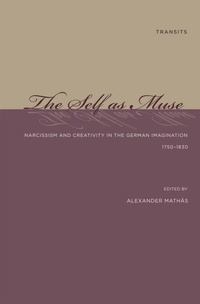
The Self as Muse
Narcissism and Creativity in the German Imagination 1750-1830
1st Edition
Published on 22. April 2011
232 pages
978-1-61148-033-7 (ISBN)
Description

While there are countless philosophical and psychological studies that focus on sources of the self, narcissism has found relatively little attention in a pre-Freudian context. The Self as Muse fills this gap by examining various aspects of narcissism and their significance for the outpouring of creativity in late eighteenth and nineteenth-century German literature.
In many Eighteenth-century works of the period narcissism refers to the creation of an idealized image of the self and the desire to merge with this image. It provided an impetus for poetic production as writers resorted to the Greek myth of Narcissus to express what they perceived as the inner workings of their soul. Yet they were also acutely aware of the vain, and therefore narcissistic, motivations for their explorations of the self. While those influenced by the Pietist tradition attempted to distinguish between an "unselfish" self-scrutiny and self-indulging vanity, others like Goethe took advantage of narcissism's creative potential and integrated it into their aesthetic endeavors. The abundance of confessional and autobiographical accounts, the burgeoning of poetry drawing on personal experience, the emergence of a type of drama that is based on empathy, and the concern with an individual's ability to control one's senses and emotions in general testify to an unprecedented interest in notions of the self in German literature.
Mathäs explains the emergence of narcissism in the literature of the period as a sense-inspired concept that aims to bring about a better comprehension of both the self and other human beings, and how writers used narcissism to improve the moral behavior of their readers. It examines eighteenth-century representations of narcissism against the background of Freudian and post-Freudian notions of the concept, and explores narcissism as a creative process that engages both reader and writer in the production of meaning. By showing narcissism's pervasive allure for a broad array of literary productions, the vol
In many Eighteenth-century works of the period narcissism refers to the creation of an idealized image of the self and the desire to merge with this image. It provided an impetus for poetic production as writers resorted to the Greek myth of Narcissus to express what they perceived as the inner workings of their soul. Yet they were also acutely aware of the vain, and therefore narcissistic, motivations for their explorations of the self. While those influenced by the Pietist tradition attempted to distinguish between an "unselfish" self-scrutiny and self-indulging vanity, others like Goethe took advantage of narcissism's creative potential and integrated it into their aesthetic endeavors. The abundance of confessional and autobiographical accounts, the burgeoning of poetry drawing on personal experience, the emergence of a type of drama that is based on empathy, and the concern with an individual's ability to control one's senses and emotions in general testify to an unprecedented interest in notions of the self in German literature.
Mathäs explains the emergence of narcissism in the literature of the period as a sense-inspired concept that aims to bring about a better comprehension of both the self and other human beings, and how writers used narcissism to improve the moral behavior of their readers. It examines eighteenth-century representations of narcissism against the background of Freudian and post-Freudian notions of the concept, and explores narcissism as a creative process that engages both reader and writer in the production of meaning. By showing narcissism's pervasive allure for a broad array of literary productions, the vol
More details
Series
Edition
1. Auflage
Language
English
Place of publication
New York
United States
Publishing group
Associated University Presses
Target group
Professional and scholarly
ISBN-13
978-1-61148-033-7 (9781611480337)
Copyright in bibliographic data and cover images is held by Nielsen Book Services Limited or by the publishers or by their respective licensors: all rights reserved.
Schweitzer Classification
Other editions
Additional editions
Book
04/2011
Bucknell University Press,U.S.
€115.50
Shipment within 3-4 weeks
Persons
Alexander Mathäs is professor of German at the University of Oregon and author of Narcissism and Paranoia in the Age of Goethe and Der Kalte Krieg in der deutschen Literaturkritik: Der Fall Martin Walser.
Content
1 Acknowledgments
2 Narcissism and the Self: An Introduction
3 Part I: Narcissism and the Senses
4 Narcissism and the Sublime
5 Narcissism, the Self, and Empathy: The Paradox that Created Modern Literature
6 Part II: Narcissism and Morality
7 Self-Reflection and Knowledge in a Hamann's Early Philosophical and Aesthetic Writings
8 Narcissistic Investments and Transformations in Theodor Gottlieb von Hippel's Lebensläufe nach aufsteigender Linie and Über die Ehe
9 "Some Day My Prince Will Come": Fürstenspiegel and the Bourgeos Writer
10 Part III: Over and Against Freud
11 Werther's Sentimental Narcissism: Consciousness, Communication, and the Origin of the Modern Psyche
12 "I suffered and I loved": Narcissism and Abject Desire in Goethe's "Confessions of a Beautiful Soul"
13 Part IV: Reading and Writing Narcissism
14 Textual Narcissism in Kleist's "Über das Marionettentheater"
15 That Specter in My Name: Writing and Its Mirror Effects in Hoffmann and Poe
16 Notes on Contributors
2 Narcissism and the Self: An Introduction
3 Part I: Narcissism and the Senses
4 Narcissism and the Sublime
5 Narcissism, the Self, and Empathy: The Paradox that Created Modern Literature
6 Part II: Narcissism and Morality
7 Self-Reflection and Knowledge in a Hamann's Early Philosophical and Aesthetic Writings
8 Narcissistic Investments and Transformations in Theodor Gottlieb von Hippel's Lebensläufe nach aufsteigender Linie and Über die Ehe
9 "Some Day My Prince Will Come": Fürstenspiegel and the Bourgeos Writer
10 Part III: Over and Against Freud
11 Werther's Sentimental Narcissism: Consciousness, Communication, and the Origin of the Modern Psyche
12 "I suffered and I loved": Narcissism and Abject Desire in Goethe's "Confessions of a Beautiful Soul"
13 Part IV: Reading and Writing Narcissism
14 Textual Narcissism in Kleist's "Über das Marionettentheater"
15 That Specter in My Name: Writing and Its Mirror Effects in Hoffmann and Poe
16 Notes on Contributors
