

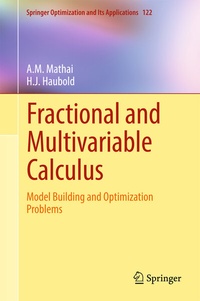
Fractional and Multivariable Calculus
Description

This textbook presents a rigorous approach to multivariable calculus in the context of model building and optimization problems. This comprehensive overview is based on lectures given at five SERC Schools from 2008 to 2012 and covers a broad range of topics that will enable readers to understand and create deterministic and nondeterministic models. Researchers, advanced undergraduate, and graduate students in mathematics, statistics, physics, engineering, and biological sciences will find this book to be a valuable resource for finding appropriate models to describe real-life situations.
The first chapter begins with an introduction to fractional calculus moving on to discuss fractional integrals, fractional derivatives, fractional differential equations and their solutions. Multivariable calculus is covered in the second chapter and introduces the fundamentals of multivariable calculus (multivariable functions, limits and continuity, differentiability, directionalderivatives and expansions of multivariable functions). Illustrative examples, input-output process, optimal recovery of functions and approximations are given; each section lists an ample number of exercises to heighten understanding of the material. Chapter three discusses deterministic/mathematical and optimization models evolving from differential equations, difference equations, algebraic models, power function models, input-output models and pathway models. Fractional integral and derivative models are examined. Chapter four covers non-deterministic/stochastic models. The random walk model, branching process model, birth and death process model, time series models, and regression type models are examined. The fifth chapter covers optimal design. General linear models from a statistical point of view are introduced; the Gauss-Markov theorem, quadratic forms, and generalized inverses of matrices are covered. Pathway, symmetric, and asymmetric models are covered in chapter six, the concepts are illustrated with graphs.
Reviews / Votes
"This book presents the readers with a basic overview of the rigorous approach to the study of fractional and multivariate calculus in the context of model building and optimization problems. This book covers a broad range of topics that will enable readers to fully understand and create deterministic and nondeterministic models. . book is well presented and would be very useful for researchers and graduate students working in several areas including mathematics, physics, chemistry, engineering, finance and even social sciences." (James Adedayo Oguntuase, zbMATH 1376.26001, 2018)More details
Other editions
Additional editions
Persons
Content
1. Essential of Fractional Calculus.- 2. Multivariable Calculus.- 3. Deterministic Models and Optimization.- 4. Non-deterministic Models and Optimization.- 5. Optimal Regression Designs. -Index.
