

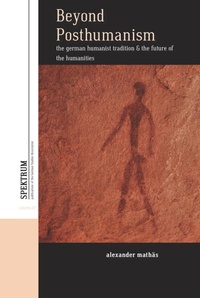
Beyond Posthumanism
Description

Kant, Goethe, Schiller and other eighteenth-century German intellectuals loom large in the history of the humanities-both in terms of their individual achievements and their collective embodiment of the values that inform modern humanistic inquiry. Taking full account of the manifold challenges that the humanities face today, this volume recasts the question of their viability by tracing their long-disputed premises in German literature and philosophy. Through insightful analyses of key texts, Alexander Mathäs mounts a broad defense of the humanistic tradition, emphasizing its pursuit of a universal ethics and ability to render human experiences comprehensible through literary imagination.
More details
Other editions
Additional editions
Person
Alexander Mathäs is Professor Emeritus of German at the University of Oregon.
Content
List of Illustrations
Acknowledgments
List of Abbreviations
Introduction
Chapter 1. Signs and Wonders: The Humanist Pedagogy of Eighteenth-Century Universal Histories of Mankind
Chapter 2. Religion, Anthropology, and the Mission of Literature in Schiller's Universalgeschichte
Chapter 3. The Sublime as an Objectivist Strategy
Chapter 4. The Importance of Herder's Humanism and the Posthumanist Challenge
Chapter 5. Humanist Antinomies: Goethe's Iphigenie auf Tauris and Torquato Tasso
Chapter 6. Incorporating Change: The Role of Science in Goethe's and Carl Gustav Carus's Humanist Aesthetics
Chapter 7. Karl Marx's and Ludwig Feuerbach's Materialism in Gottfried Keller's "Kleider Machen Leute"
Chapter 8. The End of Pathos and of Humanist Illusions: Schiller and Schnitzler
Chapter 9. Blurring the Human/Animal Boundary: Hofmannsthal's Andreas
Chapter 10. Humanism and Ideology: Thomas Mann's Writings (1914-30)
Chapter 11. Between Humanism and Posthumanism: Hermann Hesse's Steppenwolf
Conclusion
Works Cited
Index
