

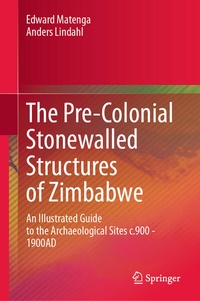
The Pre-Colonial Stonewalled Structures of Zimbabwe
Description

This book provides a general guide to stone-structures of the pre-colonial period called zimbabwes. This is a name which denotes their usage as prestige buildings and that a particular quality of masonry with frequent application of wall decoration patterns was required, which distinguishes them from many other stone structures of coarse workmanship. At least 300 sites are known within the borders of Zimbabwe alone, while a few more are found in Botswana, South Africa and Mozambique. However, recent findings have indicated that stone buildings in southern Angola of similar typology also carry decoration patterns that suggests a much wider distribution in the region than was previously thought.
The word Z imbabwe is of historical origin which has been customized to refer to a specific typology of stone walls and to distinguish them from the rest of low-grade buildings which number several hundred. In the 16 th century, it denoted royal and chiefly settlements built in stone and it was used figuratively to imply the presence there of such important political figures. In this guide, zimbabwe (lower case and in italics) refers to stone walls whereas when in upper case it refers either to Great Zimbabwe or Zimbabwe the modern country.
This work is the first comprehensive volume to act as a guide to the archaeological stone wall structures. Z imbabwe sites are the only immovable cultural remains of substantial physical form that have been inherited from a pre-colonial past. In a post-colonial state, they are extremely valuable as tangible evidence of the historical continuity of indigenous populations with a pre-colonial past. Their history implies an inheritance for present and future generations and entrust ownership to the public. Religious activities connected with the sites imply not just vestigial importance, but embody cosmological values that bind people together. A descriptive inventory such as this guidebook serves two purposes, i.e. a heritage register to support conservation programmes and as a popular study guide to interest both local and international visitors.
More details
Other editions
Additional editions
Persons
Edward Matenga is a Heritage expert and archaeologist. Principal Researcher and Director at Archaeological and Heritage Service Africa (Pty Ltd). PhD in Archaeology and Heritage, Uppsala University (Sweden). Past Director of Great Zimbabwe World Heritage Site 1998-2004. Participated in UNESCO and ICOMOS missions in Africa. Has authored several books and articles in scientific journals on Heritage management.
Anders Lindahl is a Professor in laboratory and experimental archaeology, specialized in the different phases of the ceramic handicraft and settlement pattern. Head of the Laboratory for Ceramic Research, dept. of Geology, Lund University and Lead researcher at the Ceramics Technology Laboratory, University of Pretoria. Since 1988 involved in various projects in South, South-Eastern and Western Africa.
Content
Chapter 1. Introduction.- Chapter 2. The sites in Masvingo Province.- Chapter 3. The sites in Matabeleland Provinces.- Chapter 4. The sites in Midlands Province.- Chapter 5. The sites in Mashonaland Provinces.- Chapter 6. The sites in Manicaland Province.
