

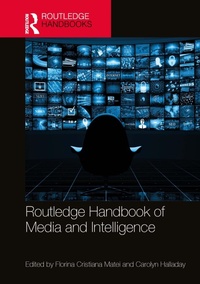
Routledge Handbook of Media and Intelligence
1st Edition
Published on 24. March 2026
498 pages
978-1-040-74784-1 (ISBN)
Description

This handbook examines media portrayals of intelligence institutions, cultures and conduct in various political regimes, showing how they inflect and reflect public views of the intelligence community.
Specifically, this volume assesses how popular media portrayals of intelligence agencies influences such realms as public perception, opinion, and support of intelligence; recruitment endeavours; democratic transformation of intelligence services; transparency versus secrecy; outreach and messaging efforts; and intelligence interagency sharing, cooperation and collaboration, both domestically and internationally. The book chapters are divided into three thematic sections:
Part I: Theoretical Concepts Part II: Case Studies of Non-Democratic or Nominally Democratic Regimes
Part III: Case Studies of Consolidated and Consolidating Democracies
The volume also looks toward newer and emerging media around the world to explore ways in which both the intelligence sector and its image in media and popular culture may be changing.
Filling a clear gap in the literature, this book will be of much interest to students of intelligence studies, media and communication studies, national security and International Relations.
Specifically, this volume assesses how popular media portrayals of intelligence agencies influences such realms as public perception, opinion, and support of intelligence; recruitment endeavours; democratic transformation of intelligence services; transparency versus secrecy; outreach and messaging efforts; and intelligence interagency sharing, cooperation and collaboration, both domestically and internationally. The book chapters are divided into three thematic sections:
Part I: Theoretical Concepts Part II: Case Studies of Non-Democratic or Nominally Democratic Regimes
Part III: Case Studies of Consolidated and Consolidating Democracies
The volume also looks toward newer and emerging media around the world to explore ways in which both the intelligence sector and its image in media and popular culture may be changing.
Filling a clear gap in the literature, this book will be of much interest to students of intelligence studies, media and communication studies, national security and International Relations.
More details
Edition
1. Auflage
Language
English
Place of publication
London
United Kingdom
Publishing group
Taylor & Francis Ltd
Target group
College/higher education
Professional and scholarly
Product notice
Reflowable
Illustrations
12 Tables, black and white
File size
2,55 MB
ISBN-13
978-1-040-74784-1 (9781040747841)
Copyright in bibliographic data and cover images is held by Nielsen Book Services Limited or by the publishers or by their respective licensors: all rights reserved.
Schweitzer Classification
Other editions
Additional editions
Florina Cristiana Matei | Carolyn Halladay
Routledge Handbook of Media and Intelligence
Book
approx. 03/2026
1st Edition
Routledge
€313.50
Not yet published
Persons
Florina Cristiana Matei is a Senior Lecturer at the Center for Homeland Defense and Security, Naval Postgraduate School, California. She is the co-editor (with Thomas Bruneau) of The Routledge Handbook of Civil-Military Relations (2012; 2021); (with Halladay) of The Conduct of Intelligence in Democracies: Processes, Practices, Cultures (2019); and (with Halladay, and Estevez) of the Handbook of Latin American and Caribbean Intelligence Cultures (2022).
Carolyn Halladay is an historian and a lawyer, who serves as a Senior Lecturer and Academic Associate at the Center for Homeland Defense and Security, Naval Postgraduate School, California.
Carolyn Halladay is an historian and a lawyer, who serves as a Senior Lecturer and Academic Associate at the Center for Homeland Defense and Security, Naval Postgraduate School, California.
Content
Foreword, Robert Dover Section I: Theoretical Concepts Chapter 1: Introduction, Florina Cristiana Matei and Carolyn Halladay Chapter 2: Image and Imagination: Intelligence and Popular Culture in a Changing World, Carolyn Halladay and Florina Cristiana Matei Chapter 3: "Spot the Spy": A Century of Media Images of British Espionage and Intelligence, Bruce Thompson and Maya Gonzalez Chapter 4: "They Come Not Single Spies But in Battalions" or Intelligence and Spycraft in Shakespeare's Times and Works and the Transference of Espionage Information to the Modern Era, Michael Willis Chapter 5: Intelligence in Video Games in Comparative Perspective, Thomas Glade Chapter 6: Laughing Matters: Humor and Intelligence, Carolyn Halladay and Paul Clark Section II: Case Studies of Non-Democratic or Nominally Democratic Regimes Chapter 7: 100 Years of the Chekist Public Relations: Four Case Studies, Filip Kovacevic Chapter 8: China, Joshua Henson Chapter 9: The Golden Collars: Deconstructing Heroes and Villains in an Iranian Spy Movie, Arvin Khoshnood and Ardavan M. Khoshnood Section III: Case Studies of Consolidated and Consolidating Democracies Chapter 10: Imagining Alternative Worlds: The Impact of Video Games on the US Intelligence Community, Dan White Chapter 11: French "Spy"tacular: Intelligence in 21st Century Films, Laura Gogny and Albert Christian Matei, with Florina Cristiana Matei, and Andres de Castro Garcia Chapter 12: Chilling Affect: Nordic Noir and Intelligence, Carolyn Halladay and Paul Clark Chapter 13: Now You See Us: The Special Case of an Intelligence Law in the Netherlands and the Referendum against It, Adina Stefan Chapter 14: The Portrayal of the Mossad in Film: A Content Analysis, Nadav Morag Chapter 15: The Shaping of the Public Image of Spain's Intelligence Services since the Transition to Democracy, Ruben Arcos and Antonio M. Diaz Fernandez Chapter 16: Salazar?s International and State Defense Police (PIDE) Through the Eyes of Portuguese Radio and Television (RTP), Andres de Castro and Enrique Fernandez-Carrera Chapter 17: Memory, Fearmongering and Identity in Film: Cultural Constructions of the Repressive Apparatus of the "Securitate" in Democratic Romania, Irena Chiru, Cristina Ivan and Andreea Stoian Karadeli Chapter 18: Political Cadence: Mexico and the Dominican Republic's Indoctrination and the Media, Catherine Lantigua Chapter 19: "Disappeared"? Deciphering Argentina's Intelligence Portrayal on Screen, Florina Cristiana Matei Chapter 20: Uruguay and Chile: Theatrical and Historical Media's Fragmentary Depiction of Intelligence During the Cold War Era, Richard Elmore Chapter 21: The Other Side of Silence: Peruvian Media During Insurgency, and the Legacy of Collusion with SIN, Jacques Suyderhoud Chapter 22: The Influence of American Media on Brazilian Society: A Historical Overview with Contemporary Intelligence Implications, Bruno Dias with Carolyn Halladay Chapter 23: The Caribbean Basin, Kevin Peters Chapter 24: African Intelligence Services in Film, Marcella Myers Chapter 25: Whipping Up a Storm: Misrepresentation of India's Foreign Intelligence in Bollywood, Dheeraj Paramesha Chaya Chapter 26: Hints and Whispers: Impressions in Fiction of Singapore's Intelligence Culture and Security Sector, Shannon Brown Chapter 27: Someone Else Will Come: Expendable Spies in Divided Korea, Marianne Taflinger Chapter 28: Conclusion: Media in Intelligence and National Security, Jan Goldman
