

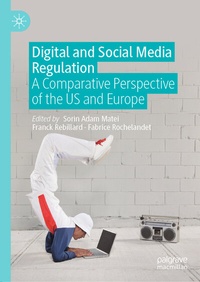
Digital and Social Media Regulation
Description

Digital and social media companies such as Apple, Google, and Facebook grip the globe with market, civic, and political strength akin to large, sovereign states. Yet, these corporations are private entities. How should states and communities protect the individual rights of their citizens - or their national and local interests - while keeping pace with globalized digital companies? This scholarly compendium examines regulatory solutions which encourage content diversity and protect fundamental rights. The volume compares European and US regulatory approaches, including closer focus on topics such as privacy, copyright, and freedom of expression. Further, we propose pedagogical models for educating students on possible regulatory regimes of the future. Our final chapter invites readers to consider social and digital media regulation for both this generation and the ones to come.
Chapter(s) "Introduction: New Paradigms of Media Regulation in a Transatlantic Perspective", "From News Diversity to News Quality: New Media Regulation Theoretical Issues" and "The Stakes and Threats of the Convergence Between Media and Telecommunication Industries" are available open access under a Creative Commons Attribution 4.0 International License via link.springer.com.
More details
Other editions
Additional editions
Persons
Sorin Adam Matei studies the social implication of technologies in individual and group affairs. He is the author of books on social media and knowledge creation. He is Professor of Communication in Brian Lamb School of Communication and the Associate Dean of Research and Graduate Education in the College of Liberal Arts at Purdue University in West Lafayette, Indiana, USA.
Franck Rebillard is Professor of Media Studies at Université Sorbonne Nouvelle, France, where he leads the IRMÉCCEN research team within the LABEX ICCA. His own works deal with the socio-economics of the Internet and discourse analysis of online news. He is the author of three books dedicated to the Web 2.0 (2007), media diversity (2013) and digital culture (2016), and of several articles published in national and international journals.
Fabrice Rochelandet is Full Professor in Communication Science at the Arts & Media Faculty at Université Sorbonne Nouvelle, France. He is a member of the Institutde Recherche sur le Cinéma et l'Audiovisuel and Laboratory of Excellence Cultural Industries & Art Creation. His current fields of research are the economics of creative industries, digital innovation and regulation.
