

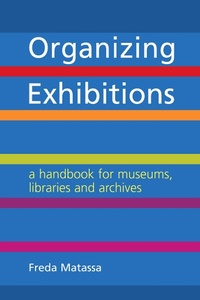
Organizing Exhibitions
Description

This ground-breaking book is the first to provide museum staff, librarians and archivists with practical guidance on creating and organizing successful exhibitions.
Drawing on international museum practice but applicable to any exhibition or display, the book sets out a time-line from the initial idea to the final legacy. Backed up by advice and guidance and with a list of resources for those who require in-depth knowledge, it has up-to-date information on new developments such as sustainability and flexibility in environmental conditions. Also included are the ten biggest mistakes and the top ten tips for exhibition success.
Part One covers the 10 key stages for a successful exhibition: idea, planning, organization, packing and transport, installation, openings, maintenance and programmes, closure, touring, and legacy. Part Two is a directory of advice and resources, supplementing the information provided in Part One.
Readership: Written by an international expert and designed for the first-time exhibition organizer as well as the professional, this book will become the standard for exhibition success. Recommended for museum staff, cultural heritage students, librarians, archivists, private collectors and anyone who needs practical guidance on organizing exhibitions.
More details
Other editions
Additional editions
Person
Freda Matassa FRSA MA(Hons) DipAL DipEd is a wellknown UK expert on collections management who advises, teaches and lectures internationally. Former Head of Collections Management at the Tate Gallery and co-founder of the European Registrars Conference, she is expert adviser on several European projects for museum standards and to the Minister of Culture on immunity from seizure. She was recently named one of the Top 50 Women to Watch in the arts and is the author of Museum Collections Management (Facet, 2011).
Content
Introduction
- Exhibition organization
- The successful exhibition
- Background
- Exhibition benefits
- Planning an exhibition
- Notes and References
PART 1: A STEP-BY-STEP GUIDE TO ORGANIZING EXHIBITIONS1. Idea
- Fundamentals
- Concept
- Objects
- Policy
- People
- Space
- Finance
- Audience and programmes
- Time schedule
- Objectives and risks
- Stage One checklist
- Summary
- Notes and references
2. Planning
- Fundamentals
- Project management
- Communication
- Project team
- Schedule
- Loans and lenders
- Exhibition space
- Budget
- Insurance
- Exhibition design
- Transport
- Stage Two checklist
- Summary
- Notes and references
3. Organization
- Fundamentals
- Loans and lenders
- Design and build
- Environment
- Insurance
- Transport
- Marketing and publications
- People
- Stage Three checklist
- Summary
- Notes and references
4. Packing and transport
- Fundamentals
- Internal moves
- External moves
- Lenders delivering their own loans
- Insurance
- Stage Four checklist
- Summary
- Notes and references
5. Installation
- Fundamentals
- Planning for installation
- Team
- Schedule
- Gallery preparation
- Access
- Delivery
- Unwrapping and inspection
- Receiving couriers
- Display furniture and fixings
- Placing and hanging
- Labels and signage
- Lighting
- Preparation for the opening
- Invigilators
- Stage Five checklist
- Summary
- Notes and references
6. Openings
- Fundamentals
- What kind of opening?
- Planning
- Safety and security
- On the day
- Afterwards
- Stage Six checklist
- Summary
7. Maintenance and programmes
- Fundamentals
- Monitoring
- Ongoing requirements
- Daily activities
- Events and programmes
- Stage Seven checklist
- Summary
- Notes and references
8. Closure
- Fundamentals
- Planning
- Deinstallation
- Return
- Completion
- Stage Eight checklist
- Summary
9. Touring exhibitions
- Fundamentals
- Why send an exhibition on tour?
- Planning and agreements
- During the tour
- End of the tour
- Exhibition tour checklist
- Summary
- Notes and references
10. Legacy
- Fundamentals
- The importance of legacy
- Evaluation
- Impact
- Archives
- Stage Ten checklist
- Summary
- Notes and references
PART 2: DIRECTORY
- Air freight security
- Claims
- Commissions
- Contractors
- Copyright
- Couriers
- Customs, import and export
- Damage reporting
- Disclaimers
- Display cases
- Due diligence
- Emergency plan
- Environment
- Ethics
- Government indemnity
- Hazardous materials
- Insurance
- Light and lighting
- Pest management
- Security
- Sustainability
- Unclaimed loans
- Valuations
- Visitors with special needs
Bibliography
- Publications
- Standards
- Websites
