

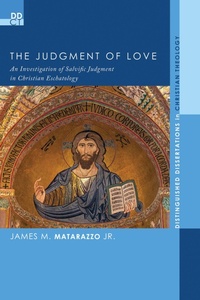
The Judgment of Love
An Investigation of Salvific Judgment in Christian Eschatology
Published on 19. October 2018
330 pages
978-1-5326-4464-1 (ISBN)
Description

This book seeks to explore the concept of divine judgment in Christian eschatology. It contends that this judgment is salvific rather than destructive. This notion can be described aphoristically as iudicandus est salvandus ("to be judged is to be saved"). The provocation to Christian eschatology is that human beings are not saved from judgment, but are saved within it. The exploration begins defining the context and moves into a review of the symbols and problems of judgment through a reappraisal of De novissimis ("concerning the last things"), the last section found in traditional works of Christian dogmatics. This is followed by a critical engagement with the soteriological optimism posited by four twentieth- and twenty-first century theologians: Sergei Bulgakov, Hans Urs von Balthasar, J. A. T. Robinson, and Marilyn McCord Adams. The event of the judgment is then defined as the event of absolute recognition: that it is within the eschatic recognition of God, the self, and the other that transformation and glorification of human persons occur in a way that avoids a dual outcome of salvation and damnation. The book concludes by proposing that we may approach divine judgment with faith, hope, and love--not only for ourselves, but for the human race as a whole.
More details
Other editions
Additional editions
James M. Matarazzo
The Judgment of Love
An Investigation of Salvific Judgment in Christian Eschatology
Book
10/2018
Wipf & Stock Publishers
€38.10
Shipment within 3-4 weeks
James M. Matarazzo
The Judgment of Love
An Investigation of Salvific Judgment in Christian Eschatology
Book
10/2018
Wipf & Stock Publishers
€61.60
Shipment within 3-4 weeks
Person
James M. Matarazzo, Jr is a Minister at the First Congregational Church of Guilford, Connecticut. Previously, he was Lecturer in Theology at Ripon College Cuddesdon, Oxford, and a member of the Faculty of Theology and Religion at the University of Oxford.
Content
- Intro
- Title Page
- Foreword
- Preface
- Acknowledgements
- Abbreviations
- Chapter 1: Introduction
- 1. Eschatology as an Exercise of Hope
- 2. The Task
- 3. The Methodological Approach
- 4. Argument for Disposition and Exclusions
- Chapter 2: The Symbols and Problems of Judgment
- 1. Introduction
- 2. The Symbol and Problem of Death
- 3. Discarnation: The Problem of Intermediate Eschatology
- 4. Pessimistic Eschatology and the Problem of Hell
- 5. Conclusion
- Chapter 3: The Larger Hope: Divine Judgment in Optimistic Soteriology
- 1. Introduction
- 2. Sergei Bulgakov: The Judgment of Love
- 3. Hans Urs von Balthasar: The Judgment of Hope
- 4. John A. T. Robinson: Defending the Doctrine of God
- 5 Marilyn McCord Adams: Horrors and Therapeutic Eschatology
- 6. Conclusion
- Chapter 4: The Purpose of Divine Judgment
- 1. Introduction
- 2. Judgment's Purpose as Dualistically Retributive
- 3. Judgment's Purpose as Salvific Retribution: Sergei Bulgakov
- 4. Judgment's Purpose as Non-retributive and Rectifying: Jürgen Moltmann
- 5. Judgment's Purpose as the Transformation and Constitution of Personhood: Markus Mühling
- 6. Conclusion
- Chapter 5: Towards a Christian Eschatology of Absolute Recognition
- 1. Absolute Recognition: Eschatic Recognition Theory
- 2. The Problem of Eschatic Libertarian Free Will
- 3. Christ as the Recognizer of Human Beings: The Christological Dilemma
- 4. The (Im)Possibility of Eschatic Non-Recognition
- 5. Semper Novum: The Outcome of the Judgment of Absolute Recognition
- 6. Conclusion: Ut sit Deus omnia in omnibus
- Chapter 6: Conclusion
- Bibliography
