

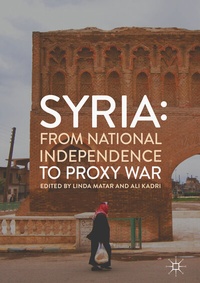
Syria: From National Independence to Proxy War
Description

This edited collection aims to analytically reconceptualise the Syrian crisis by examining how and why the country has moved from a stable to a war-torn society. It is written by scholars from a variety of disciplinary backgrounds, all of whom make no attempt to speculate on the future trajectory of the conflict, but aim instead to examine the historical background that has laid the objective conditions for Syria's descent to its current situation. Their work represents an attempt to dissect the multi-layered foundation of the Syrian conflict and to make understanding its complex inner workings accessible to a broader readership. The book is divided into four parts, each of which elaborates on the origins and dynamics of today's crisis from the perspective of a different discipline. When put together, the four parts provide a holistic picture of Syria's developmental trajectory from the early twentieth century through to the present day. Themes addressed include Syria's postcolonialdevelopment efforts, its leap into socialism and then into neoliberalism in the late twentieth century, its politics within the resistance front, and finally its food and health security concerns.
Reviews / Votes
"The literature on Syria is deadened by lack of proper acknowledgment of Syria's complex history and its role not only in the Arab world but in world affairs. Linda Matar and Ali Kadri have produced a superb edited collection that digs deep into the history, the economy, the politics and culture of Syria - allowing us to have a much richer assessment of the destruction of the country in the past decade. A valuable book." (Vijay Prashad, Director, Tricontinental: Institute for Social Research, India)More details
Other editions
Additional editions
Persons
Linda Matar is Senior Research Fellow at the National University of Singapore (NUS). She is also Lecturer at the NUS's College of Alice and Peter Tan. Her research interests include the political economy of the Arab Near East and Southeast Asia. She is the author of The Political Economy of Investment in Syria (2016).
Ali Kadri is Senior Fellow at the NUS and Visiting Fellow at the London School of Economics, UK. His recent publications include The Cordon Sanitaire: A Single Law Governing Development in East Asia and the Arab World (2018).
Content
Chapter 1: Introduction: Syria in the Imperialist Cyclone.- Part I: A Historical Perspective of the Syrian Conflict.- Chapter 2: What Went Wrong: Understanding the Trajectory of Syria's Conflict.- Chapter 3: The New Struggle for Syria and the Nature of the Syrian State.- Chapter 4: Syria: Strong State versus Social Cleavages.- Part II: Macroeconomy and Society.- Chapter 5: Macroeconomic Framework in Pre-Conflict Syria.- Chapter 6: The Syrian Conflict: Selective Socioeconomic Indicators.- Chapter 7: Lebanon Can't Give Him a Future: Revolutionary Subjectivity and Syrian Rebel-Workers in Beirut.- Part III: The Politics of the Syrian conflict.- Chapter 8: Syria in the 'Resistance Front': Persistence through Reconfiguration?.- Part IV: Sectoral Analysis.- Chapter 9: The Political Economy of Public Health in Syria: Some Global and regional Considerations.- Chapter 10: The Political Economy of Thermidor in Syria: National and International Dimensions.- Chapter 11: Syria's Food Security: From Self-Sufficiency to Hunger as a Weapon.- Chapter 12: Conclusion: China's role in Syria's National Security.
