

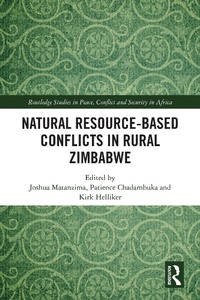
Natural Resource-Based Conflicts in Rural Zimbabwe
1st Edition
Published on 2. August 2024
274 pages
978-1-040-10286-2 (ISBN)
Description

This book investigates the range of conflicts over land and other natural resources in contemporary Zimbabwe, considering the different forms these conflicts take, and the ensuing outcomes.
Zimbabwe is a country rich in natural resources, including land, wildlife, minerals, and water resources. These resources are integral to the formal and informal livelihoods of most Zimbabweans, as well as supporting many key industries. Wildlife, land, and water resources are also embedded in indigenous knowledge systems, religious beliefs, and rituals in many rural communities, forming an important part of people's identity and sense of belonging. However, this book demonstrates the ways in which rural communities are being denied access to these resources and being displaced by extractive companies and the government. Their response is often to turn to violence to try to reclaim their lands. Drawing on original empirical research from different conflicts across Zimbabwe, the book also considers the issue in the context of problems such as climate change, human-wildlife conflicts, and politico-economic crises.
This book will be useful to policy makers, students, conservationists, and academics across the fields of sociology, human geography, development, political science, and environment studies.
Zimbabwe is a country rich in natural resources, including land, wildlife, minerals, and water resources. These resources are integral to the formal and informal livelihoods of most Zimbabweans, as well as supporting many key industries. Wildlife, land, and water resources are also embedded in indigenous knowledge systems, religious beliefs, and rituals in many rural communities, forming an important part of people's identity and sense of belonging. However, this book demonstrates the ways in which rural communities are being denied access to these resources and being displaced by extractive companies and the government. Their response is often to turn to violence to try to reclaim their lands. Drawing on original empirical research from different conflicts across Zimbabwe, the book also considers the issue in the context of problems such as climate change, human-wildlife conflicts, and politico-economic crises.
This book will be useful to policy makers, students, conservationists, and academics across the fields of sociology, human geography, development, political science, and environment studies.
Reviews / Votes
This collection marks a new plateau in the study of rural Zimbabwe. A full generation after rapid, violent rapid land reform, the distinction between private and common lands has broken down. Mining and its resource curse have filled the economic void left by the collapse of tourism. This cohort of emergent, insightful authors traces startling - sometimes heart-rending - dynamics of conflict: between smallholders and a Chinese mining corporation, between foragers and the state, between large and small ethnicities, and between women and men. As always, Zimbabweans fight for their rights, however defined and contested.David Hughes, Rutgers University, USA. Author of the book Whiteness in Zimbabwe: Race, Landscape, and the Problem of Belonging.
Natural resource conflicts are on the rise, made more intense by the effects of climate change. This is definitely the case in Zimbabwe. This important book looks at how conflicts play out around land, water, minerals and their intersections. Based on original research from every corner of the country, the case studies reveal how struggles over resources give rise to contestations around authority, with major implications for politics and governance. This must-read book will be of interest to researchers, policymakers and field practitioners and anyone interested in the politics of environmental change in Zimbabwe and beyond.
Ian Scoones, Professor, Institute of Development Studies, University of Sussex, United Kingdom
This innovative interdisciplinary text focuses on natural resource-based conflicts in rural Zimbabwe where individuals face everyday challenges in obtaining land and water rights as well as access to fisheries and forests. Rural dwellers live in precarious situations due to a combination of unequal power dynamics and unjust laws that compromise their land tenure rights. They are prone to displacement without compensation due to mineral discoveries, dam constructions, and urban expansion. The book is essential reading for historians, sociologists, anthropologists, environmentalists, urban planners and rural development specialists.
Terence M Mashingaidze, Department of History, Midlands State University, Zimbabwe
There is need to rethink natural resource governance in the light of everyday conflicts that are multi- layered, within rural Zimbabwe. The structural forms of conflicts at micro, meso and macro levels, affect inclusive processes and equitable resource development. This comes at a time when different policy vectors are being proposed nationally to enhance the natural resource governance pillars in rural and urban Zimbabwe to enhance processes of resource efficiency.
Professor Patience Mutopo, Ministry of Environment, Climate and Wildlife, Zimbabwe
More details
Series
Edition
1. Auflage
Language
English
Place of publication
London
United Kingdom
Publishing group
Taylor & Francis Ltd
Target group
College/higher education
Professional and scholarly
Illustrations
2 Tables, black and white
ISBN-13
978-1-040-10286-2 (9781040102862)
Copyright in bibliographic data and cover images is held by Nielsen Book Services Limited or by the publishers or by their respective licensors: all rights reserved.
Schweitzer Classification
Other editions
Additional editions
Joshua Matanzima | Patience Chadambuka | Kirk Helliker
Natural Resource-Based Conflicts in Rural Zimbabwe
Book
approx. 11/2025
1st Edition
Routledge
€64.10
Not yet published
Joshua Matanzima | Patience Chadambuka | Kirk Helliker
Natural Resource-Based Conflicts in Rural Zimbabwe
Book
08/2024
1st Edition
Routledge
€178.90
Shipment within 10-20 days
Persons
Joshua Matanzima is a researcher at the Centre for Social Responsibility in Mining (Sustainable Minerals Institute), University of Queensland in Brisbane, Australia. He holds a PhD in anthropology from La Trobe University, Australia. His research interests include natural resources conflicts between indigenous people, governments, and extractive companies; social aspects of mining and energy transitions; and social, environmental, and governance risks and impacts of large-scale infrastructure development and conservation projects. He has carried out extensive fieldwork on these topics in the Middle-Zambezi Valley.
Patience Chadambuka is a researcher, lecturer and acting chairperson at the Department of Community Studies, Faculty of Social Sciences, Midlands State University, Zimbabwe. She holds a PhD in sociology from Rhodes University, South Africa. She researches and writes on land, livelihoods, ethnicity and gender. She has also been awarded international research grants on climate change and disability studies.
Kirk Helliker is Emeritus Research Professor at the Department of Sociology, Rhodes University, South Africa, where he heads the Unit of Zimbabwean Studies, which he founded. The Unit was formed in 2015 and seeks to contribute to the development of emerging, early-career, and mid-career Zimbabwean (and other) scholars. He publishes widely on Zimbabwean history, politics, and society and has supervised a significant number of PhD and MA students.
Patience Chadambuka is a researcher, lecturer and acting chairperson at the Department of Community Studies, Faculty of Social Sciences, Midlands State University, Zimbabwe. She holds a PhD in sociology from Rhodes University, South Africa. She researches and writes on land, livelihoods, ethnicity and gender. She has also been awarded international research grants on climate change and disability studies.
Kirk Helliker is Emeritus Research Professor at the Department of Sociology, Rhodes University, South Africa, where he heads the Unit of Zimbabwean Studies, which he founded. The Unit was formed in 2015 and seeks to contribute to the development of emerging, early-career, and mid-career Zimbabwean (and other) scholars. He publishes widely on Zimbabwean history, politics, and society and has supervised a significant number of PhD and MA students.
Content
1: Natural Resource-Based Conflicts in Zimbabwe PART A: Land, Natural Resources and Conflict 2: Domestic Communal Land Grabbing and Dwindling Peri-Urban Spaces: The Case of Midlands District's Mataga Communal Areas 3: Natural Resource Conflicts in Western Zimbabwe 4: Othering Doma Foragers: Contestations Over Natural Resources in the Mid-Zambezi Valley 5: Women's Land Access and Gendered Land Conflicts in Hwedza and Makoni Districts 6: Resource Conflicts in Chiredzi District: The Case of the Minority Hlengwe against Settlers and the State, 1950s-2022 Part B: Water and Conflict 7: Water as a Site of Contestation at Lake Kariba 8: Conflicts over River Sand Use and Management in Binga District 9: Conflict over Land and Water Resources in Zimunya, Manicaland Province 10: Whose Water is it? Underground Water and Social Conflicts in Fuleche, Hurungwe District, c1958-2020 11: Governance, Power Dynamics and Conflicts in Norton's Small-Scale Fisheries 12: Conflicts over Natural Resources at Mutirikwi Dam in Masvingo Province PART C: Minerals and Conflict Chapter 13: Farmer-Miner Conflicts in Mberengwa North, 2000-2020 14: Mining-Induced Displacement and Resource Conflicts in Chiadzwa 15: Farming-Mining Conflicts surrounding Land Use on A1 Farms in Shurugwi District 16: Conflicts over Harnessing of Diamond Resources in Marange Communal Area, Eastern Zimbabwe, 2006 - 2015
