

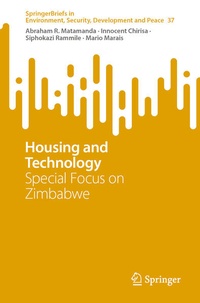
Housing and Technology
Description

The housing and human settlement sector is fast changing, and technology is making it more complex than ever before. With reference to Zimbabwe, a developing country in Southern Africa, the essence of this book is to bring out housing as an issue within the technology debate and practice. The following themes emerge from the 6 chapters in the book:
The characterisation and conceptualisation of housing and technology and the nexus of both
The complexity of housing challenges and the problems governments face in providing adequate housing, especially for the poor
Diverse practices in housing construction through the application of different typologies of technology
Assessment of the feasibility of technologies in housing development in Zimbabwe by mirroring them against global experiences.Discussion of alternative policy approaches that may guide technology integration in housing development.
This book will excite scholars and practitioners in urban and development studies, construction project management, urban sociology, geography, real estate together with policymakers and government officials.More details
Other editions
Additional editions
Persons
Abraham R. Matamanda lectures in the Department of Geography, University of the Free State, South Africa. His current research is on urban governance and planning, climate change adaptation, urban food systems, and medical geography.
Innocent Chirisa, is a Full Professor in Environmental Planning and Management and Urban and Regional Planning. He has a keen interest in urban and peri-urban dynamics. Currently, focusing on environmental systems dynamics concerning land-use, ecology, water and energy.
Siphokazi Rammile lectures in the Department of Urban and Regional Planning at the University of the Free State. She combines experience in private practice and academia. Her research interests include urban design, open space planning, tactical urbanism and urban spatial displacement.
Mario Marais, is a Principal Researcher in the Technology Innovation, Monitoring and Evaluation research group of the E-Government Impact Area in the CSIR Next Generation Enterprises and Institutions Cluster in Pretoria, South Africa. He has experience in organisational, entrepreneurial and community development research and monitoring and evaluation (M&E).