

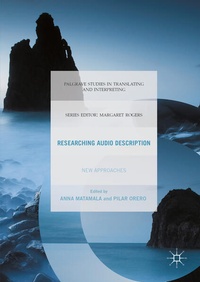
Researching Audio Description
New Approaches
1st Edition
Published on 21. June 2016
XX, 328 pages
978-1-137-56917-2 (ISBN)
Description

Audio description is one of the many services available to guarantee accessibility to audiovisual media. It describes and narrates images and sounds and resulting audio is then mixed with the original soundtrack. Audio description is a complex process that touches production, distribution and reception.
Researching Audio Description: New Approaches
gathers academic information and data from the many existing research projects, practices, and training across the world. The book has a telescopic approach, from two introductory chapters where accessibility in general is contextualised as a human right, and the basic concepts of disability and impairment are explored. Research on specific features for audio description script drafting are focused in the second part of the book, with a view to revising existing funded projects and their outcomes. The book offers a wealth of information on both the practical and philosophical, from different approaches in perception and cognition,and different research methodologies. Project information contained in the contributions identifies trends in current research-funded studies which will be valuable as a pointer towards future proposals. The book shows the dynamic state of audio description practice, training and research, while contributing towards the growing critical mass needed in building the field of accessibility studies.
Reviews / Votes
"Researching Audio Description: New Approaches is an introduction to state of the art research in Audio Description that is a must read for anyone doing research in or embarking on research in AD and media accessibility. It offers a panoramic picture of a multi-faceted field, its concepts, research methods and current applications as well as a solid basis for further research." - Aline Remael, University of Antwerp, Belgium
More details
Series
Language
English
Place of publication
London
United Kingdom
Publishing group
Palgrave Macmillan UK
Target group
Professional and scholarly
Product notice
Reflowable
Illustrations
XX, 328 p. 17 illus., 15 illus. in color.
File size
9,59 MB
ISBN-13
978-1-137-56917-2 (9781137569172)
DOI
10.1057/978-1-137-56917-2
Schweitzer Classification
Other editions
Additional editions
Book
07/2016
Palgrave Macmillan
€106.99
Shipment within 10-20 days
Persons
Anna Matamala is a lecturer at Universitat Autònoma de Barcelona. Her research interests are audiovisual translation and media accessibility, and she has published extensively in these topics and has participated in many funded projects such as DTV4ALL or HBB4ALL. She is a member of TransMedia research group.
Pilar Orero is a lecturer at Universitat Autònoma de Barcelona. Her research interests are audiovisual translation and media accessibility, and she has published extensively in these topics and has participated in many funded projects such as DTV4ALL and ADLAB. She leads HBB4ALL. She is a member of TransMedia research group.
Pilar Orero is a lecturer at Universitat Autònoma de Barcelona. Her research interests are audiovisual translation and media accessibility, and she has published extensively in these topics and has participated in many funded projects such as DTV4ALL and ADLAB. She leads HBB4ALL. She is a member of TransMedia research group.
Content
1. Audio Description and Accessibility Studies: Work in Progress.- PART I: RE-THINKING ACCESSIBILITY.- 2. On Accessibility as a Human Right, with an Application to Media Accessibility.- 3. Impairment and Disability - Challenging Concepts of 'Normality'.- PART II: FROM THEORY TO PRACTICE: RESEARCHING AUDIO DESCRIPTION.- 4. Cognitive Approach to Audio Description.- 5. Game Accessibility for the Blind: Current Overview and the Potential Application of Audio Description as the Way Forward.- 6. Should Audio Description Reflect the Way Sighted Viewers Look at Films? Combining Eye-Tracking and Reception Study Data.- 7. Audio Description Washes Brighter? A Study in Brand Names and Advertising.- 8. What Should I Say? Tentative Criteria to Prioritize Information in the Audio Description of Film Characters.- 9. How Co-Speech Gestures are Rendered in Audio Description: A Case Study.- 10. Foreign Language Class with Audio Description: A Case Study.- 11. An Overview of Audio Description in Thai Television.- PART III: AUDIO DESCRIPTION PROJECTS.- 12. The ADLAB project.- 13. From DTV4LL to HBB4ALL: Accessibility in European Broadcasting.- 14. The ALST Project: Technologies for Audio Description.- 15. Audio Description of Press Illustrations for Young Readers by Young Volunteers.- 16. Open Art - Designing Accessible Content in a Multimedia Guide App for Visitors With and Without Sensory Impairments.
