

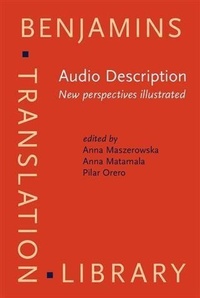
Audio Description
New perspectives illustrated
1st Edition
Published on 30. October 2014
VIII, 216 pages
978-90-272-6942-3 (ISBN)
Description

Audio description (AD) is a narrative technique which provides complementary information regarding the where, who, what and how of any audiovisual content. It translates the visuals into words. The principal function of this ad hoc narrative is to make audiovisual content available to all: be it a guided city tour of Barcelona, a 3D film, or a Picasso painting. Audio description is one of the younger siblings of Audiovisual Translation, and it is epigonic to the audiovisual translation modality chosen. This book is the first volume on the topic written in English and it brings together an international team of leading audio description teachers, scholars, and practitioners to address the basic issues regarding audio description strategies. Using one stimulus, Quentin Tarantino's film Inglourious Basterds (2009), the authors analysed what, when, where and how to audio describe. The book is written in a collaborative effort, following a bottom up approach. The many issues that surfaced in the process of the analysis were grouped in broader categories represented in the ten chapters this book contains. A good example of a successful international collaboration, the volume sets a robust practical and theoretical framework for the many studies on audio description to come in the future. Considering the structure of the individual contributions, the book is not only oriented towards the identification of the challenges that await the describer, but it also offers an insight into their possible solutions.
More details
Other editions
Additional editions
Book
10/2014
John Benjamins Publishing Co
€90.10
Shipment within 10-15 days
Persons
Content
- Audio Description
- Editorial page
- Title page
- LCC data
- Dedication page
- Table of contents
- Introduction. From source text to target text
- 1. The project
- 2. The partners
- 3. The book
- 4. The film
- 5. The chapters
- References
- Film references
- Chapter 1. Audiointroductions
- 1. Literature review
- 2. Audiointroduction for Inglourious Basterds
- 3. Strategies
- 3.1 The process
- 3.2 Characters
- 3.3 Locations
- 3.4 Visual style
- 3.5 Background information
- 3.6 Synopsis
- 3.7 Putting it all together
- 4. Language
- 5. Conclusions and suggestions for further research
- References
- Film references
- Chapter 2. Intertextuality
- 1. Introduction
- 2. Verbal intertextuality and Inglourious Basterds
- 3. Nonverbal intertextuality and Inglourious Basterds
- 4. Context of situation and context of culture
- 5. Author intent and audience interpretation
- 6. Intertextuality and Tarantino
- 7. Conclusion
- References
- Film references
- Chapter 3. Textual cohesion
- 1. Theoretical introduction
- 2. Inglourious Basterds. Initial comments
- 3. Audio description of Inglourious Basterds
- 4. Another example text - The English Patient
- 5. A longer perspective
- 6. Conclusion
- References
- Film references
- Appendix 1. Original screenplay of The English Patient
- Appendix 2. Long-term cohesion in continuous and discontinuous phases (Inglourious Basterds)
- Chapter 4. Spatio-temporal setting
- 1. Introduction
- 2. Examples: Analysis
- 3. Theory and bibliography
- 3.1 Literature on the audio description of spatio-temporal settings
- 3.2 The narratological take on spatio-temporal settings for AD
- 3.3 The basic components of spatio-temporal settings
- 3.4 The construction of spatio-temporal settings by the author
- 3.5 The reconstruction of spatio-temporal settings by the audience
- 4. A possible strategy for audio describing spatio-temporal settings
- 5. The language
- 6. Conclusion
- References
- Film references
- Chapter 5. Film language and tools
- 1. Introduction
- 2. Analysis of the examples
- 2.1 Aesthetic breaks
- 2.2 Split screen
- 2.3 Sharp scene cuts
- 2.4 Parallel editing
- 2.5 Close-ups
- 2.6 Slow motion
- 2.7 Camera pedding
- 3. Theory and bibliography
- 4. AD strategies: Alternative possibilities
- 4.1 Aesthetic breaks
- 4.2 Split screen
- 4.3 Sharp scene cuts
- 4.4 Parallel editing
- 4.5 Close-ups
- 4.6 Slow motion
- 4.7 Camera pedding
- 5. Concluding remarks
- References
- Film references
- Chapter 6. Audio describing text on screen
- 1. Text on screen in Inglourious Basterds: An introduction
- 2. Text on screen in audio description: Guidelines and research
- 3. Text on screen and AD: Possible strategies
- 3.1 Logos and credits
- 3.2 Inserts or superimposed titles
- 3.3 Various types of text on screen
- 3.4 Subtitles
- 4. Conclusions
- References
- Film references
- Chapter 7. The importance of sound for audio description
- 1. Introduction
- 2. The opening scene
- 3. AD as a type of audiovisual translation
- 4. Types of sound in film
- 5. Literature review
- 6. Analysis of sound in Inglourious Basterds and its importance for AD
- 6.1 Sounds representing acts of violence
- 6.2 Sounds from flashbacks
- 6.3 Symbolic sounds
- 6.4 Sounds accompanying text on screen
- 7. Music
- 8. Multilingual soundscape
- 9. Sound audio description strategies
- 10. Conclusion
- References
- Film references
- Chapter 8. Character fixation and character description
- 1. Introduction
- 2. Naming and describing characters: State of the art
- 3. AD strategies for naming and describing characters in Inglourious Basterds
- 3.1 Naming and describing Hans Landa
- 3.2 Naming and describing Aldo Raine
- 3.3 Naming and describing Shosanna Dreyfus
- 3.4 Naming and describing the supporting actors
- 4. Conclusions
- References
- Film references
- Chapter 9. Strategies for dealing with cultural references in audio description
- 1. Cultural references in Inglourious Basterds: An introduction
- 2. Cultural references in audio description: Guidelines and research
- 3. Cultural references and AD: Possible strategies
- 3.1 Emblems and insignia
- 3.2 Newspapers and press articles
- 3.3 Real-life characters
- 3.4 Popular culture: Cinema and literature
- 3.5 Body language
- 3.6 Food and drink
- 3.7 Religious symbols
- 4. Conclusions
- References
- Film references
- Chapter 10. Gestures and facial expressions in audio description
- 1. Gestures and facial expressions in Inglourious Basterds: An introduction
- 2. Gestures and facial expressions in audio description: Overview of literature and guidelines
- 3. Classification of gestures for AD purposes and proposed strategies
- 4. Gestures and facial expressions and AD: Possible strategies
- 4.1 AD of discourse-filling gestures and facial expressions
- 4.2 AD of discourse-supporting gestures and facial expressions
- 4.3 AD of discourse-conflicting gestures
- 5. Conclusion
- References
- Film references
- Chapter 11. Secondary elements in audio description
- 1. Introduction
- 2. Attempting a functional classification
- 3. Theory revisited
- 4. Perception
- 5. Experimental analysis
- 5.1 Hypothesis
- 5.2 Corpus
- 5.3 Apparatus
- 5.4 Procedure
- 5.5 Results
- 6. Different AD strategies
- 7. Conclusions
- References
- Film references
- Index
