

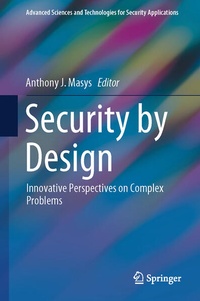
Security by Design
Description

This edited book captures salient global security challenges and presents 'design' solutions in dealing with wicked problems. Through case studies and applied research this book reveals the many perspectives, tools and approaches to support security design. Security design thereby can support risk and threat analysis, risk communication, problem framing and development of interventions strategies. From the refugee crisis to economic slowdowns in emerging markets, from ever-rising numbers of terrorist and cyberattacks to global water shortages, to the proliferation of the Internet of Things and its impact on the security of our homes, cities and critical infrastructure, the current security landscape is diverse and complex. These global risks have been in the headlines in the last year (Global Risks Report) and pose significant security challenges both nationally and globally. In fact, national security is no longer just national. Non-state actors, cyber NGO, rising powers, and hybrid wars and crimes in strategic areas pose complex challenges to global security. In the words of Horst Rittel (1968):"Design is an activity, which aims at the production of a plan, which plan -if implemented- is intended to bring about a situation with specific desired characteristics without creating unforeseen and undesired side and after effects."
More details
Other editions
Additional editions
Person
Content
Chapter 1: Principles of Design Thinking.- Chapter 2: An Integral Futures lens on the future security issues.- Chapter 3: Innovations in Active Shooting Emergency Medical Response and Triage.- Chapter 4: Mass Migration, Humanitarian Assistance and Crisis Management: Embracing Social Innovation and Organizational Learning.- Chapter 5: system dynamic humanitarian aid.- Chapter 6: Cyber-Physical Systems Governance: A Framework for (meta)CyberSecurity Design.- Chapter 7: To feel secure or to be secure, that is the question.- Chapter 8: Clustering Heterogeneous Semi-Structured Social Science Datasets for Security Applications.- Chapter 9: Critical Infrastructure and Resilience: integrating interdependencies.- Chapter 10: The Application of Warden's Concentric Ring Theory to Applegate's Offensive Cyber Maneuver Strategy in Modern Conflicts.- Chapter 11: Fentanyl Crisis: a National Security matter.- Chapter 12: Risk-based aviation security - designing-out terror.- Chapter 13: Customizing Web-EOC Crisis Management Software to Facilitate Collaboration and Increase Situational Awareness: Advances in Business Resource Center (BRC) Design for Business Continuity Management.- Chapter 14 Advances in Cybersecurity Design: An Integrated Framework to Quantify the Economic Impacts of Cyber-terrorist Behavior.- Chapter 15: Operationalizing 'Deliverology' for Humanitarian Aid and Disaster Risk Reduction: Accelerating improvement in delivery.- Chapter 16: Nuclear Waste Management: Security and Safety Implications.- Chapter 17: Building Effective Emergency Management Public-Private Partnerships (PPP) for Information Sharing.
